 Bellingham Siding
 Fairhaven's Siding Sits Between the Bay and the Trees
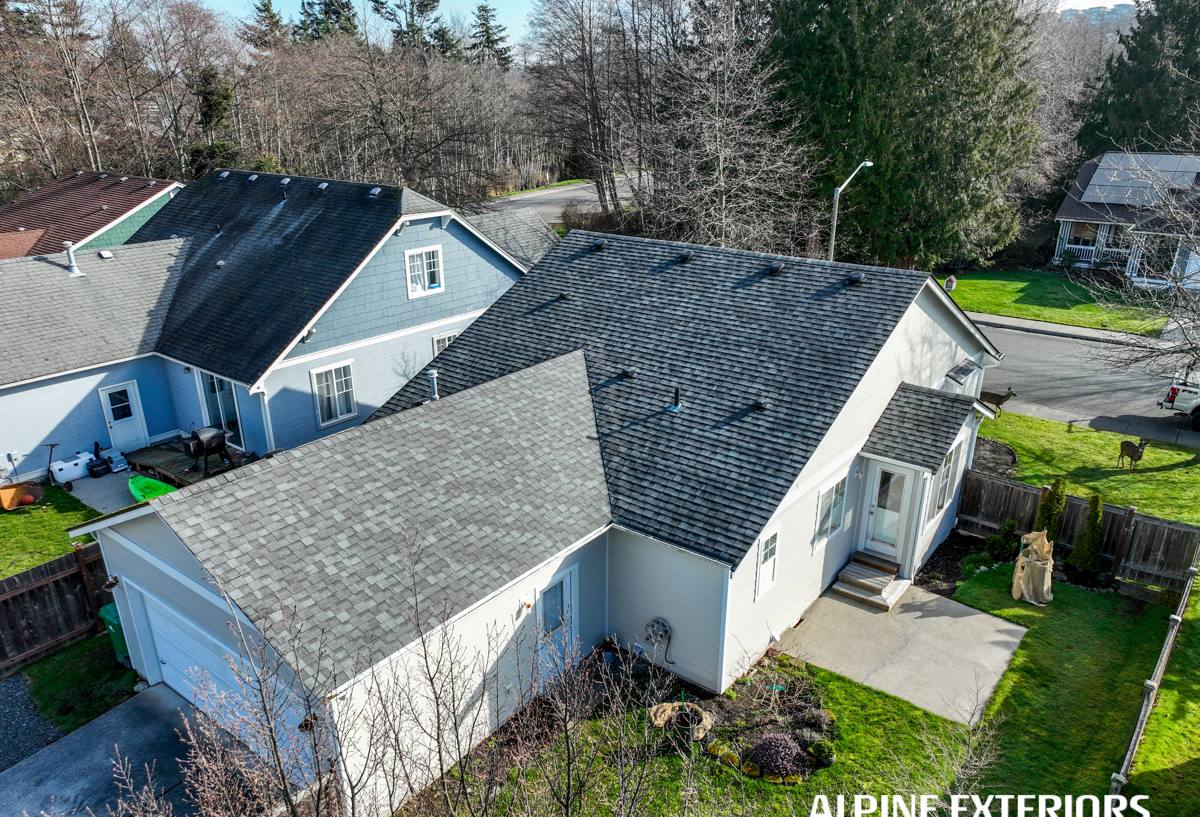
Fairhaven is one of the more distinctive pockets of Bellingham to own a home in. It sits close to Bellingham Bay, backs up toward wooded slopes near Chuckanut, and carries a mix of older character homes and newer construction packed onto tree-shaded lots. That combination — waterfront exposure on one side and dense tree cover on the other — puts Fairhaven siding through a different set of stresses than a house out in the flatter, more open parts of Whatcom County.
We work on homes across Bellingham, but Fairhaven comes up often enough in our estimates that we've learned to expect certain patterns: siding that looks fine from the street but shows moisture staining on the shaded side, trim that's held moss longer than it should have, and older wood or engineered wood siding that's softened at the bottom courses near grade. None of that is unusual for the neighborhood. It's just what salt air, driving rain, and a long moss season do to a home over enough winters.
What the Local Climate Actually Does to Exterior Materials
Salt Air
Homes closer to Bellingham Bay pick up airborne salt and moisture that settles on exterior surfaces, fasteners, and trim. It's a slower process than the coastal weathering you'd see right on the open ocean, but over years it can accelerate corrosion on unprotected metal fasteners and flashing, and it adds to the general moisture load a wall assembly has to manage.
Driving Rain
Wind off the water pushes rain sideways into siding, not just straight down onto it. That matters because a lot of siding failures aren't caused by rain hitting a wall — they're caused by rain getting behind the siding through a gap, a bad seam, or a poorly flashed window and staying wet longer than the material can tolerate. Driving rain finds those weak points faster than a calm, straight-down rain ever would.
Moss Season
Bellingham's moss season runs long, and Fairhaven's tree canopy makes it longer still. Shaded, north-facing walls and anything near overhanging branches stay damp for extended stretches, which is exactly the environment moss and algae need to take hold. On the wrong siding material, that sustained dampness doesn't just look bad — it can soften the substrate underneath.
Why the Siding Product You Choose Matters More Here
In a drier climate, the difference between siding products is mostly about looks and price. In a place like Fairhaven, the material itself becomes a bigger factor in how the wall performs over 10, 20, and 30 years. Some materials handle sustained moisture and coastal air well. Others need more maintenance to hold up, or start showing problems earlier than homeowners expect.
| Material | How it handles sustained damp/moss exposure | How it handles salt-air / coastal conditions |
|---|---|---|
| Vinyl siding | Doesn't feed moss growth itself, but seams and panel edges trap moisture; can warp or fade over time | Fasteners and trim pieces are the weak point; panels can become brittle with age |
| Cedar / primed spruce | Absorbs moisture readily; needs regular refinishing to resist rot and moss staining | Higher maintenance burden near the water; repainting/resealing cycle shortens |
| LP SmartSide (engineered wood) | Engineered to resist moisture better than raw wood, but edges and cut ends still need diligent sealing and upkeep | Manufacturer warranty and performance depend heavily on correct field treatment of every cut edge |
| James Hardie fiber cement | Non-combustible, dimensionally stable material that doesn't feed mold or rot the way wood-based products can | Factory-baked ColorPlus finish resists fading and holds up under coastal air exposure |
Why We Only Install James Hardie
We made a decision as a company to install James Hardie fiber cement siding exclusively — we don't install vinyl, LP SmartSide, Cemplank, Allura, primed spruce, or cedar. That's not because those products are worthless; plenty of homes around the region have them and get by fine with regular upkeep. It's because after years of installation and repair work in Whatcom County's wet, mossy, coastal-influenced climate, Hardie is the product we trust to perform with the least ongoing maintenance and the fewest callbacks.
A few specifics that matter for a neighborhood like Fairhaven:
- Hardie's HZ5 product line is engineered for climates with freeze-thaw cycles and sustained moisture, which fits western Washington's weather pattern well.
- It's fiber cement, not wood-based — it doesn't provide the organic material that moss, algae, and fungi feed on the way raw or engineered wood products can.
- ColorPlus factory-applied finish is baked on under controlled conditions, so it resists the fading and chalking that field-applied paint can suffer under UV and salt air.
- It's non-combustible, which matters increasingly for insurance considerations regionwide.
- The transferable warranty is straightforward and backed by a manufacturer with a long track record, rather than something a homeowner has to decode fine print to understand.
None of that means Hardie is maintenance-free. It still needs proper caulking maintenance, periodic washing, and attention if a tree limb or sprinkler keeps a section wet longer than it should be. But compared to the materials we walked away from, it starts from a stronger baseline in exactly the conditions Fairhaven throws at it.
What Correct Installation Looks Like in a Neighborhood Like This
Fiber cement siding is only as good as the installation behind it, and in a moisture-heavy, tree-shaded, coastal-adjacent neighborhood, the details matter more than usual.
Flashing and Water Management
Every window, door, and horizontal trim piece needs proper flashing so driving rain off the bay doesn't have a path behind the siding. This is the single most common source of hidden damage we find on older Fairhaven homes — not siding failure itself, but water that got behind it years earlier through a missed flashing detail.
Clearances and Ventilation
Siding needs proper clearance from grade, roofing, and decks, and the wall assembly behind it needs to be able to dry out between rain events. In shaded, damp spots this clearance matters even more, because those areas simply don't get the sun exposure that helps a wall dry faster elsewhere in Bellingham.
Fastener Choice
Given the salt air exposure closer to the water, fastener corrosion resistance is worth getting right the first time rather than dealing with staining or failure down the line.
It's Not Just Siding — Roofing, Windows, and Decks Face the Same Conditions
We're a full exterior contractor, and in Fairhaven the same climate factors that affect siding show up on the rest of the home too.
Roofing: The same shaded, damp conditions that grow moss on north-facing siding grow it on roofs, especially under tree canopy. Moss on a roof holds moisture against shingles and shortens their service life if left unaddressed.
Windows: Driving rain tests window flashing and seals harder than calm weather does. Older windows in Fairhaven's character homes are a common source of the hidden moisture problems we find when we open up a wall for siding work.
Decks: Decks facing the water or sitting under trees deal with the same sustained dampness and salt exposure, which affects fastener choice, board material, and how often a deck needs maintenance to stay sound.
Looking at these together matters, because a siding job that ignores a leaking window or a moss-choked roof edge is only solving part of the problem.
A Practical Maintenance Checklist for Fairhaven Homes
- Trim back branches and vegetation that keep any wall section shaded and damp longer than the rest of the house.
- Check north-facing and tree-covered walls for moss or algae buildup at least once a year — catching it early is far easier than removing established growth.
- Inspect caulking around windows, doors, and trim joints annually; gaps are the entry point for driving rain.
- Keep gutters clear so overflow isn't running down siding during heavy Whatcom County rain events.
- Rinse siding periodically to clear salt residue and organic buildup, especially on walls facing the bay.
- Have any soft spots, staining, or bubbling siding inspected promptly rather than waiting for it to spread.
Why a Local Crew Matters for a Neighborhood Like Fairhaven
A crew that mostly works inland or in drier parts of the state doesn't always account for how differently a waterfront-adjacent, tree-shaded neighborhood weathers a house. Knowing which walls in Fairhaven tend to hold moss longest, how much driving rain a given exposure actually takes, and how Whatcom County's permitting and inspection process works for exterior projects all come from doing this work locally, repeatedly, on homes like the ones in this neighborhood — not from a general playbook applied everywhere the same way.
If you're noticing moss buildup, staining, softening trim, or you're simply planning ahead for a home in Fairhaven, we're happy to take a look and talk through what we're seeing in plain terms. There's no pressure and no cost to get an estimate — just a straightforward look at your home's exterior and what it would take to get it in solid shape for the next few decades.