 Bellingham Siding
 Two Products, One Decision That Lasts Decades
If you're researching siding for a home in Bellingham or anywhere else in Whatcom County, you've probably run into both James Hardie fiber cement and LP SmartSide engineered wood siding. Both are marketed as upgrades over vinyl. Both claim to handle Pacific Northwest weather. And both show up on contractor bid sheets, which makes the decision confusing if you're not in this trade every day.
We install James Hardie exclusively. We don't carry LP SmartSide, and this page explains the actual material differences behind that decision — not marketing claims, but how each product is built, how it behaves over 20-30 years in our climate, and where the real trade-offs are. LP SmartSide is a legitimate, engineered product with a real manufacturer warranty behind it. It's not a scam or a "bad" product. It's just built from a different base material with a different failure mode, and in a climate like ours, that difference matters more than it does in drier parts of the country.
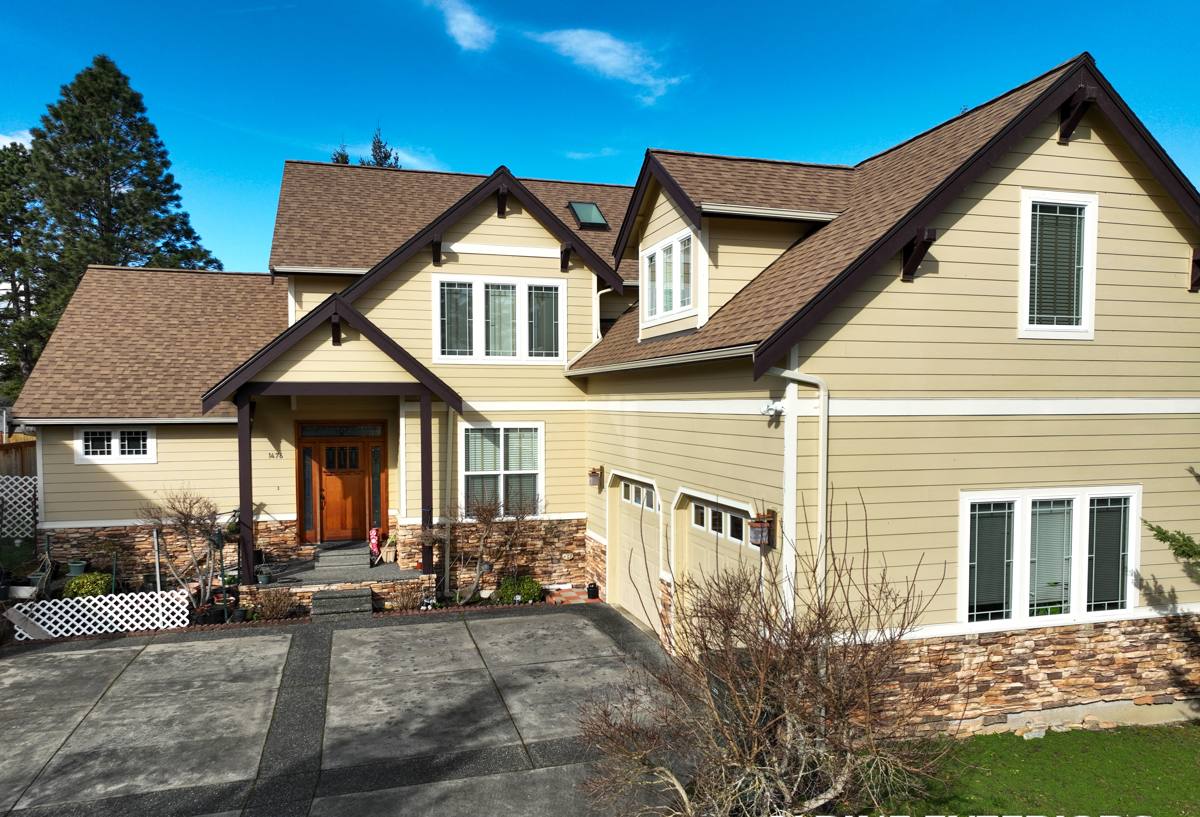
What Each Product Actually Is
James Hardie Fiber Cement
James Hardie siding is made from a mix of Portland cement, sand, and cellulose fiber, cured under pressure and heat. The result is a rigid, non-combustible board that doesn't have wood grain running through it — it's an engineered mineral product shaped to look like wood lap, shingle, or panel siding. Because there's no wood fiber exposed at the surface, it doesn't feed rot fungus or wood-boring insects the way a wood-based product can.
LP SmartSide
LP SmartSide is an engineered wood product — strand board (similar in concept to OSB) treated with zinc borate for insect and fungal resistance, then coated with a resin-saturated overlay and primed at the factory. It's real wood fiber, engineered and treated to resist moisture better than untreated lumber. It's a step up from old-style hardboard siding, which had a well-documented reputation for swelling and failing when it got wet repeatedly. LP has addressed a lot of those old issues, but the base material is still wood, and wood's relationship with water is the central fact you have to plan around.
How Bellingham's Climate Stresses Siding
Whatcom County siding doesn't get an easy ride. We're close enough to Bellingham Bay and the Salish Sea that homes on or near the water deal with salt-laden air that accelerates corrosion of fasteners and finishes. On top of that, our driving rain — wind-blown rain that hits walls at an angle instead of falling straight down — pushes moisture into every seam, lap joint, and unsealed cut edge on a building's exterior. And because we get so many overcast, damp months in a row, north-facing and shaded walls here grow moss and algae almost every winter, sometimes starting as early as October and holding on into May.
None of that is exotic weather. It's just persistent. The products that hold up best here are the ones engineered to shrug off repeated wetting and drying cycles without losing structural integrity or finish quality, year after year, without a homeowner having to stay on top of maintenance to keep ahead of it.
Moisture Behavior: The Core Difference
This is where fiber cement and engineered wood genuinely diverge, and it's worth being specific rather than vague about it.
Fiber cement is dimensionally stable when wet. It can absorb some moisture at cut edges or through the surface, but it doesn't swell, delaminate, or lose structural strength the way wood-based products can if water gets past the finish. That's a direct result of the mineral composition — there's no wood fiber matrix to break down.
Engineered wood siding, including LP SmartSide, is more moisture-sensitive by nature. The manufacturer's own installation instructions are strict about sealing every cut end, maintaining ground clearance, keeping caulk joints intact, and avoiding standing water contact — because if water gets past the treated surface and into the wood strand core, especially at an unsealed cut edge, that's where swelling and eventual degradation start. In a drier climate, an installer who's a little loose with those details might get away with it for years. In Bellingham's driving rain and repeated wet-dry cycling, those installation details stop being optional and start being the difference between a product that lasts and one that doesn't.
To be fair, this is partly an installation-quality issue as much as a material issue — a poorly installed product of either type will underperform. But fiber cement gives you a wider margin for error, because the base material itself doesn't degrade the way wood strand does when moisture gets past a compromised seal.
Salt Air and Fasteners
Salt-laden air near the bay accelerates corrosion on exposed metal — nail heads, trim flashing, fasteners. This affects both siding types roughly equally since it's about the hardware, not the board material, but it's another reason correct fastener specification and installation detailing matters more here than it would 50 miles inland.
Fire Resistance
James Hardie fiber cement is non-combustible — it doesn't contribute fuel to a fire, which matters for wildfire-adjacent properties, defensible space considerations, and in some cases insurance underwriting. LP SmartSide, as an engineered wood product, is combustible, though the manufacturer states it performs better in fire exposure testing than untreated solid wood siding. If fire resistance is a priority for your property — and increasingly it's a factor insurers ask about even in Western Washington — that's a meaningful, non-marketing difference between the two products.
Moss, Algae, and Finish Durability
Given how much of the year Whatcom County stays damp and shaded on north and east-facing walls, siding finish quality shows up fast — usually within the first five to seven years — as either holding its color and shedding growth cleanly, or showing chalking, mildew staining, and moss creep in the laps and butt joints.
James Hardie's ColorPlus finish is a factory-baked, multi-coat finish applied and cured under controlled conditions before the boards ever reach the jobsite, backed by its own separate finish warranty. LP SmartSide ships primed, not fully finished — the topcoat is a field-applied paint job, done by the installing contractor or a painter after installation. That means the finish quality and its long-term performance depend heavily on who painted it, what paint was used, and how well the site conditions cooperated on painting day. A factory finish removes that variable entirely.
Side-by-Side Comparison
| Factor | James Hardie Fiber Cement | LP SmartSide |
|---|---|---|
| Base material | Cement, sand, cellulose fiber | Engineered wood strand, zinc borate treated |
| Combustibility | Non-combustible | Combustible (treated for improved fire performance) |
| Moisture response | Dimensionally stable; doesn't swell | Moisture-sensitive at exposed/cut edges if seals fail |
| Factory finish | Yes — ColorPlus baked-on finish, separate warranty | Primed only; topcoat applied on-site after install |
| Insect resistance | Inherent (no wood fiber to feed on) | Treated (zinc borate) to resist insects and fungus |
| Typical product warranty | 30-year limited, transferable | Manufacturer-stated limited warranty, terms vary by product line |
| Installation sensitivity | Moderate — standard fiber cement practices | Higher — strict sealing/clearance details required by manufacturer |
Cost Factors to Weigh, Not Just Sticker Price
LP SmartSide often carries a lower material cost than James Hardie, and that's a real, honest difference — we won't pretend otherwise. But the fair comparison isn't material cost alone, it's cost over the ownership period. A few things to weigh:
- Repainting cycle: a factory-finished product delays the first full repaint far longer than a field-primed product, which typically needs its first topcoat maintenance sooner.
- Cut-edge sealing labor: engineered wood products require diligent sealing of every field cut, which adds labor time and long-term maintenance discipline that fiber cement doesn't demand to the same degree.
- Warranty structure: compare what's actually covered — material only, or material and labor — and whether the warranty transfers to a new owner if you sell.
- Resale perception: in this region, buyers and inspectors increasingly recognize fiber cement as the higher-durability standard, which can matter at resale.
- Insurance: non-combustible cladding is occasionally a factor in homeowner's insurance pricing or underwriting, worth a quick call to your agent either way.
Installation Quality Matters More Than the Brand
Neither product performs to its rating if it's installed wrong. Both James Hardie and LP SmartSide publish detailed installation manuals covering clearances, fastener patterns, flashing, and joint treatment — and both manufacturers can void warranty coverage when those instructions aren't followed. The difference is what happens when an installer cuts a corner: on fiber cement, a missed sealant detail is a maintenance item. On engineered wood, a missed sealant detail at a cut edge or butt joint is where moisture intrusion and swelling actually start. That asymmetry is a core reason we standardized on one product we can install to spec every time, rather than splitting our crews' attention and expertise across two very different materials with two very different tolerance levels for error.
What to Check Before You Choose Either Product
- Ask any contractor for their actual installation manual compliance — clearances, fastener schedule, joint sealing — not just "we've done this before."
- Get the warranty document itself, not a summary, and read what voids it.
- Ask whether the finish is factory-applied or field-applied, and who is responsible for repainting down the road.
- Check how the product has held up on similar homes in Whatcom County specifically — coastal exposure and shaded moss-prone walls are the real test, not a showroom sample.
- Confirm whether the warranty is transferable if you plan to sell within the warranty period.
Why We Install Only James Hardie
We made the call to carry one fiber cement system rather than stock both materials because the two products demand different installation disciplines, and we'd rather have crews who are deeply expert in one system than moderately competent in two. Given what Bellingham's salt air, driving rain, and moss season do to a wall over 20-plus years, we think the non-combustible, dimensionally stable, factory-finished product gives homeowners the widest margin for error and the least ongoing maintenance burden. That's our professional judgment, not a knock on every engineered wood product on the market — LP SmartSide has real applications where it performs well. For our climate and the way we want to stand behind our work, Hardie is what goes on the homes we install.
If you're weighing options for your own home, we're happy to walk through what we see on Whatcom County homes and give you a straight answer — including if fiber cement isn't the right fit for your project. Reach out for a free, no-pressure estimate using the form below.