 Bellingham Siding
 Siding in Ferndale: What the Climate Actually Does to a House
Ferndale sits close enough to the water and low enough in the Nooksack valley that homes here take on a specific combination of punishment: salt-laden air drifting in off the Strait, long stretches of driving rain through fall and winter, and short, weak-sun summers that never quite dry a north wall out before the next storm arrives. None of that is dramatic on its own. What it does is accumulate. Siding that would hold up fine in a drier inland climate starts to show problems in Whatcom County years earlier than it should — swelling at seams, paint that won't hold a finish, moss and algae creeping up from the ground line and down from the eaves.
Salt air is corrosive to fasteners and finishes even a few miles inland, and Ferndale's mix of farmland, river bottom, and coastal exposure means moisture sits in the air longer than it does in a lot of neighboring communities. Add a roofline shaded by mature trees or a north-facing wall that rarely sees direct sun, and you've got the conditions that grow moss faster than most homeowners can keep up with pressure washing. This is the environment we're actually building for when we talk about siding, roofing, windows, and decks in Ferndale — it's not generic Pacific Northwest weather talk, it's the specific set of stresses a house here has to shed water, moss, and salt for decades without failing.
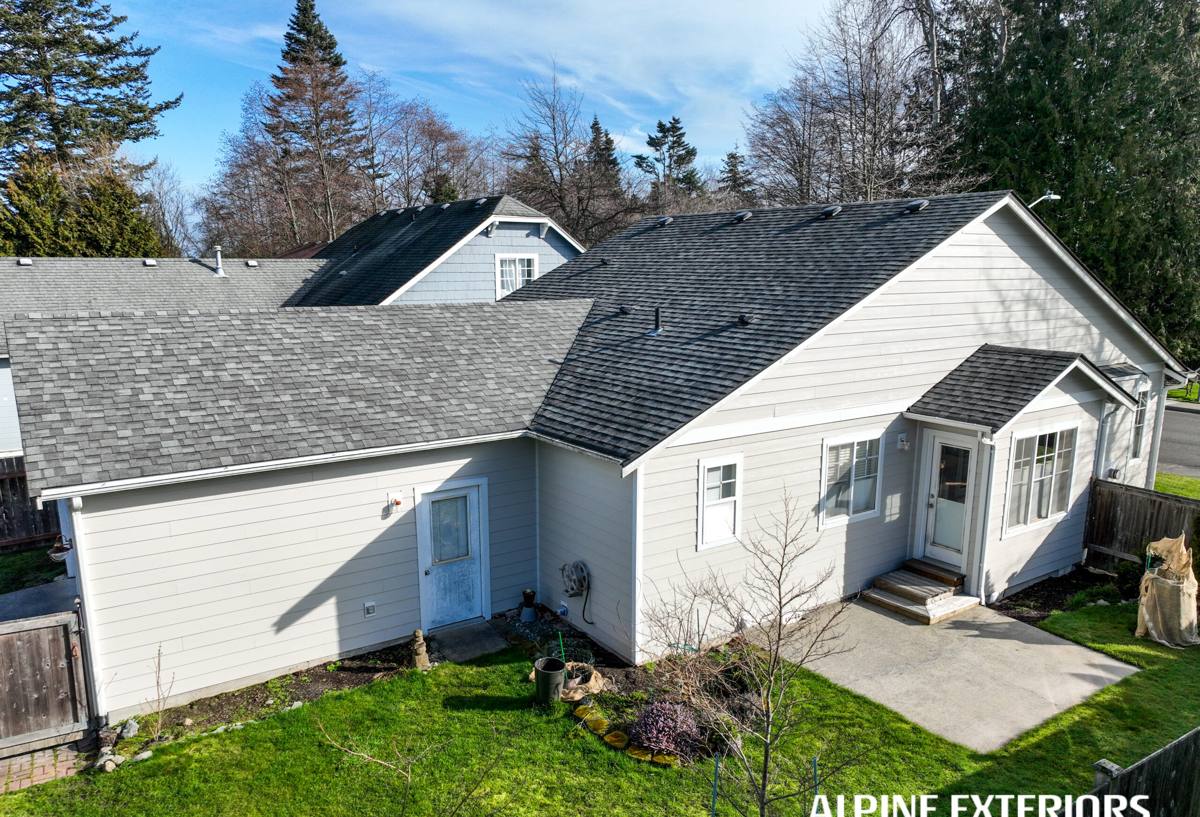
Why We Only Install James Hardie Fiber Cement
We made a decision a long time ago to standardize on one siding product across every job: James Hardie fiber cement. We don't install vinyl, LP SmartSide, Cemplank, Allura, primed spruce, or raw cedar, and we think homeowners deserve an honest explanation of why — not a sales pitch, a real comparison.
Fiber cement is non-combustible, which matters more each year as wildfire smoke and ember exposure become a bigger part of Pacific Northwest summers. It's engineered to resist moisture intrusion rather than absorb it, which is the single biggest factor in how long a wall assembly lasts in a wet climate like Whatcom County's. And James Hardie's ColorPlus factory finish is baked on and warranted, rather than field-applied and left to the weather and the installer's timing. That combination — non-combustible material, moisture-engineered core, factory-cured finish, backed by a strong transferable warranty — is why we stopped installing anything else.
What Homeowners Should Know About the Alternatives
This isn't a case of the other products being junk. Cedar looks beautiful and has a long tradition in this region, but it's a maintenance commitment: refinishing on a cycle, vigilance about moisture and rot, and a real risk if that maintenance slips for even a few years in a climate this wet. Vinyl is inexpensive and low-maintenance in the sense that it doesn't need painting, but it can warp in temperature swings, fades unevenly over time, and doesn't offer the fire performance or the solid feel of fiber cement. Wood composite products like LP SmartSide perform reasonably when installation is flawless, but they're more sensitive to installation errors around seams, flashing, and cut edges — get those details wrong in a climate that rains sideways off the water, and moisture finds its way in. We'd rather build our reputation on one product we install correctly every time than juggle five products with five different failure modes.
| Material | Moisture Resistance | Fire Rating | Maintenance Burden | Typical Finish Life |
|---|---|---|---|---|
| James Hardie fiber cement | Engineered for wet climates | Non-combustible | Low — factory finish | 15+ years on ColorPlus finish |
| Cedar | Good if maintained; poor if neglected | Combustible | High — refinish on a cycle | 3-7 years between refinishing |
| Vinyl | Doesn't absorb, but seams can leak | Combustible, can deform under heat | Low, but can't be refinished | Fades over time, not repaintable easily |
| Wood composite (e.g. LP SmartSide) | Good if installation is precise | Combustible | Moderate — edge and seam vigilance | Field-applied finish, variable |
How Our Siding Installation Process Works
Inspection and Tear-Off
We start by pulling the old siding and actually looking at what's underneath — sheathing condition, existing water damage, and whether previous flashing was installed correctly. In a climate like Whatcom County's, it's common to find hidden moisture damage around old window and door openings that was never visible from outside. We'd rather find it now than have it surface again in five years.
Weather Barrier and Flashing First
The siding itself is only part of the system. Correct house wrap, properly lapped flashing at every window, door, and roofline intersection, and rainscreen detailing where it's called for are what actually keep driving rain out of the wall assembly. Most siding failures we see in this region trace back to flashing and moisture barrier mistakes, not the siding material itself.
Installing to James Hardie's Specification
James Hardie's warranty is only as good as the installation behind it, which means fastener spacing, joint treatment, clearance from grade and roof lines, and caulking all have to be done to spec — not "close enough." We install to that standard on every job, which is also what keeps the manufacturer's warranty intact for the homeowner.
Trim, Caulking, and Final Finish
ColorPlus panels and trim arrive factory-finished, so the goal on-site is protecting that finish through installation and sealing every joint correctly rather than field-painting the whole house afterward. That's part of what keeps the finish looking consistent for so much longer than a site-applied paint job.
Roofing, Windows, and Decks — Same Climate, Same Standards
Siding doesn't work in isolation. A roof that's shedding water poorly will overload the siding and trim below it; windows with failed flashing send moisture straight into the wall cavity behind otherwise good siding; and a deck built without attention to ledger flashing and drainage will rot at the house connection regardless of how well the siding above it was installed. We handle all four — siding, roofing, windows, and decks — because in a climate like Ferndand's, they need to be thought of as one connected system, not four separate projects with four different standards.
For roofing, that means correct underlayment and flashing details built for sustained rain, not just code-minimum. For windows, it means flashing integration with whatever siding system is going on around them, whether that's new Hardie siding or an existing wall. For decks, it means ledger board flashing, proper drainage away from the house, and material choices suited to a climate where standing moisture and moss are a year-round concern, not just a winter one.
Signs a Ferndale Home Needs Attention
Most siding, roofing, and trim problems in this area show up gradually, and homeowners often assume normal weathering when it's actually early failure. A few things worth checking:
- Soft or spongy spots when you press on siding near the bottom courses or around window sills
- Paint that's bubbling, peeling, or chalking heavily on north- or west-facing walls
- Moss or dark streaking that returns within weeks of being cleaned off
- Visible gaps or separation at seams, corners, or trim joints
- Warping, cupping, or bowing in individual boards or panels
- Water stains on interior walls or ceilings near exterior corners after a heavy rain
- Rust streaking from fasteners, which often means the fastener itself is failing
Any one of these is worth a look before it turns into a sheathing or framing repair, which costs considerably more than addressing siding early.
What Drives Cost on a Ferndale Siding Project
Every house is different, but the same handful of factors tend to move the price of a siding project up or down:
| Factor | Why It Matters |
|---|---|
| Existing sheathing condition | Hidden moisture damage found at tear-off adds repair scope before new siding can go on |
| Home size and wall complexity | More corners, gables, and dormers mean more cutting, flashing, and labor time |
| Siding profile chosen | Lap, shingle-style, and panel profiles carry different material and labor costs |
| Trim and accent detail | Custom trim work and color-matched accents add time beyond a basic install |
| Access and site conditions | Steep grades, tight lot lines, or difficult staging areas affect labor time |
We don't quote broad numbers without seeing the house, but these are the factors we walk through with every Ferndale homeowner during an estimate so there aren't surprises once work starts.
Why a Local Crew Matters Here
A lot of exterior problems in Whatcom County come down to details that only show up when you've worked on enough houses in this specific climate — where moss actually forms first on a given roofline, how much clearance siding really needs above grade when the ground stays saturated most of the winter, which corners of a house take the worst of the wind-driven rain off the water. A crew that mostly works in drier climates and treats every job the same way is going to miss things that a crew based here and used to these conditions won't. We're not interested in being generalists; we're interested in getting the details right for the houses in this specific area, on one product system we know inside and out.
Maintenance Expectations After Installation
One of the practical advantages of James Hardie siding in a climate like this is how little ongoing maintenance it asks for compared to wood. There's no refinishing cycle to keep on a calendar. What we do recommend is a periodic rinse to keep moss and algae from establishing, a visual check of caulking at trim joints every couple of years, and prompt attention to anything that looks like it's come loose or been impacted — branches, ladders, equipment. That's a far lighter maintenance load than cedar demands, and it holds up better over time than vinyl in the specific ways that matter in a wet, salt-air environment: seams, fastener corrosion, and finish fade.
Getting an Estimate
If you're weighing a siding, roofing, window, or deck project on a Ferndale home, we're happy to come take a look, walk the exterior with you, and talk through what we're seeing — no pressure, no obligation. Fill out the form below to get started with a free estimate.