 Bellingham Siding
 Birchwood sits close enough to Bellingham Bay and the surrounding wetlands that homes here deal with a specific combination of weather stress: salt-tinged air moving in off the water, long stretches of driving rain through the fall and winter, and a moss and mildew season that can stretch for months given how little direct sun some north-facing walls get under the Pacific Northwest's persistent cloud cover. None of that is unusual for Whatcom County, but it adds up differently on siding than it does on a roof or a driveway, and it's worth understanding before you decide what to put on the outside of your house.
We're a Bellingham-based exterior contractor working on siding, roofing, windows, and decks. Birchwood is inside our regular service area, and we've seen firsthand what the combination of moisture and organic growth does to different siding materials over time. This page covers what that means for homes in the area and how we approach siding work here.
What Birchwood's Climate Actually Does to Siding
The Pacific Northwest's marine climate is often described in simple terms — "it rains a lot" — but the details matter more than the generality. Bellingham gets a long wet season, not just a few big storms, and low-angle winter sun means shaded and north-facing wall sections can stay damp for days between rain events. Add proximity to salt water and you get airborne salt that settles on exterior surfaces and accelerates corrosion on fasteners, trim, and any metal components tied into the siding system.
Moss and Mildew Season
Moss doesn't need standing water to take hold — it needs sustained dampness and a surface it can grip. Wood-based sidings (cedar, primed spruce) and wood-based composite products give moss and mildew more to latch onto, especially in shaded areas, under eaves with poor overhang, or on the north and west-facing walls that get the most weather and the least drying sun. Once organic growth establishes itself, it holds moisture against the substrate longer, which is exactly the condition that leads to rot in wood-based products and coating failure in painted ones.
Driving Rain and Wind-Driven Moisture
Birchwood's proximity to open water means wind-driven rain isn't rare — it's a normal part of a fall or winter storm. That matters for siding because wind-driven rain doesn't just hit a wall, it can push moisture up under laps, around penetrations, and into any gaps in flashing or caulking. A siding system's water-management details — how it laps, how it's flashed at windows and doors, how it drains — matter as much as the material itself.
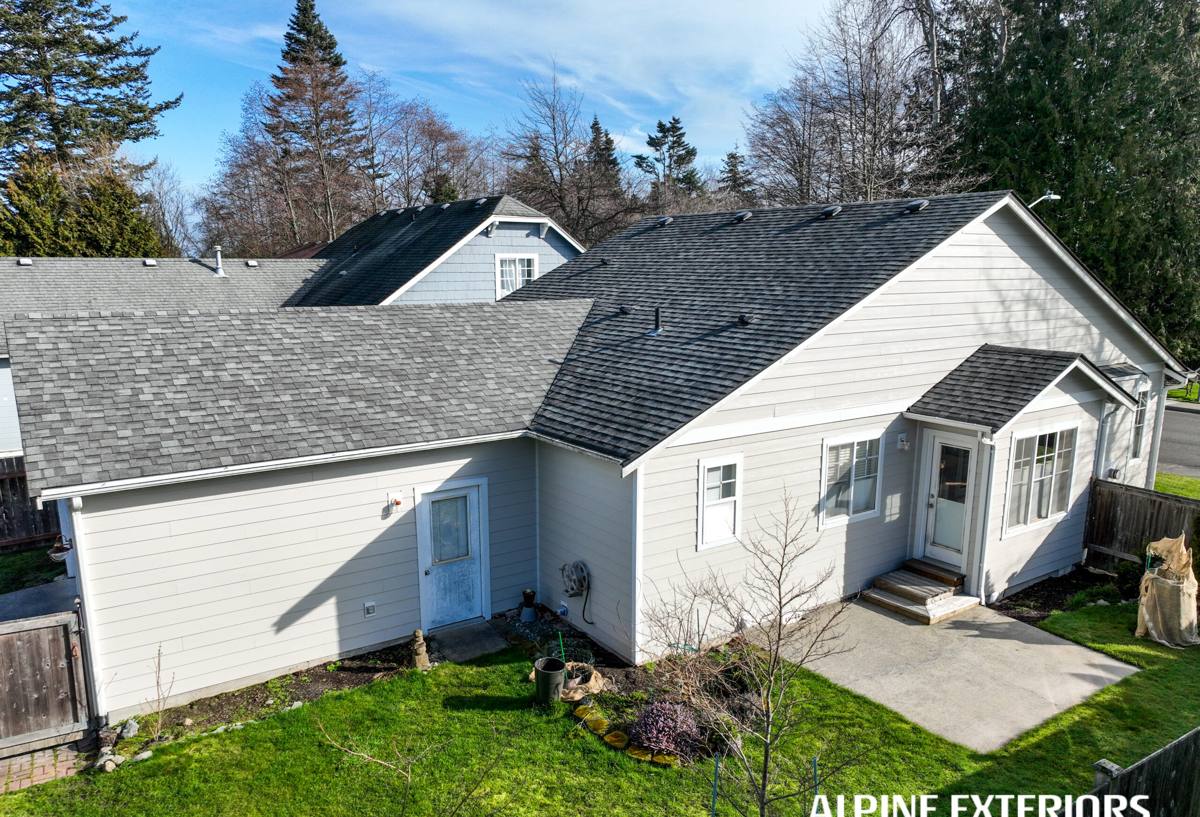
Why We Only Install James Hardie Fiber Cement
We don't install vinyl siding, LP SmartSide, Cemplank, Allura, primed spruce, or cedar. That's a deliberate standard, not a limitation of what we're capable of doing, and it's worth explaining honestly rather than just asserting it.
Vinyl
Vinyl is inexpensive and low-maintenance in the sense that it doesn't need repainting, but it's a thin plastic product that expands and contracts significantly with temperature swings, can crack or become brittle over time, and offers essentially no fire resistance. In a marine climate with driving rain, vinyl's seams and J-channels are also common points where wind-driven moisture finds its way behind the cladding.
Wood-Based Composites (LP SmartSide, Cemplank, Allura)
Engineered wood products like LP SmartSide use resin-treated wood strand substrates that are genuinely improved over old-style hardboard, and they can perform well in drier climates. But they're still wood-based, which means they're more vulnerable to moisture intrusion at cut edges, fastener holes, and butt joints than a cement-based product — exactly the failure points that matter most in a climate with Birchwood's rain and humidity profile. Cemplank and Allura are fiber cement products from other manufacturers; they compete directly with Hardie on paper, but we've standardized on one system, one warranty structure, and one factory finish process rather than juggling multiple product lines with different specs and support.
Cedar and Primed Spruce
Real wood siding has genuine appeal — it looks good and it's a traditional material for this region. But it's also the material most exposed to everything discussed above: moss, mildew, rot at end grain and fastener penetrations, and a repainting or restaining cycle that only gets more frequent in a wet climate. Primed spruce in particular relies entirely on the paint film staying intact; once that fails at a seam or cut edge, moisture gets into the wood underneath and the damage is often hidden until it's advanced.
What James Hardie Gets Right
James Hardie fiber cement is non-combustible, dimensionally stable across temperature and humidity swings, and manufactured with a factory-applied ColorPlus finish that's baked on rather than field-painted — which matters a lot in a climate where field-applied paint has to cure in unpredictable weather. Hardie's HZ5 product line is engineered specifically for climates like ours, with moisture and freeze-thaw performance built into the formulation. It also carries a strong transferable warranty backed by a manufacturer with a long track record, which matters more once a home changes hands.
Installation Quality Matters as Much as the Product
Fiber cement siding is only as good as its installation. Hardie's own specifications call for specific fastener patterns, clearances above grade and roof lines, proper flashing at every penetration and transition, and correct joint treatment — all details that are easy to shortcut and hard to spot once the siding is up and painted. In a climate that delivers sustained wind-driven rain, gaps in those details are where water gets behind the cladding regardless of how good the material itself is.
- Minimum clearance maintained between siding and grade, decks, and roof lines
- Manufacturer-specified fastener type, spacing, and depth
- Flush, properly flashed butt joints and corners
- Correct flashing and sealant at every window, door, and penetration
- Rain-screen or drainage plane detailing appropriate to the wall assembly
- Caulking and touch-up limited to manufacturer-approved products
Roofing, Windows, and Decks in a Coordinated Approach
Siding doesn't work in isolation. A roof with poor drainage or damaged flashing sends water down onto siding it was never meant to handle continuously. Old windows with failed seals leak moisture into wall cavities behind new siding. A deck ledger board attached without proper flashing is a common source of hidden rot regardless of what's on the walls around it. Because we handle all four trades, we look at the whole exterior envelope rather than treating siding as a standalone project — which matters in particular on older Birchwood homes where multiple systems may be original or from different renovation eras.
Cost Factors for Birchwood Siding Projects
Every home is different, but the following factors consistently move the price of a siding project up or down. We don't publish fixed per-square-foot pricing because these variables change the number too much to make a flat rate meaningful.
| Factor | Why It Matters |
|---|---|
| Existing siding material | Wood or vinyl tear-off adds labor and disposal; some substrates need extra sheathing repair |
| Wall complexity | Dormers, bump-outs, and multiple gables increase cutting, flashing, and trim work |
| Hidden moisture damage | Rot found during tear-off requires sheathing or framing repair before new siding goes on |
| Home height and access | Multi-story sections need scaffolding or lift access, which affects labor time |
| Trim and Hardie profile choice | Lap width, shingle-style panels, and trim detail level all affect material and labor cost |
| Color and finish selection | Factory ColorPlus finishes vary in cost by line; custom field-painting adds cost and maintenance |
Why a Local Crew Matters Here
A crew that works in Whatcom County year-round understands things a traveling or out-of-area installer doesn't have to think about: how far above grade siding needs to sit given our rainfall patterns, which wall orientations in this area need the most attention to moss and drainage, and how local permitting and inspection actually work in Bellingham and the surrounding unincorporated areas. We're not guessing at what this climate does to a house — we're dealing with it on jobs across the region on an ongoing basis.
Signs Your Birchwood Home May Need Siding Attention
- Visible moss or dark streaking on north- or west-facing walls
- Soft or spongy spots when pressing on wood siding, especially near the bottom courses
- Paint that's peeling, bubbling, or failing faster than a normal repaint cycle
- Cracked, warped, or separating panels or boards
- Visible gaps at seams, corners, or around windows and doors
- Rising energy bills that may point to compromised insulation behind failing siding
If you're seeing any of that on a Birchwood home, or you're simply planning ahead for a siding, roofing, window, or deck project, we're happy to take a look and talk through honest options — no pressure, no hard sell. Reach out for a free estimate using the form below.