 Bellingham Siding
 Why Siding Fails Faster in Whatcom County
Siding doesn't usually fail all at once. It fails one season at a time — a little more moisture getting behind a seam each winter, a little more paint chalking off each summer, until one day a homeowner notices a soft spot by a downspout and realizes the problem has been building for years. In Bellingham, that timeline moves faster than it does in drier parts of the country. Salt-laden air off Bellingham Bay, driving rain that comes in sideways during a southwesterly blow, and a moss season that can stretch from October through May all put steady pressure on exterior walls.
Knowing what early siding failure actually looks like — not just the dramatic stuff, but the subtle stuff — is what separates a homeowner who catches a problem at the "repair" stage from one who gets hit with a full wall rebuild. This page walks through the signs, in the order most people actually notice them.
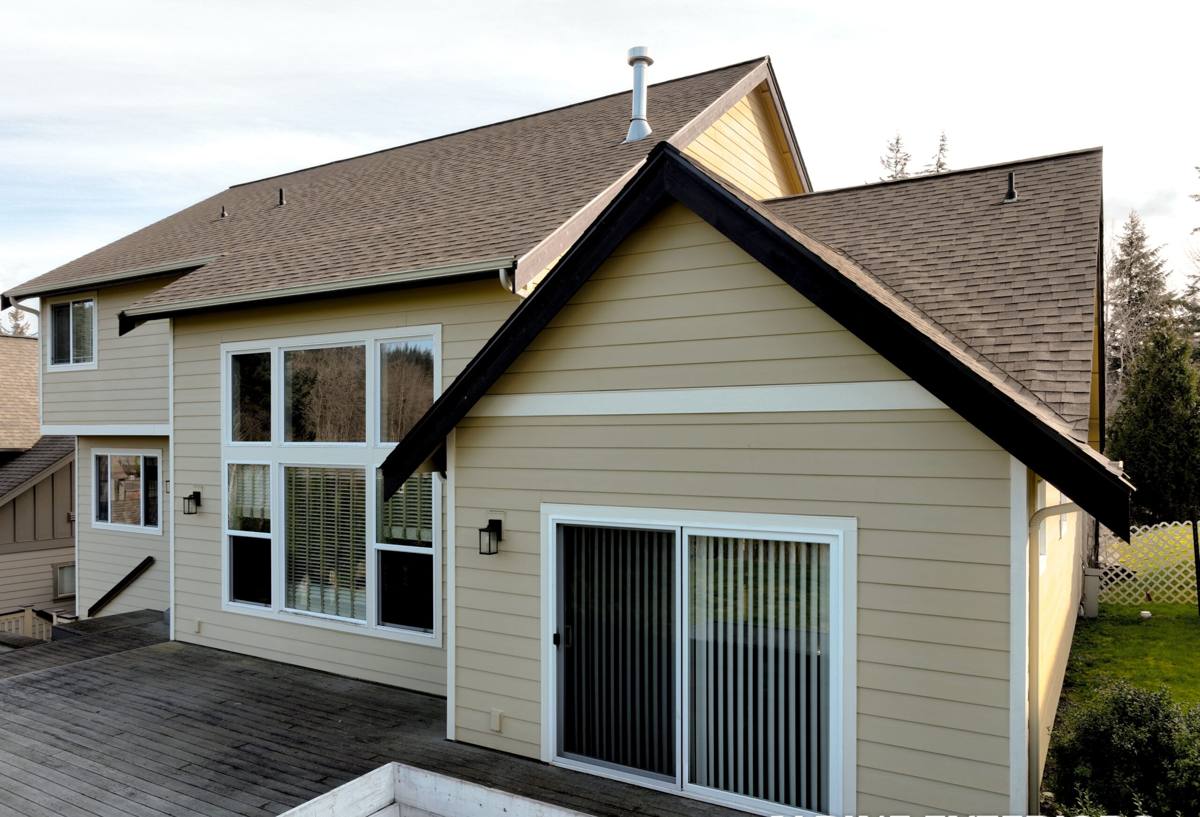
1. Paint That's Bubbling, Peeling, or Chalking
Paint failure is often the first visible clue that siding is taking on moisture it shouldn't be. When water gets into the substrate underneath a painted surface — whether that's wood, engineered wood, or fiber cement — it pushes outward as it tries to evaporate, and the paint film bubbles or peels in response.
What to look for
- Bubbles or blisters in the paint film, especially near the bottom of panels or below windows
- Peeling that exposes bare substrate rather than just old paint
- Chalky white residue that rubs off on your hand (some chalking is normal aging; heavy chalking paired with color fade is not)
- Paint failure that's isolated to one wall — usually the side that takes the most weather, often west- or southwest-facing in this region
A little chalking after 10+ years is normal weathering. Bubbling and peeling within the first several years of a paint job is a sign that something underneath is wet — and that's worth investigating before repainting over it.
2. Warping, Buckling, or Rippling Panels
Wood-based sidings — including primed spruce, cedar, and engineered wood products — are dimensionally reactive. They expand when they absorb moisture and contract as they dry, and repeated cycles of that (which Bellingham's wet-dry seasonal swing guarantees) eventually cause boards to warp, cup, or ripple along their length. You'll usually see this as a wavy shadow line across an otherwise flat wall, most visible in low-angle morning or evening light.
Vinyl siding can show a related but different problem: buckling or waviness caused by heat expansion, or panels popping out of their track after enough freeze-thaw and wind-load cycling. Either way, once a panel has visibly warped or buckled, it has already lost its ability to shed water the way it was designed to — it's not just cosmetic.
3. Cracks, Splits, and Gaps at Seams
Cracking shows up differently depending on the material, but it always means the same thing: water now has a direct path behind the cladding.
Where cracks typically start
- Butt joints and seams — the horizontal or vertical joins between panels are the weakest point in almost any siding system if they weren't flashed and caulked correctly
- Around fasteners — nail or screw heads that were driven too tight, or into a substrate that's since shrunk, can crack the material radiating outward from the fastener
- Corners — inside and outside corner trim takes the most expansion/contraction stress on the wall
- Impact points — a stray branch, ladder, or lawn equipment strike can start a crack that then wicks water for years before it's noticed
Even a hairline crack matters. Wood and engineered wood swell at the crack edges every time they get wet, which widens the gap a little more each cycle.
4. Soft Spots, Sponginess, and Rot
This is the sign that means the damage is no longer surface-level. If you press on a section of siding — especially near the bottom of a wall, under a window sill, around an outdoor spigot, or near a deck ledger board — and it gives slightly or feels spongy rather than solid, water has been sitting in the material long enough to start breaking it down.
Rot doesn't stay contained to the siding itself. Left long enough, it spreads to the sheathing and framing behind it, which turns a siding repair into a structural repair. Soft spots are one of the few signs on this list that justify calling a contractor immediately rather than waiting for a seasonal inspection.
5. Moss, Algae, and Persistent Green or Black Staining
Whatcom County's long moss season means almost every home here deals with some green growth on north-facing walls, under eaves, and anywhere shade and moisture linger. The important distinction is between growth that's purely surface-level and growth that signals the siding underneath is staying wet.
Cosmetic vs. a real warning sign
| Observation | Likely just cosmetic | Worth investigating further |
|---|---|---|
| Light green film, easily rinsed off | Yes | — |
| Moss growing in a caulk line or seam | — | Yes — moisture is being held at that joint |
| Black streaking below a gutter or downspout | Usually cosmetic (algae/mildew from splashback) | Check gutter alignment and re-clean; recurring streaks mean water is hitting the wall repeatedly |
| Moss growing on a section that also feels soft to the touch | — | Yes — treat as a priority |
| Growth concentrated at ground level where mulch or landscaping touches siding | — | Yes — soil/mulch contact keeps siding wet regardless of material |
Moss and algae themselves rarely cause failure directly — the concern is what they indicate about how long that section of wall stays damp.
6. Rising Heating Bills or Drafts Near Exterior Walls
Siding is the outermost layer of a wall assembly, but when it fails, the effects show up inside the house too. Gaps, warping, and rot compromise the weather barrier behind the siding, which can let in drafts and let out conditioned air. If heating bills have crept up without an obvious explanation, or a room near an exterior wall feels noticeably colder than the rest of the house in winter, it's worth having the siding checked along with the insulation.
7. Fastener Issues — Popped, Rusted, or Streaking Nails
Nail heads that back out over time, rust streaks bleeding down from a fastener, or fastener heads that are visibly corroded are all signs of a siding system under stress — either from the wrong fastener for the material, over-driving during installation, or moisture getting into the fastener penetration itself. Rust streaking in particular, common in coastal air like Bellingham's, is a sign the fasteners weren't rated for the exposure they're getting.
8. Insect Activity
Carpenter ants and other wood-boring insects are drawn to damp, softened wood — which means insect activity on or near siding is often a secondary sign that moisture damage is already underway. Small holes, sawdust-like debris (frass) at the base of a wall, or ants observed entering/exiting siding seams are worth investigating promptly, since the insects are a symptom of the underlying moisture problem, not the root cause.
9. Age and Maintenance History
Sometimes the most reliable sign isn't a visible defect at all — it's the calendar. Every siding material has a realistic service life, and that life gets shorter with coastal salt exposure, high annual rainfall, and inconsistent repainting. A homeowner walking through a pre-purchase inspection, or simply taking stock of a home they've owned for 20+ years, should weigh the siding's age and maintenance record as heavily as any single visible flaw.
Quick self-check
- Walk the full perimeter of the house, including areas hidden behind shrubs or fencing
- Check north- and west-facing walls separately — they age differently in this climate
- Press-test any area that looks discolored, stained, or has visible growth
- Look up under eaves and around every window and door trim piece
- Note anywhere landscaping, mulch, or a deck sits directly against the siding
- Write down what you find with rough locations — this makes a contractor's inspection faster and more accurate
What Happens If These Signs Are Ignored
Siding problems are rarely urgent in the moment, which is exactly why they're easy to put off. But moisture that gets behind cladding doesn't stay put — it moves into sheathing, framing, and insulation, and repair costs climb accordingly. A problem that would have been a localized panel replacement at year one can turn into sheathing repair and a partial wall rebuild by year three or four, especially in a climate that rarely gives materials a long stretch to fully dry out between rain events.
Why We Only Install James Hardie
We see the failure patterns above on a lot of different siding materials — wood, engineered wood, vinyl — and the common thread is almost always moisture management and material stability under repeated wet-dry cycling. That's the core reason this company installs James Hardie fiber cement exclusively. It's non-combustible, doesn't swell or rot the way wood-based products can, and comes with a factory-applied ColorPlus finish designed to hold up against UV and moisture without the repainting cycle that drives a lot of the paint failure described above. Hardie's HZ5 product line is specifically engineered for wet, moisture-heavy climates like ours, and it carries a strong transferable warranty that reflects real confidence in long-term performance when it's installed to spec.
If you're noticing any of the signs above on your own home, the smartest next step is a proper inspection rather than a guess. We offer free, no-pressure estimates for Bellingham and Whatcom County homeowners — walk us through what you're seeing, and we'll tell you honestly whether it's a repair, a partial replacement, or something that can wait.