 Bellingham Siding
 Why Bellingham Homes Take a Beating from Moisture
If you live in Whatcom County, your siding works harder than siding almost anywhere else in the country. Bellingham sits between the Salish Sea and the Cascade foothills, which means your walls deal with a combination most homes never face: salt-laden marine air, wind-driven rain that hits siding sideways instead of straight down, and a long, damp moss season that keeps north-facing walls wet for weeks at a stretch. None of that is dramatic on its own. It's the accumulation — month after month, year after year — that eventually finds the weak point in a wall system.
Most homeowners think about siding failure as a cosmetic problem: fading, peeling, a board that looks tired. The more expensive problem is invisible. Moisture that gets behind the siding and into the wall assembly can rot sheathing and framing for years before anyone notices, because the siding on the surface can still look perfectly fine.
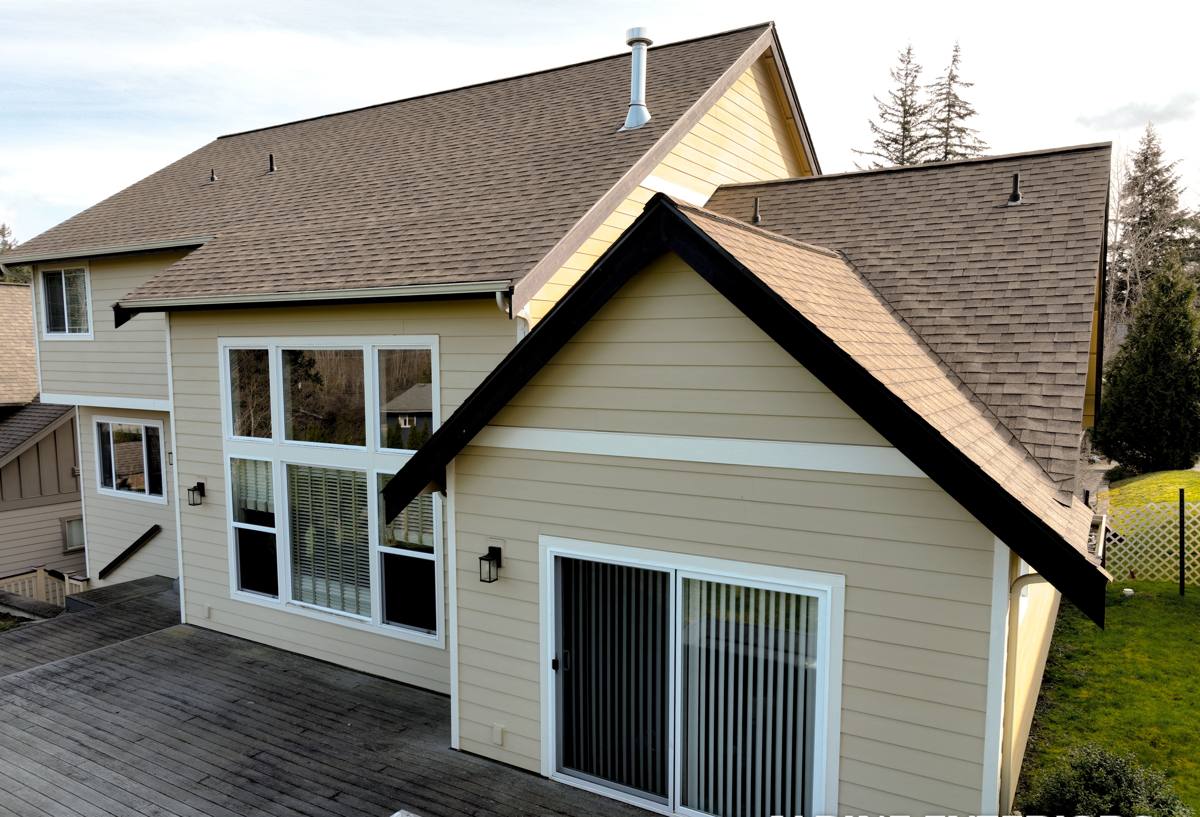
How Moisture Actually Gets Behind Siding
Water rarely soaks straight through a wall. It gets in through specific, predictable entry points, and once it's behind the siding, gravity and capillary action pull it further than most people expect.
The usual entry points
- Failed or missing caulk at trim joints, window and door casings, and butt joints between siding pieces
- Nail holes and fastener penetrations that were never sealed correctly
- Missing or poorly lapped flashing above windows, doors, and horizontal trim
- Siding installed tight to the ground, a deck, or a roofline with no clearance for water to drain and dry
- Gaps where siding meets roof-to-wall intersections, chimneys, or vents
In a driving rainstorm — which Bellingham gets plenty of, especially off Bellingham Bay and the Strait — wind pressure can force water into gaps that would never leak in a calm rain. That's why a house can pass years of ordinary weather and then develop a leak the first time a real windstorm rolls through.
What's supposed to stop it
A correctly built wall isn't relying on the siding surface alone to keep water out. Behind the siding should be a water-resistive barrier (housewrap or building paper) and, ideally, a drainage gap that lets any water that does get past the siding run down and out instead of sitting against the sheathing. When that drainage plane is missing, damaged, or improperly lapped — often because of a rushed or poorly detailed installation — the siding becomes the only line of defense, and it isn't designed to be.
Why Rot Starts Behind the Siding, Not On It
Wood rot needs three things: moisture, oxygen, and a food source (wood). The wall cavity behind your siding provides all three once water gets trapped there, and it's often warmer and less ventilated than the exterior surface, which actually accelerates decay. That's the frustrating part for homeowners — by the time rot is visible from the outside, as soft trim, dark staining, or a section of siding that flexes under light pressure, the damage has usually been developing behind the surface for a long time.
Sheathing is typically the first casualty, followed by framing members if the moisture source isn't caught. In older Bellingham homes with cedar or old-growth wood siding, we also commonly find rot concentrated at specific stress points: below window sills, at deck ledger connections, near roof-to-wall transitions, and along the lowest few feet of wall where splashback and moss buildup keep the material wet longest.
Signs You Might Already Have a Moisture Problem
Most rot doesn't announce itself. These are the signals worth taking seriously, especially on north- and west-facing walls that see the most driving rain and the least direct sun to dry out.
- Soft or spongy spots when you press on siding or trim, particularly near the bottom of walls
- Paint that's bubbling, peeling, or failing repeatedly in the same spot despite repainting
- Dark streaking, discoloration, or a musty smell near exterior walls, especially indoors along baseboards
- Visible gaps opening up at caulk lines, trim joints, or siding seams
- Heavy, persistent moss or algae growth on siding that never fully dries out
- Warping, cupping, or separation of individual siding boards
- Insect activity (carpenter ants, in particular, are drawn to damp, decaying wood)
Any one of these on its own might be minor. Two or three together, especially clustered in one area, usually means it's worth having someone open up the wall and take a real look rather than just patching the surface.
Not All Siding Materials Handle Moisture the Same Way
Part of what determines whether a house develops rot problems is the siding material itself — specifically, how it responds when it does get wet, because in this climate, it eventually will.
| Material | How it behaves when wet | Long-term moisture risk in this climate |
|---|---|---|
| Solid wood / cedar | Absorbs moisture directly into the fiber; swells and shrinks with wet/dry cycles | High — needs consistent refinishing and is vulnerable at end grain and joints |
| Engineered wood siding | Wood-based composite; edges and cut ends are especially sensitive to standing water | Moderate to high — installation detailing at seams and bottoms is critical |
| Vinyl | Doesn't absorb water itself, but doesn't stop water either — relies entirely on what's behind it | Moderate — problems show up behind the siding, not on it, which delays detection |
| Fiber cement | Cement-based core resists water absorption and doesn't swell, rot, or feed insects | Low, when installed with correct flashing, clearances, and factory-sealed cut edges |
No siding material makes wall-assembly details optional — flashing, drainage gaps, and clearances matter no matter what's on the outside. But the material does change how forgiving the system is when something behind it isn't perfect, and how much of the moisture burden falls on the material itself versus the barrier behind it. That's a large part of why we standardized on James Hardie fiber cement: it doesn't rot, it doesn't feed insects, and its factory-applied ColorPlus finish holds up to Bellingham's marine air and long wet season without the recurring refinishing that wood and engineered wood products require.
What Correct Installation Actually Involves
Material choice matters, but installation quality is what actually determines whether a wall stays dry. We see rot on houses with good materials and see healthy walls behind mediocre materials — the difference is almost always in the details.
The non-negotiables
- A continuous, properly lapped water-resistive barrier behind the siding, with no gaps or reversed laps
- Correct flashing at every window, door, and horizontal trim transition, integrated with the barrier — not just caulked over the top
- Proper clearance between siding and the ground, roofing, decks, and patios so water can drain and the material can dry
- Manufacturer-specified fastening — correct nail type, spacing, and penetration depth
- Sealed and primed cut ends, especially on any material with an engineered or composite core
- Kick-out flashing at roof-to-wall intersections so water is directed away from the wall instead of behind it
Skipping any one of these doesn't necessarily cause an immediate problem. It just removes a layer of protection, and in a climate that delivers as much driving rain and sustained dampness as Whatcom County does, those margins matter more than they would somewhere drier.
Repair vs. Replace: What Rot Damage Really Means
Once rot is confirmed, the scope of the fix depends entirely on how far it's spread and whether the underlying cause has been identified.
- Localized surface rot caught early, at a single trim board or siding piece, can sometimes be addressed by replacing just that section and correcting the water entry point that caused it.
- Sheathing damage means the siding in that area has to come off, the sheathing repaired or replaced, and the drainage plane rebuilt correctly before new siding goes back on.
- Framing damage is the most serious tier — structural members compromised by long-term moisture exposure require a carpenter or structural repair before any siding work makes sense.
This is why we always recommend an actual inspection rather than guessing from curb appeal. A wall that looks fine from the sidewalk can hide a much bigger repair, and a wall with cosmetic wear but a sound structure underneath might need far less work than it appears.
Preventing Moisture Problems Going Forward
Whether you're maintaining existing siding or planning a replacement, a few habits go a long way in this climate:
- Keep gutters clean and downspouts directing water away from the foundation and walls
- Trim vegetation back from siding so walls can dry out between rain events instead of staying shaded and damp
- Re-caulk trim and joints on a regular schedule rather than waiting for visible failure
- Address moss buildup on siding promptly, especially on shaded north walls
- Walk the exterior once or twice a year and press-test suspicious areas, particularly near grade, decks, and window sills
- Have flashing and caulk checked any time you have roofing, deck, or window work done nearby, since those trades can disturb existing details
Getting an Honest Assessment
Moisture and rot problems are almost always cheaper to deal with the earlier they're caught. If you're seeing any of the warning signs above, or you're simply due for an exterior that can handle another few decades of Bellingham weather without becoming a repeated maintenance project, we're happy to take a look. We'd rather give you a straight answer about what's actually going on behind your siding than sell you a repair — or a full replacement — you don't need. Reach out for a free, no-pressure estimate and we'll walk the exterior with you.