 Bellingham Siding
 Siding in Cordata: What Local Homes Are Up Against
Cordata sits in north Bellingham, one of the newer growth areas of the city, with a mix of newer subdivisions, townhomes, and commercial development along the Cordata Parkway corridor. Homes here run the gamut from recently built vinyl-clad construction to older wood and composite siding that's now fifteen, twenty, or more years into its life. Whatever the vintage, the exterior of a Cordata home is doing the same job: standing between the family inside and a Pacific Northwest climate that never really lets up.
Bellingham's weather isn't dramatic in the way a hurricane or a hard freeze is dramatic. It's persistent. Whatcom County gets long stretches of low-intensity rain, marine air pulling moisture off the Salish Sea, and short winter days where a north-facing wall might not see direct sun for weeks. That combination is exactly what wears down the wrong siding material — not through one big event, but through years of quiet, cumulative moisture exposure.
Salt Air and Driving Rain
Cordata isn't waterfront, but Bellingham as a whole sits close enough to the Salish Sea that salt-laden air moves through the region, especially on windier days. Salt air accelerates corrosion on fasteners and metal trim, and it interacts with paint and coatings in ways that inland climates don't have to deal with. Add wind-driven rain — which in this part of Whatcom County doesn't always fall straight down, it comes in at an angle and finds every gap, seam, and unsealed joint — and you've got a climate that actively hunts for weaknesses in an exterior.
The Long Moss Season
Anyone who's lived in Bellingham through a winter knows moss isn't a seasonal nuisance here, it's close to a year-round tenant. Shaded walls, north exposures, and anywhere airflow is restricted (behind shrubs, under eaves, near fences) stay damp longer than they should. On the wrong siding material, sustained moss and algae growth isn't just cosmetic — it holds moisture against the surface, which is where rot, delamination, and coating failure start.
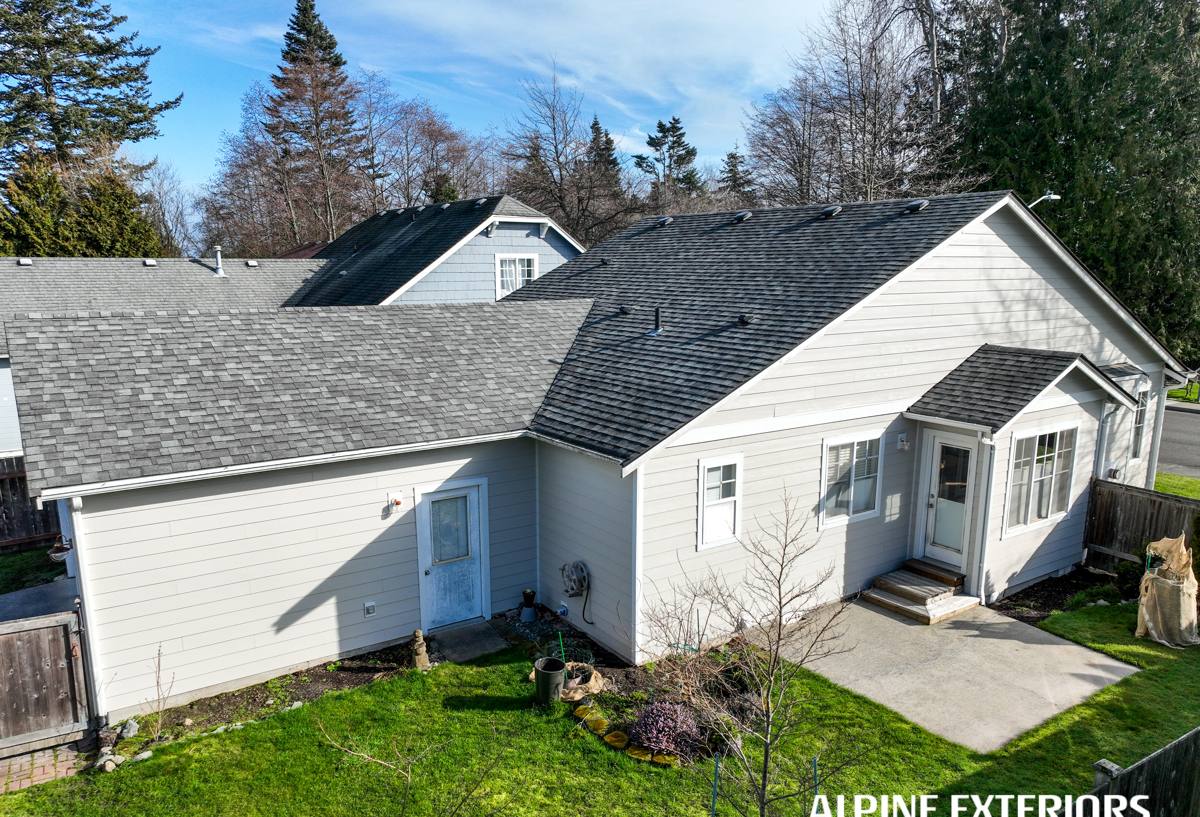
Why We Only Install James Hardie Fiber Cement
We're a full exterior contractor — siding, roofing, windows, and decks — and on every siding job in Cordata and the rest of Whatcom County, we install James Hardie fiber cement. Not vinyl, not LP SmartSide, not primed cedar or spruce, not other fiber cement brands like Cemplank or Allura. That's a deliberate standard, not a sales pitch, and it's worth explaining why.
- Vinyl expands, contracts, and can warp or crack in temperature swings, and it doesn't hold paint if a homeowner ever wants to change the color. In a climate with constant moisture cycling, the seams and J-channels on vinyl are also where water tends to find its way behind the cladding.
- LP SmartSide is an engineered wood product, which means the wood fiber core is still vulnerable at cut edges and any point where the factory coating is compromised — exactly the failure mode that matters in a climate defined by sustained dampness and moss.
- Primed cedar or spruce looks great on day one but requires ongoing maintenance (recoating, caulking, moisture monitoring) that most homeowners underestimate. In a market like Bellingham where the wet season runs long, that maintenance window gets narrow.
- Other fiber cement brands (Cemplank, Allura) are legitimate products, but we've standardized our crews, our install details, and our warranty relationship around one manufacturer so we can guarantee the work — not just sell a material.
James Hardie fiber cement is non-combustible, dimensionally stable, and factory-finished with ColorPlus technology, which means the color is baked on in a controlled environment rather than field-applied. It resists moss and mildew far better than wood-based products, it doesn't rot, and Hardie's HZ5 product line is engineered specifically for climates like ours — freeze-thaw cycling, sustained moisture, and coastal-influenced weather. That's the material we stand behind on every Cordata home we side.
How a Siding Project Works in Cordata
1. Assessment and Estimate
We start with a walkaround of the home — looking at current siding condition, trim and flashing details, window and door transitions, and any signs of trapped moisture or moss buildup. This is also when we talk through Hardie product lines and colors that fit the home and the neighborhood.
2. Tear-Off and Inspection of the Sheathing
Once old siding comes off, we can actually see what's underneath — sheathing condition, existing house wrap, and any rot or water damage that wasn't visible from outside. This step matters more in Whatcom County than in drier climates, because moisture problems here tend to develop slowly and stay hidden behind the cladding.
3. Weather Barrier and Flashing
Correct water management behind the siding — house wrap, flashing at every window and door, proper overlaps — is what actually keeps driving rain out. This is the part of the job that's invisible once the siding goes up, and it's also the part most likely to be rushed on a lower-bid job.
4. Hardie Installation to Manufacturer Spec
James Hardie siding has specific installation requirements — fastener spacing, clearances from grade and roof lines, caulking at joints — that are part of what makes the warranty valid. We install to that spec, not to a shortcut version of it.
5. Final Walkthrough
We go through the finished exterior with the homeowner, check trim and caulk lines, and make sure everything matches what was scoped at the estimate.
Beyond Siding: Roofing, Windows, and Decks
Siding doesn't fail in isolation. A roof that's shedding water onto a wall, a window that's not flashed correctly, or a deck ledger board that's trapping moisture against the house can all undermine even a well-installed siding job. Because we handle roofing, windows, and decks as well as siding, we look at the exterior as one connected system rather than four separate trades that don't talk to each other. For a Cordata home, that matters most at the details: roof-to-wall transitions, window flashing, and deck attachment points, which are consistently where moisture problems in this climate actually start.
Cost Factors for a Cordata Siding Project
Every home is different, but the same factors drive cost on most siding jobs in this area. This is meant as a general guide, not a quote — actual pricing depends on the specifics of your home.
| Factor | Why It Matters |
|---|---|
| Home size and wall complexity | More corners, gables, and cutouts mean more labor and material waste. |
| Condition of existing sheathing | Hidden rot or water damage found during tear-off adds repair scope. |
| Hardie product line and profile | Lap siding, shingle-style panels, and board-and-batten all price differently. |
| Trim and detail work | Window/door trim, fascia, and corner boards add labor time. |
| Access and site conditions | Tight lots, slopes, and landscaping close to the house affect crew logistics. |
| Story height | Two-story and multi-story walls require more scaffolding and staging time. |
Why a Local Crew Matters
A contractor based here has seen how Whatcom County weather actually treats a house over years, not just at the moment of installation. We know which wall orientations in this area tend to hold moss longest, how driving rain off the Salish Sea behaves differently than a straight-down rainstorm, and where flashing details tend to get skipped on cheaper jobs — because we've torn open enough old siding to see the pattern. That local knowledge shows up in the small decisions on a job: where extra flashing goes, how ventilation gaps are handled, which details get extra attention on a north-facing wall in Cordata versus a south-facing wall.
It also means accountability. If a warranty question comes up five or ten years down the road, you're dealing with a crew that's still working in Bellingham, not tracking down a company that moved on to another region.
Signs Your Cordata Home May Need New Siding
- Persistent moss or algae staining that comes back within weeks of cleaning
- Soft spots, bubbling, or visible warping in wood-based or composite siding
- Paint that's peeling or failing faster than a normal repaint cycle would suggest
- Visible gaps or separation at seams, corners, or trim boards
- Rising energy bills that may point to a compromised weather barrier
- Cracking or chalking on vinyl siding that's reached the end of its service life
A Straightforward Process, No Pressure
We're not the contractor that installs whatever's cheapest to win the bid. We install James Hardie fiber cement because it's what holds up to Bellingham's salt air, driving rain, and long moss season without asking homeowners to sign up for a maintenance schedule they'll fall behind on. If your Cordata home's siding is showing its age, or you're weighing options before a bigger renovation involving roofing, windows, or a deck, we're happy to take a look and give you a straight assessment — no pressure, no inflated urgency, just what we'd actually recommend if it were our own house. Reach out for a free estimate using the form below.