 Bellingham Siding
 Siding in York: A Neighborhood That Sits Right in Bellingham's Weather
York is one of Bellingham's older, established residential neighborhoods, close enough to downtown and Bellingham Bay that the marine climate is never far away. Homes here range from early-1900s bungalows to mid-century remodels and newer infill construction, but they all face the same basic problem: this part of Whatcom County stays wet, cool, and shaded for a large part of the year, and the air carries a mix of moisture and salt off the bay. Siding that isn't built for that combination shows it faster here than it would somewhere drier and inland.
If you've lived in York for any length of time, you already know the pattern. Fall brings the first sustained rain, winter settles into a long stretch of grey, wet days with short daylight hours, and spring doesn't really dry things out until well into the season. Add mature tree cover on many York lots and you get siding, trim, and roofing that stay damp longer than they should, especially on north- and west-facing walls that don't get much direct sun.
What That Means for Exterior Materials
Wood-based and wood-adjacent siding products absorb moisture at cut edges, fastener holes, and any place the factory coating gets compromised. Once moisture gets into the substrate, it doesn't leave quickly in a climate like this — the drying window between rain events is short, and shaded walls barely get one at all. Over years, that cycle of absorb-swell-dry is what drives the swelling, delamination, and rot problems that show up on homes with the wrong siding for this region. Salt-laden air adds a second layer of stress, accelerating corrosion on fasteners and trim hardware and contributing to the buildup that lets algae and moss take hold on shaded siding surfaces.
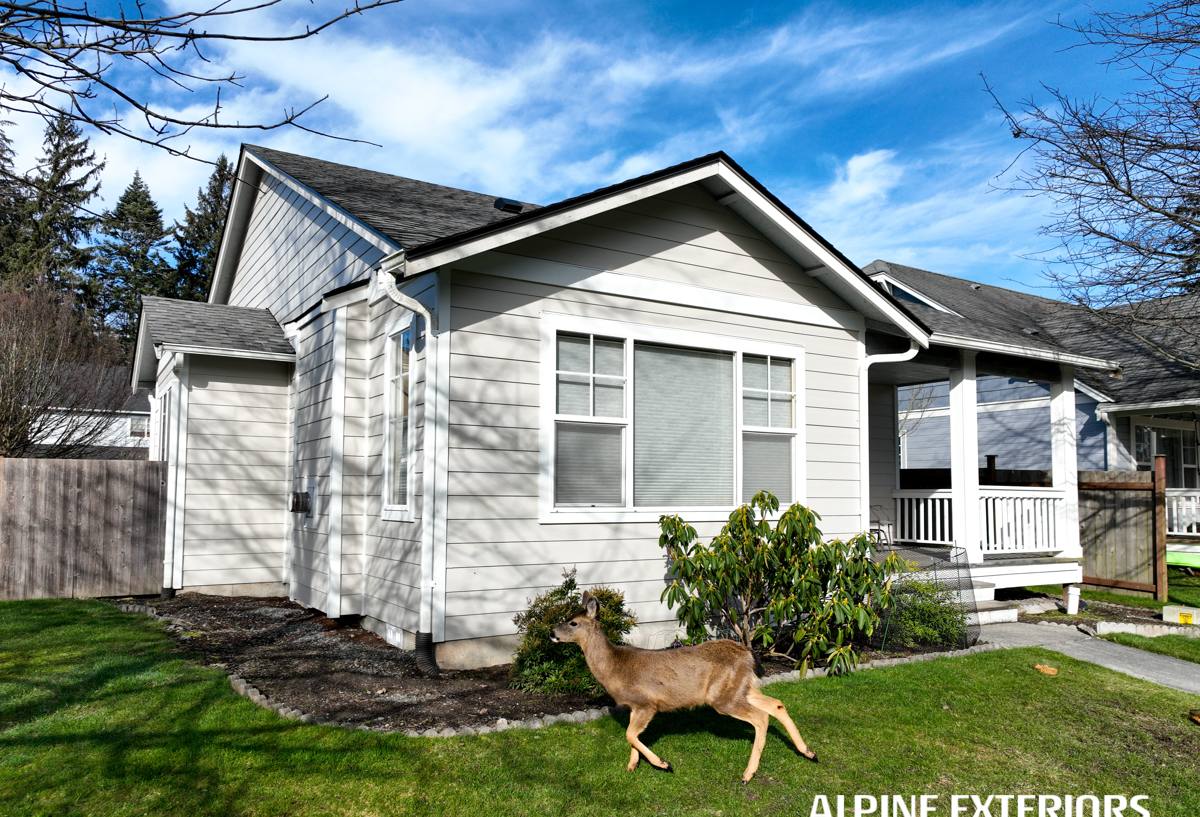
Why We Only Install James Hardie Fiber Cement
We install James Hardie siding exclusively — not vinyl, not LP SmartSide, not Cemplank or Allura, not primed spruce or cedar. That's a deliberate standard, not a sales pitch, and it's worth explaining honestly rather than just asserting it.
Vinyl siding is inexpensive and low-maintenance in mild climates, but it's a thin, flexible plastic product that can warp in temperature swings, crack in cold snaps, and fade over time — and it doesn't hold paint, so your color options are locked in for the life of the product. LP SmartSide and similar engineered-wood products perform reasonably well when installation is flawless and maintenance is kept up every year, but they're wood-based at the core, which means the same moisture-absorption vulnerabilities that affect cedar apply here too, just with a different manufacturing process. Primed spruce and raw cedar are traditional, attractive materials, but they demand the most maintenance of any siding option — regular repainting, caulking, and inspection — and in a wet, shaded neighborhood like York, that maintenance schedule gets tighter, not looser.
James Hardie fiber cement is cement, sand, and cellulose fiber — non-combustible, dimensionally stable, and engineered specifically for wet climates through Hardie's HZ10 product line, which is formulated for the Pacific Northwest's rain and humidity profile. It doesn't rot, it resists moisture-driven swelling far better than wood-based products, and the ColorPlus factory finish is baked on under controlled conditions, so it holds color and resists fading better than field-applied paint. That's why it's what we put on homes in York and across Bellingham — not because other products are worthless, but because we've made a professional judgment about what holds up best in this specific climate.
Where Hardie Actually Comes From on the Cost Question
Hardie siding typically costs more upfront than vinyl and is comparable to or somewhat more than engineered wood, depending on the profile and finish you choose. The way to think about it isn't sticker price alone — it's cost over the life of the siding, factoring in repainting cycles, repair likelihood, and how the product performs specifically in a wet, salt-influenced environment like York.
| Factor | Vinyl | Engineered Wood (LP SmartSide) | James Hardie Fiber Cement |
|---|---|---|---|
| Core material | PVC plastic | Wood strand/resin composite | Cement, sand, cellulose fiber |
| Moisture behavior | Doesn't absorb, but traps moisture behind it | Absorbs at cut edges/damage if maintenance lapses | Highly moisture-resistant; engineered for wet climates (HZ10) |
| Repainting needed | Cannot be effectively repainted | Every 8-12 years typically | ColorPlus finish rated for decades before repaint |
| Fire resistance | Melts/deforms under heat | Combustible | Non-combustible |
| Typical lifespan when installed to spec | 20-30 years | 20-30 years with upkeep | 30-50+ years |
What Full-Exterior Service Looks Like for a York Home
Most homes eventually need more than just siding attention, and we handle siding, roofing, windows, and decks so a York homeowner isn't coordinating four separate contractors and four separate warranty structures. That matters practically: a roofing issue and a siding issue in this climate are often related, since flashing, gutters, and wall systems all work together to keep water out.
Siding Replacement and Repair
For a full siding replacement, we start with an honest assessment of your existing exterior — where moisture has gotten in, where trim and flashing need attention, and where the wall assembly itself needs correction before new siding goes on. Installing Hardie over a compromised substrate just hides a problem instead of fixing it, so we address the underlying issues first: proper water-resistive barrier, correct flashing at windows and doors, and adequate clearance at grade and roof lines.
Roofing
Roofing and siding failures often trace back to the same root cause in this climate — water finding a way past flashing, valleys, or transitions. We look at roof condition as part of any siding project because a leak at the roofline will eventually show up as damage on the wall below it, no matter how good the siding is.
Windows
Window replacement is frequently paired with siding work because the flashing details around a window are exactly where water intrusion tends to start. Doing both at once means the window and the siding around it are integrated correctly the first time, rather than patched together in two separate projects years apart.
Decks
Decks in York face their own version of the same climate problem: standing moisture, shaded areas that never fully dry, and the moss and algae growth that comes with it. We build and repair decks with drainage, ledger flashing, and material choices that account for a long wet season rather than a handful of sunny months.
How the Project Actually Runs
- Free on-site assessment of your current siding, trim, and any related roofing, window, or deck concerns
- Honest evaluation of what's driving any existing damage — moisture path, ventilation, flashing, substrate condition
- A written estimate that separates material, labor, and any substrate repair so you know what you're paying for
- Correct installation to Hardie's fastening, clearance, and flashing specifications — not shortcuts that void the warranty
- Final walkthrough and documentation of the transferable warranty coverage
Installation Details That Matter More Than People Expect
James Hardie siding performs the way it's rated to perform only when it's installed correctly, and that's where a lot of the real-world difference between contractors shows up. Nail placement, joint treatment, clearance from the ground and roofline, and proper caulking at penetrations all affect how the product holds up over decades, not just years. In a climate that gives siding less time to dry out between rain events, installation errors that might be minor elsewhere can become moisture problems here.
We also pay attention to details that are easy to skip: keeping the bottom edge of the siding at proper clearance above grade, decks, and roof surfaces; using stainless or hot-dip galvanized fasteners rated for coastal exposure; and making sure kick-out flashing is in place wherever a roofline meets a wall, which is one of the most common sources of hidden water damage in homes throughout Whatcom County.
Dealing With Moss, Algae, and Shaded Walls
York's tree canopy and the region's long wet season mean north- and west-facing walls in shaded yards can stay damp for extended stretches, which is exactly the environment moss and algae need to establish. Hardie's factory finish resists staining and biological growth better than raw wood or many painted surfaces, but no siding is immune if a wall never gets sun or airflow. Where we can, we address the contributing factors — trimming clearance from vegetation, checking gutter function, confirming grading directs water away from the foundation — as part of the overall exterior plan, not just the siding itself.
A Practical Inspection Checklist for York Homeowners
- Check north- and west-facing walls for moss, algae, or persistent dark staining
- Look for soft spots, bubbling paint, or visible swelling at siding seams and butt joints
- Inspect trim and corner boards for cracking or separation from the wall
- Confirm gutters are clear and downspouts direct water away from the foundation
- Check for gaps or missing caulk around windows, doors, and any wall penetrations
- Look at the roofline where it meets siding for signs of water staining below
- Note any siding that's in direct contact with soil, mulch, or deck surfaces
What to Do If You See These Signs
None of these on their own mean you need a full siding replacement. Some are simple maintenance items — cleared gutters, refreshed caulk, trimmed vegetation. Others, like swelling at seams or staining below a roofline, are worth a professional look before they turn into a bigger repair. The earlier a moisture issue gets caught in this climate, the less it costs to fix.
Why a Local Crew Matters in Whatcom County
A contractor based in Bellingham deals with this exact weather pattern on every job, not occasionally. That familiarity shows up in the small decisions — flashing choices, fastener selection, where clearance matters most — that a crew unfamiliar with marine climates might not think twice about. It also means we're accountable locally: the same company that installs your siding is the one you'd call if a warranty question comes up years down the road, and we're not driving in from out of the area to do it.
We also understand the practical side of working in an established neighborhood like York — mature landscaping, older utility setups, and homes built to standards from a different era than what's used today. Respecting that context is part of doing the work right, not an afterthought.
Ready to Talk About Your Home
If you're noticing moss buildup, soft spots, fading, or you're just planning ahead for a home in York that's due for new siding, roofing, windows, or a deck, we're happy to take a look and give you a straightforward assessment — no pressure, no sales script. Fill out the form below to schedule a free estimate.