 Bellingham Siding
 A Local Crew That Knows Sunnyland
Sunnyland is one of Bellingham's older, established residential neighborhoods, and that shows in its housing stock — a mix of mid-century homes, additions built onto original footprints, and newer infill construction sitting on the same lots. Any contractor who works here for long starts to notice patterns: which exposures take the worst weather, which original siding choices held up and which didn't, and how a house's age tends to predict what's hiding behind the exterior. That kind of pattern recognition doesn't come from a single job. It comes from doing this work, on this kind of housing stock, in this exact climate, over and over.
We're a Bellingham-based exterior contractor working across Whatcom County, and Sunnyland is well within our regular service area. We handle siding, roofing, windows, and decks — the systems that together make up a home's building envelope. Treating them as connected rather than separate trades is part of how we avoid the kind of piecemeal repairs that just move a moisture problem from one part of the house to another.
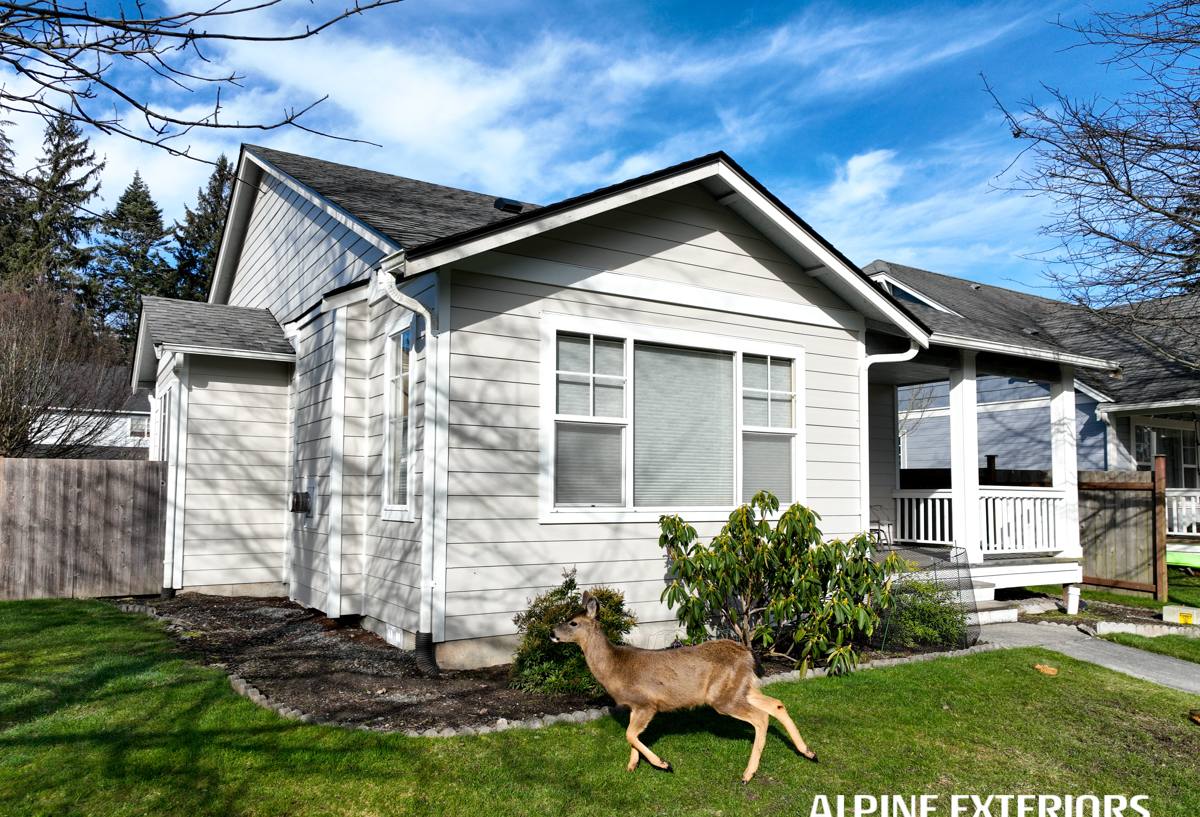
What the Bellingham Climate Does to a House
Bellingham sits close enough to the water that salt-laden air is a real factor for exterior materials, not just a coastal talking point. Combine that with the region's driving rain — wind-blown rain that hits siding at an angle instead of just falling straight down — and you get a climate that tests every seam, joint, and fastener on a building's exterior far more than a drier inland climate would.
Then there's moss. Whatcom County's long wet season, mild temperatures, and shaded lots (Sunnyland has plenty of mature tree cover) create ideal conditions for moss and algae to establish on roofs, siding, and trim for a good stretch of the year. Moss isn't just a cosmetic issue. It holds moisture against the surface it's growing on, and over time that trapped moisture is what causes real damage — rot in wood-based materials, coating breakdown, and accelerated wear on roofing.
The Three Things We're Always Designing Against
- Salt air exposure: accelerates corrosion of fasteners and metal flashing, and degrades finishes that aren't built for it
- Driving rain: pushes water into laps, seams, and penetrations that a calmer climate would never test
- Moss and organic growth: holds moisture against surfaces and shortens the effective life of anything that can't shed it
Why We Install Only James Hardie Fiber Cement Siding
We made a decision as a company to install one siding system: James Hardie fiber cement. We don't install vinyl, LP SmartSide, Cemplank, Allura, primed spruce, or cedar. That's not because those products have no merit — several of them are reasonable choices in the right application — it's because we don't want to stand behind a product whose real-world trade-offs, in this specific climate, don't hold up to the standard we want on every house we touch.
What Rules Out the Alternatives Here
Vinyl siding is affordable and low-maintenance in mild, dry climates, but it's a petroleum-based product that can warp, become brittle, or fade under sustained UV and temperature swings, and its seams and panel joints give wind-driven rain more opportunities to find a way behind the cladding. Wood-based products — cedar, primed spruce, and OSB-based composites like LP SmartSide — perform well when maintenance stays current, but in a climate with this much sustained moisture and moss pressure, that maintenance schedule is unforgiving. Miss a repaint or resealing cycle by even a year or two, and moisture gets a foothold that's expensive to reverse. Cemplank and Allura are also fiber cement, technically similar to Hardie in composition, but we standardized on one manufacturer's climate-engineered product line and factory finish system rather than mixing suppliers, because it lets us guarantee installation specs and warranty coverage without ambiguity.
Fiber cement itself — as a category — resists the specific failure modes that matter most here: it's non-combustible, it doesn't rot, and it holds its shape and finish under wet-dry cycling far better than wood or vinyl. James Hardie's HZ5 product line is specifically engineered for climates with sustained moisture exposure, which describes Whatcom County about as well as any region in the country.
What James Hardie Gets Right for This Region
| Factor | Why It Matters Here |
|---|---|
| ColorPlus factory finish | Baked-on finish resists fading and chipping better than field-applied paint, and holds up under UV and salt air exposure |
| Non-combustible core | Fiber cement doesn't burn, feed, or spread fire the way wood-based siding can |
| HZ5 climate engineering | Formulated for regions with heavy moisture exposure rather than a generic all-climate blend |
| Rot resistance | Cement-based composition doesn't provide organic material for moss and mildew to break down |
| Transferable warranty | Coverage that follows the house, which matters to buyers if the home is ever sold |
Siding Installation in Sunnyland
Correct installation matters more than product choice — a good product installed wrong will fail early no matter what the manufacturer's spec sheet promises. In a driving-rain climate, that means proper flashing at every window and door opening, correct panel overlap, fastener spacing to manufacturer spec, and a water-resistive barrier detailed so it actually drains rather than trapping moisture behind the cladding. We follow James Hardie's published installation instructions to the letter, because deviating from them is one of the most common ways a warranty claim gets denied later.
On a re-side, we also pay attention to what's underneath. Older Sunnyland homes with original siding sometimes have sheathing or framing that's taken on moisture damage over the decades, especially at grade level, around old penetrations, or under valleys where the original flashing was inadequate by today's standards. We check for that during tear-off rather than assuming it away, because installing new siding over compromised sheathing just hides a problem instead of fixing it.
Roofing, Windows, and Decks — The Rest of the Envelope
Siding is the piece most homeowners think about first, but it's one part of a system. A roof that's shedding moss-driven granule loss, windows with failed seals letting moisture into the wall cavity, or a deck with rot at the ledger board can all undermine even a perfectly installed siding job.
Roofing
Moss removal and prevention are a recurring need on shaded Whatcom County roofs. Beyond moss, we look at flashing condition around chimneys, vents, and valleys — these are the spots where driving rain most often finds a way in, and where a roof's real lifespan is usually decided.
Windows
Old or failing window seals are a common source of hidden moisture intrusion, particularly on the weather-facing sides of a house. Replacement windows done alongside a siding project let us properly integrate flashing between the window and the new siding, which is harder to do correctly after the fact.
Decks
Exterior decks in this climate take a beating from sustained wet weather. Ledger board attachment, proper flashing where the deck meets the house, and drainage away from the structure are the details that determine whether a deck lasts a decade or three.
What a Project Looks Like
Every home is different, but most exterior projects follow a similar arc: an on-site assessment where we look at the current siding, trim, flashing, and any moisture or moss issues; a written estimate that spells out scope, product lines, and colors; and a installation phase where we handle tear-off, sheathing repair if needed, and installation to manufacturer spec. We keep homeowners informed at each stage rather than disappearing until the job's done.
Questions Worth Asking Any Exterior Contractor
- Are you a licensed, insured contractor in Washington State, and can you provide proof?
- Do you follow the manufacturer's published installation instructions, and will that be documented?
- Who handles flashing and moisture barrier details — is it subcontracted or done by your own crew?
- What does the warranty actually cover, and is it transferable if the home sells?
- Can you explain, in plain terms, why you recommend a specific siding product for this house?
Why a Local Crew Matters
A contractor based in Bellingham deals with this exact weather pattern all year, not occasionally. That means we're not guessing about how a product or detail will hold up here — we're basing it on what we've already seen happen to houses a few streets over. It also means when a warranty question or a follow-up need comes up years down the road, we're still local and reachable, not a crew that came through once from out of the area.
If you're in Sunnyland and thinking about siding, roofing, windows, or a deck project, we're happy to take a look and give you a straightforward, no-pressure estimate — just fill out the form below.