 Bellingham Siding
 Exterior Work in Happy Valley's Marine Climate
Happy Valley sits close enough to Bellingham Bay and the surrounding lowlands that its homes take on the same weather pattern as the rest of the city, just with its own mix of tree cover, older housing stock, and hillside drainage patterns. That means salt-tinged marine air, long stretches of driving rain off the water, and a moss season that can run from fall through spring. None of that is unusual for Whatcom County, but it adds up differently on a house than it does on a lawn or a roofline, and it's worth understanding before you decide what goes back on the walls the next time siding, roofing, or trim needs replacing.
We work on homes throughout Bellingham, and Happy Valley's mix of established trees, mature landscaping, and a range of home ages from mid-century to newer builds means we see the full spectrum of what marine exposure does to exterior materials over time.
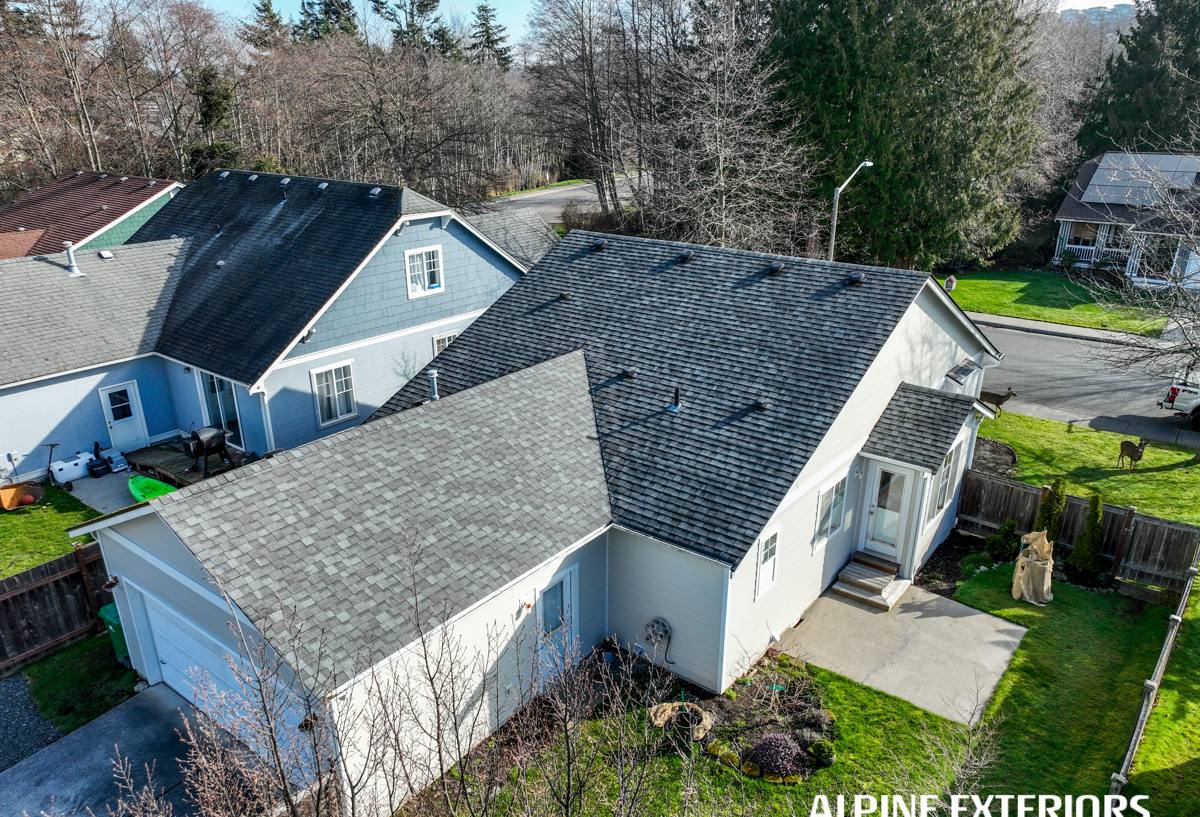
What the Climate Actually Does to a House
Salt Air and Metal Fatigue
Proximity to Puget Sound means airborne salt is a real factor here, even a few miles inland. Salt-laden moisture accelerates corrosion on exposed fasteners, flashing, and lower-grade trim hardware. Siding systems that rely on face-nailing with untreated fasteners, or trim pieces with painted-on finishes rather than factory-cured coatings, tend to show rust streaking and finish failure years before a comparable product with corrosion-resistant fasteners and a baked-on finish.
Driving Rain and Wind-Driven Moisture
Bellingham's rain rarely falls straight down. Storms moving in off the water push rain sideways against west- and south-facing walls, which means siding laps, butt joints, and window and door flashing take on a lot more stress than they would in a drier climate. Gaps that would be a minor cosmetic issue elsewhere become entry points for moisture here, and moisture that gets behind siding in a marine climate doesn't dry out quickly.
The Long Moss Season
Shade, humidity, and mild temperatures are ideal moss-growing conditions, and Whatcom County gets a long run of them. Moss holds moisture against whatever it's growing on. On a roof that means accelerated wear on shingles and moss migrating into gutters and valleys. On siding, moss and algae staining on north-facing walls and anywhere shaded by trees is a maintenance issue that some materials handle far better than others — a factory finish resists staining and can be cleaned; a bare or field-painted surface absorbs it and often needs repainting to look presentable again.
Why the Siding Material Itself Is the Real Decision
A lot of homeowners assume siding problems are about installation quality alone. Installation matters enormously, but the material underneath the paint is what determines how a wall performs over 20 or 30 years of this climate. Wood-based products — cedar, primed spruce, and engineered wood siding like LP SmartSide — depend on an intact factory or field coating to keep moisture out. Once that coating is compromised at a cut edge, a nail hole, or a joint, the wood substrate underneath can absorb water and begin to swell, delaminate, or rot from the inside, often before any problem is visible from the ground.
Vinyl siding avoids the rot question but brings its own set of trade-offs in a climate like this: it expands and contracts with temperature swings, can warp or crack under impact in colder snaps, and its color is baked into a thin material that fades over time with no way to refinish it short of full replacement. It also isn't rated for the fire resistance that fiber cement offers, which matters increasingly to insurers and to homeowners thinking about long-term risk.
This is why we made a deliberate decision as a company: we install James Hardie fiber cement siding exclusively. We don't install LP SmartSide, vinyl, Cemplank, Allura, primed spruce, or cedar. That's not a knock on every homeowner who has one of those products on their house today — many perform fine for years with regular upkeep. It's that when we looked at the moisture behavior, maintenance burden, and long-term cost of ownership across all of them in this specific climate, fiber cement built and engineered for the Pacific Northwest was the product we were willing to stand behind.
Why James Hardie, Specifically
James Hardie's fiber cement is manufactured from cement, sand, and cellulose fiber, which makes it non-combustible and dimensionally stable — it doesn't expand and contract with humidity the way wood does, and it doesn't soften or swell when it gets wet the way wood-based composites can. Hardie also builds region-specific product lines under its HardieZone system; homes here fall into the HZ5 zone, engineered for climates with significant moisture exposure, which is exactly the profile Bellingham and greater Whatcom County present.
Just as important is the ColorPlus factory finish. Instead of relying on a coat of paint applied on-site (which is only as good as the weather conditions and prep work on installation day), ColorPlus is baked on in a controlled factory process, cured in multiple coats, and backed by its own finish warranty separate from the substrate warranty. That finish resists the fading, chalking, and moss staining that hit painted wood and vinyl harder in a climate this wet and shaded.
The transferable warranty structure also matters to homeowners who may sell within the product's lifespan — a common consideration in a market like Bellingham's. A strong, transferable warranty is a real asset at resale, not just a manufacturer's promise.
Siding Is One Piece of the Exterior
Siding doesn't perform in isolation. Roofing, windows, and decking all interact with the same moisture and drainage pathways, and a weak point in any one of them can undermine the others. A few examples we see regularly:
- Roof flashing and gutter systems that don't shed water away from the wall assembly can push moisture behind siding no matter how good the siding itself is.
- Window flashing integration is one of the most common failure points on any home — siding replacement is often the best time to correct it, since the wall is already open.
- Decks attached to the house need proper ledger board flashing so runoff and standing water don't wick into the siding or sheathing behind it.
- Moss buildup on a roof in a shaded yard often signals the same conditions that will cause algae staining on adjacent siding, so it's worth addressing both together.
Because we handle siding, roofing, windows, and decks, we look at a home's exterior as one connected system rather than a series of separate trades, which matters most exactly where those systems meet.
What Correct Installation Involves
Fiber cement performs the way it's engineered to only when it's installed to the manufacturer's specifications, and this is where a lot of the difference between a siding job that lasts and one that fails early actually shows up. Key details we hold to on every job:
- Proper clearance between siding and grade, decks, roof lines, and other horizontal surfaces to prevent wicking
- Correct fastener type, spacing, and placement — under- or over-driven nails compromise both appearance and weather resistance
- A drainage plane and weather-resistant barrier installed behind the siding, not just the siding itself
- Factory-mitered or properly caulked joints at corners, window and door trim, and butt seams
- Field-touch-up paint matched to the ColorPlus finish used only where the manufacturer allows it, to preserve the factory warranty
Skipping any of these doesn't usually show up as a problem in year one. It shows up in year five or six, often as moisture damage that's more expensive to fix than it would have cost to do correctly the first time.
Cost Factors to Understand Before You Budget
Every Happy Valley home is different, so we don't quote sight-unseen prices, but these are the variables that actually move a siding project's cost:
| Factor | Why It Matters |
|---|---|
| Home size and wall complexity | More corners, gables, and dormers mean more cutting, flashing, and labor time |
| Current siding removal | Tear-off of old wood, vinyl, or a prior fiber cement job adds labor and disposal cost |
| Substrate condition | Rot or moisture damage found under old siding needs repair before new siding goes on |
| Siding profile chosen | Lap width, shingle-style panels, and board-and-batten each price differently |
| Trim and accessory scope | Full trim replacement costs more than reusing sound existing trim |
| Access and site conditions | Steep lots, mature landscaping, or tight setbacks common in older neighborhoods can add time |
Choosing a Contractor for This Kind of Work
Fiber cement is not forgiving of shortcuts, and a marine climate makes the consequences of a poor installation show up faster. A few things worth checking before you hire anyone for siding, roofing, window, or deck work in this area:
- Are they a factory-certified or manufacturer-trained installer for the specific product they're proposing?
- Will they show you the flashing and moisture-barrier details, not just the finished panel look?
- Do they carry current liability insurance and workers' compensation coverage?
- Can they explain how they'll handle window, deck, and roofline transitions, not just the flat wall areas?
- Do they stand behind both labor and product with a clear, written warranty?
- Are they familiar with Whatcom County permitting and inspection requirements for exterior work?
A local crew that works in Bellingham's climate week in and week out will recognize the early signs of moisture intrusion, rot, and moss-related wear faster than an out-of-area crew unfamiliar with how houses age here.
If you're planning siding, roofing, window, or deck work on a Happy Valley home, we're happy to take a look and talk through what we're seeing and what your options are. Reach out for a free, no-pressure estimate using the form below.