 Bellingham Siding
 Why Puget Homes Wear Differently Than You'd Expect
Puget sits close enough to Bellingham Bay that salt-laden air is a constant, low-grade factor in how exterior materials age here — even on days when nobody would call the weather dramatic. Add Whatcom County's long, wet winters and the shoulder seasons where rain seems to just hang in the air rather than fall, and you have a climate that's tough on siding in ways that don't always show up until years five, eight, or ten. Homes in this part of Bellingham aren't dealing with hurricane-force wind or desert UV. They're dealing with something slower and more persistent: moisture that never fully leaves, combined with airborne salt that accelerates corrosion and breaks down certain coatings faster than manufacturers' glossy spec sheets suggest.
We've worked on enough homes in and around Puget to know the failure patterns aren't random. They cluster on north-facing walls that never get direct sun to dry out, on lower courses of siding close to landscaping beds that stay damp, and on any seam or fastener point where water can work its way behind the cladding. Understanding those patterns is most of what separates a siding job that lasts twenty-five years from one that needs attention in year seven.
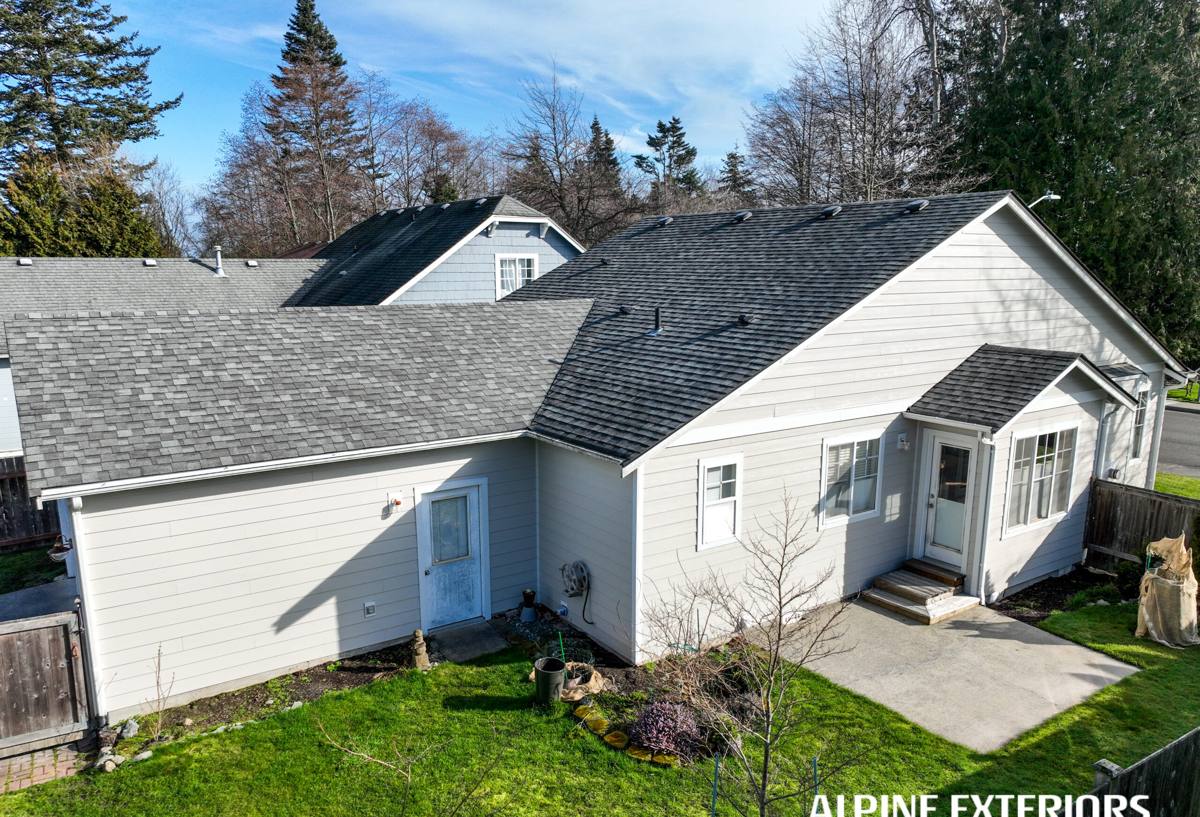
The Climate Factors That Actually Matter
Salt Air
Proximity to the bay means airborne salt particles settle on every exterior surface, including siding, fasteners, and trim. Salt is hygroscopic — it pulls moisture out of the air and holds it against whatever surface it's on. For raw or lightly treated wood products, that means more time spent damp. For metal fasteners and flashing, it means accelerated corrosion if the wrong materials were used. It's a slow process, which is exactly why it's easy to underestimate when a product is chosen based on a showroom sample rather than how it performs after a decade near the water.
Driving Rain
Rain in this part of Washington doesn't always fall straight down. Wind off the water pushes it sideways into wall assemblies, which puts real pressure on lap joints, butt seams, and anywhere siding meets a window, door, or trim board. A siding product's water-shedding design and the quality of the flashing and caulking details behind it matter more here than in drier climates where rain is occasional and usually vertical.
Moss and Sustained Dampness
Whatcom County's moss season is long — shaded, north-facing, and low-airflow areas of a house can stay damp for months at a stretch. Moss and algae don't just look bad; they hold moisture against the siding surface, and on porous or absorbent materials that sustained dampness is where rot and coating failure usually start. Siding that resists moisture absorption at the material level, not just at the paint layer, holds up dramatically better in these conditions.
Why We Install Only James Hardie Fiber Cement
We made a deliberate decision years ago to stop installing several products that are common in this region — vinyl, LP SmartSide, primed spruce and cedar, and composite alternatives like Cemplank and Allura — and to standardize on James Hardie fiber cement instead. That wasn't a marketing decision. It came out of watching how different materials actually held up on homes in wet, coastal-adjacent Pacific Northwest conditions over years, not just during the sales walk-through.
Fiber cement is non-combustible, dimensionally stable in swings of moisture and temperature, and doesn't rely on a paint film alone to keep water out — the material itself resists moisture absorption far better than wood-based or wood-composite products. James Hardie's ColorPlus finish is factory-baked rather than field-applied, which matters a great deal in a climate where field-applied paint has fewer good drying windows per year. And Hardie engineers regional product lines specifically for climates like ours, which is a level of climate-specific engineering most competing products simply don't offer.
What We're Not Saying
We're not claiming other products are junk. Vinyl is inexpensive and low-maintenance in the right setting. Cedar has real aesthetic appeal and a long history in this region. LP SmartSide and composite panel products have improved over the years. Our position is narrower and more practical: for the specific combination of salt air, driving rain, and moss-season dampness that Puget-area homes face, we've found the trade-offs on those other products — moisture sensitivity, coating maintenance, seam performance, or warranty structure — aren't ones we're willing to put our name behind. Hardie is what we choose to install because it's what we've seen perform.
How a Siding Project Works, Start to Finish
- Assessment: We walk the exterior, check current siding condition, look at trim, flashing, and any moisture-prone areas (north walls, ground-contact zones, roof-wall intersections).
- Removal and inspection: Old siding comes off and we inspect the sheathing and framing underneath for hidden rot or moisture damage before anything new goes up.
- Weather barrier and flashing: A proper water-resistive barrier and correctly lapped flashing at every window, door, and penetration go in before siding — this is the step that determines whether driving rain stays out.
- Installation: James Hardie panels or lap siding are installed to manufacturer spec, with correct fastener spacing, clearances, and caulking at joints.
- Final detailing and walkthrough: Trim, caulking, and touch-up work are finished, and we walk the job with the homeowner before calling it done.
Every step matters, but the flashing and weather-barrier work is where most long-term failures actually originate — not from the siding material itself. A crew that treats that step as an afterthought is the single biggest risk factor in any siding project, regardless of what product is going on the wall.
Why a Local Crew Matters Here
Installation quality in a climate like Whatcom County's isn't optional detail — it's the difference between siding that performs for decades and siding that fails early despite being a good product. A crew that installs primarily in drier, milder climates may not instinctively over-build the flashing details or account for driving-rain exposure the way a crew that works Bellingham and the surrounding bay-adjacent communities every week does. Local experience means knowing which walls on a typical Puget-area home need extra attention, which siding orientations stay damp longest, and how to sequence a job around a season that rarely offers long dry stretches.
It also means being reachable. If a question comes up two years after installation — a caulking joint that needs a look, a question about moss growth near the foundation line — a local company with a physical presence in the area can respond quickly, rather than a crew that installed the job and moved on to a different region entirely.
Comparing Siding Options for This Climate
| Material | Moisture Resistance | Maintenance | Fit for Salt Air / Driving Rain |
|---|---|---|---|
| James Hardie Fiber Cement | High — dimensionally stable, factory-finished | Low — occasional wash, minimal recoating | Strong; engineered product lines for wet climates |
| Vinyl | Moderate — sheds water but seams and fasteners are weak points | Low, but can crack or warp with age | Adequate; less durable long-term in coastal-adjacent wind exposure |
| Cedar / Primed Spruce | Lower — absorbs moisture, prone to rot without diligent upkeep | High — regular staining, sealing, inspection | Weakest in sustained damp, moss-prone conditions |
| LP SmartSide / Composite Panels | Moderate — engineered wood, better than raw wood but still moisture-sensitive at cut edges | Moderate — coating upkeep, edge sealing | Fair; edge and seam detailing is critical |
Cost Factors Homeowners Should Understand
Siding project costs vary based on a handful of factors that are worth understanding before you start comparing bids:
- Home size and wall complexity: More corners, gables, and dormers mean more cutting, flashing, and labor time.
- Existing condition: If sheathing needs repair after old siding comes off, that adds cost but is not optional to skip.
- Siding profile and finish: Lap siding, panel systems, and specialty trim all price differently.
- Access and site conditions: Tight lots, mature landscaping, or multi-story sections can affect labor and equipment needs.
- Flashing and weather-barrier scope: Doing this correctly, especially around windows and rooflines, takes real time and shouldn't be the line item that gets cut to save money.
Be cautious of bids that are dramatically lower than others without a clear explanation — it's often a sign that flashing detail, prep work, or material quality is being scaled back somewhere you won't see until years later.
Signs Your Current Siding Needs Attention
- Soft or spongy spots when pressed, especially near the bottom of walls or below windows
- Persistent moss or algae growth that returns quickly after cleaning
- Visible gaps, warping, or separation at seams and corners
- Paint or coating that's peeling, bubbling, or chalking heavily
- Interior signs like peeling paint or musty smell on exterior-facing walls, which can point to moisture getting through from outside
None of these on their own mean a full replacement is needed, but they're worth a professional look, especially before another wet season sets in.
Roofing, Windows, and Decks Alongside Siding
Siding rarely fails in isolation from the rest of the exterior envelope. Roof flashing that's letting water track down behind a wall, window seals that have failed, or a deck ledger board attached without proper flashing can all undermine even well-installed siding. Because we handle siding, roofing, windows, and decks, we look at the whole exterior system rather than treating siding as a standalone project — a leak at a roofline or window can show up as a siding problem years later if the root cause isn't addressed. For Puget-area homes dealing with sustained moisture exposure, that whole-envelope view matters more than it would in a drier climate where a single weak point takes longer to cause damage.
Get a Straightforward Estimate
If you're noticing wear on your home's exterior, thinking ahead to a replacement, or just want an honest read on where things stand, we're happy to take a look. There's no pressure and no obligation — just a straight assessment from a crew that works this exact climate. Use the form below to request a free estimate.