 Bellingham Siding
 New-Construction Windows Built for South Hill's Exposure
South Hill sits up on the hillside south of downtown Bellingham, which means most homes here catch more wind and weather than houses down in the flats. That elevation is part of what makes the neighborhood desirable — the views, the light, the separation from the bay-level fog — but it also means the building envelope takes a harder hit from Whatcom County's weather. Salt-laden air off Bellingham Bay, wind-driven rain that hits window walls at an angle instead of straight down, and a long wet season that keeps moss and algae established on north-facing surfaces for months at a time. New-construction windows are your one real chance to build the water management right into the wall from the start, instead of fighting it later with caulk and patchwork repairs.
"New-construction" windows are different from replacement windows in a way that matters a lot up here. They come with a nailing fin that gets integrated directly into the wall's weather-resistive barrier and flashing system, rather than being fit into an existing opening after the fact. Done correctly, that fin-and-flashing assembly is what keeps wind-driven rain out of the wall cavity for the next 30-plus years. Done poorly — or installed by a crew that doesn't understand how water actually moves on a hillside elevation — it's the single most common source of hidden rot we get called out to diagnose in this part of Bellingham.
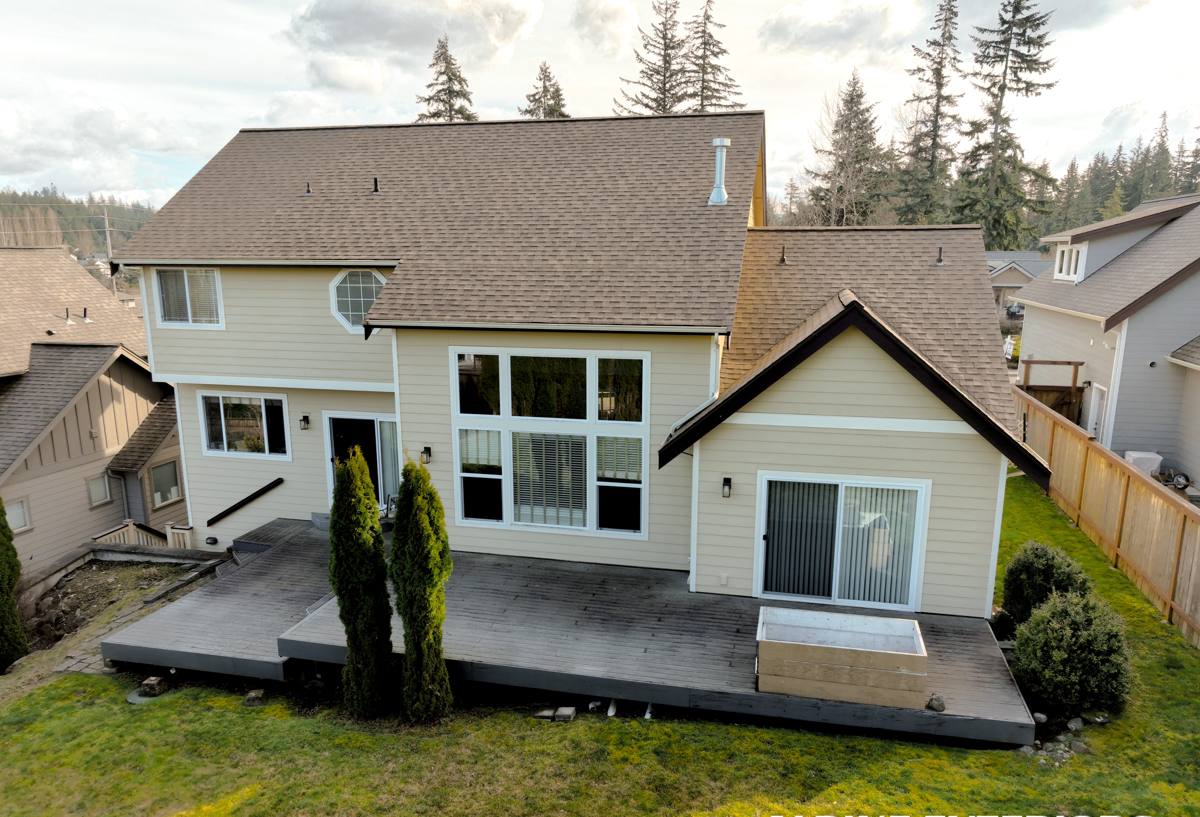
Why South Hill's Climate Changes the Job
Salt Air and Metal Components
Proximity to Bellingham Bay means airborne salt is a real factor for South Hill's higher, more exposed lots, even a couple of miles inland. Salt accelerates corrosion on window hardware, fasteners, and any exposed metal flashing. We spec corrosion-resistant fasteners and flashing metals for South Hill jobs as standard practice, not as an upsell — cheap galvanized fasteners can start showing rust streaks on light-colored siding within a few years in this environment.
Wind-Driven, Angled Rain
Elevated, open lots on South Hill often see rain that isn't falling straight down — it's being pushed sideways by wind coming off the water. That changes how much a window's sill pan, head flashing, and side-jamb integration actually need to do. A flat, minimal sill detail that would be fine on a sheltered lot in a low-lying neighborhood can let water track sideways and up under the sill on an exposed hillside wall. This is a detailing and sequencing issue, not a product issue — it comes down to how the crew builds the opening.
Moss, Algae, and Long-Term Moisture
Whatcom County's wet season runs long, and north- and east-facing walls on shaded or tree-lined South Hill lots can stay damp for weeks at a stretch. That doesn't just grow moss on your roof — it keeps window sills, trim, and cladding wetter for longer, which is exactly the condition that turns a small flashing gap into a rot problem. Material choice and drainage detailing both need to account for extended dampness, not just peak rainfall.
What a Correct New-Construction Window Installation Involves
There's a specific order of operations that keeps a new-construction window opening watertight for the life of the house. Skipping steps or doing them out of sequence is how leaks happen — often not until a few winters later, once the underlying materials have had time to fail.
- Rough opening prep — squaring, leveling, and confirming dimensions against the actual window unit before anything else happens.
- Sill pan flashing — a sloped, sealed pan at the bottom of the opening that directs any water that gets past the window itself back out to the exterior, not into the wall framing.
- Weather-resistive barrier integration — the housewrap or building paper has to be cut, lapped, and taped in the correct shingle-style sequence so water sheds down and over each layer, never up and under it.
- Window setting and fastening — plumb, level, square, and fastened per the manufacturer's schedule, which also protects the warranty.
- Flashing tape at the fin — sides first, then head flashing lapped over the top, integrated with the WRB above the window.
- Sealant at the right points only — sealing every possible gap sounds thorough, but sealing the wrong spots (like the bottom of the nailing fin) traps water in the wall instead of letting it drain out. Correct sealant placement matters as much as using sealant at all.
- Interior air sealing and insulation — closing the gap between the window frame and rough opening for both energy performance and condensation control.
Every one of those steps is inspectable while the wall is still open. Once siding goes on, you're trusting that it was done right — which is exactly why the crew's habits and attention to sequencing matter more than any single product spec sheet.
Choosing Window Products for a South Hill Home
We install a range of vinyl and fiberglass window lines depending on the home's budget, style, and performance needs. For South Hill specifically, we steer conversations toward a few practical factors:
| Factor | Why It Matters on South Hill |
|---|---|
| Frame material | Fiberglass and quality vinyl both hold up well to Whatcom County's wet climate; the bigger differentiator is dimensional stability on larger picture windows, common in view-oriented South Hill builds. |
| Glazing package | Double-pane with low-E coating is standard; homes with more west or south exposure benefit from a solar-control coating to manage glare and heat gain. |
| Hardware and fastener finish | Corrosion-resistant hardware is worth specifying given the bay's salt air, especially on higher, more exposed lots. |
| Sill and frame drainage design | Look for a sill design with a genuine drainage path, not just a flat ledge — this matters more on wind-exposed walls than on sheltered ones. |
| Warranty structure | Understand what's covered by the manufacturer versus what's covered by our installation warranty — the two are separate, and both matter. |
We don't push a single "best" brand for every home. The right product depends on the home's exposure, the homeowner's budget, and how the windows will be integrated with the rest of the exterior — siding, trim, and roofline. What we won't do is install a window system with a sill or fin design that we know performs poorly against wind-driven rain, regardless of how it's marketed. That's a professional standard, not a brand judgment.
Our Process on South Hill Jobs
New-construction window work on an occupied or nearly finished South Hill home follows a fairly consistent path from our end:
- On-site assessment — we walk the openings, check exposure by elevation, and note anything unusual about the framing or existing WRB before quoting.
- Product selection — we go over frame material, glazing, and sill design options suited to the home's specific exposure, not a one-size answer.
- Written scope and timeline — what's included, what sequence we'll follow, and how weather delays (common here) are handled.
- Flashing and WRB integration — done to manufacturer specifications, photographed at each stage before it's covered by siding.
- Final inspection and walkthrough — operation, sealing, and interior finish checked with the homeowner before we call it done.
Because South Hill has such a mix of home ages and construction styles — from older hillside builds to newer infill construction — we treat every rough opening on its own merits rather than assuming a standard detail will work everywhere.
Why Local Experience on South Hill Matters
A crew that hasn't worked this specific hillside before can still install a window correctly on paper and still get the wrong result in practice, because they're not accounting for how wind and rain actually behave on this terrain. We've worked enough South Hill and greater Bellingham homes to know which elevations need extra attention at the head flashing, which lots hold moisture longer into the spring, and where salt exposure from the bay actually starts to matter for hardware selection. That's not something you can fully substitute with a generic installation manual — it comes from having stood on enough South Hill roofs and scaffolding in a driving rain to know where the water actually goes.
It also means we're a known, findable contractor if a question comes up two or five years down the road, rather than a crew that passed through once and moved on.
Signs Your Current Windows Are Struggling With the Climate
If you're planning new construction, an addition, or replacing windows during a larger renovation, it's worth knowing what climate-related window failure looks like on a South Hill home, since it can inform how we detail the new openings:
- Dark staining or soft spots in trim below window sills
- Persistent condensation between panes (seal failure) rather than just interior condensation on cold mornings
- Paint or finish failure concentrated on one side of the house — usually the side taking the most wind-driven rain
- Musty smell or visible mold near window frames on north-facing rooms
- Moss or algae buildup on sills and trim that returns quickly after cleaning
None of these are reasons to panic, but they're useful data points about how your specific lot handles moisture — information we factor into how we detail new window openings on the same wall.
What This Means for Your Project
New-construction window installation is largely invisible once it's done — the fin, the flashing, the sill pan, and the WRB integration all disappear behind trim and siding. That's exactly why the installation quality matters more than almost any visible finish choice you'll make on the exterior. On a South Hill lot dealing with salt air, driving rain, and a long moss season, the margin for error in flashing sequence is smaller than it would be on a sheltered, low-exposure site elsewhere in Whatcom County.
If you're planning new construction, an addition with new window openings, or a full window replacement package for a South Hill home, we're happy to walk the site, talk through product options suited to your home's exposure, and give you a straightforward, no-pressure estimate. There's no cost and no obligation to get started — just fill out the form below.