 Bellingham Siding
 South Hill's Roofs Work Harder Than People Realize
South Hill sits up on the slope above downtown Bellingham, which means the homes here catch weather that flatter neighborhoods don't deal with as directly. Wind off Bellingham Bay carries salt-laden moisture inland, the tree cover on the hillside keeps parts of many roofs shaded and damp for long stretches, and the driving rain that Whatcom County sees for much of the year finds its way into any gap a roof gives it. A roof up here isn't just shedding water in a straight-down drizzle — it's dealing with wind-driven rain hitting at an angle, moss and algae growth in shaded valleys and north-facing slopes, and slow salt-air corrosion on any exposed metal. None of that is dramatic on its own, but stacked together over years, it's why roofs in this part of Bellingham tend to show their age differently than roofs in drier climates: not through one big failure, but through slow moisture intrusion, soft decking, and granule loss that nobody notices until there's a stain on a ceiling.
A new roof installation here has to be built with all of that in mind from the first layer down, not just the shingles on top.
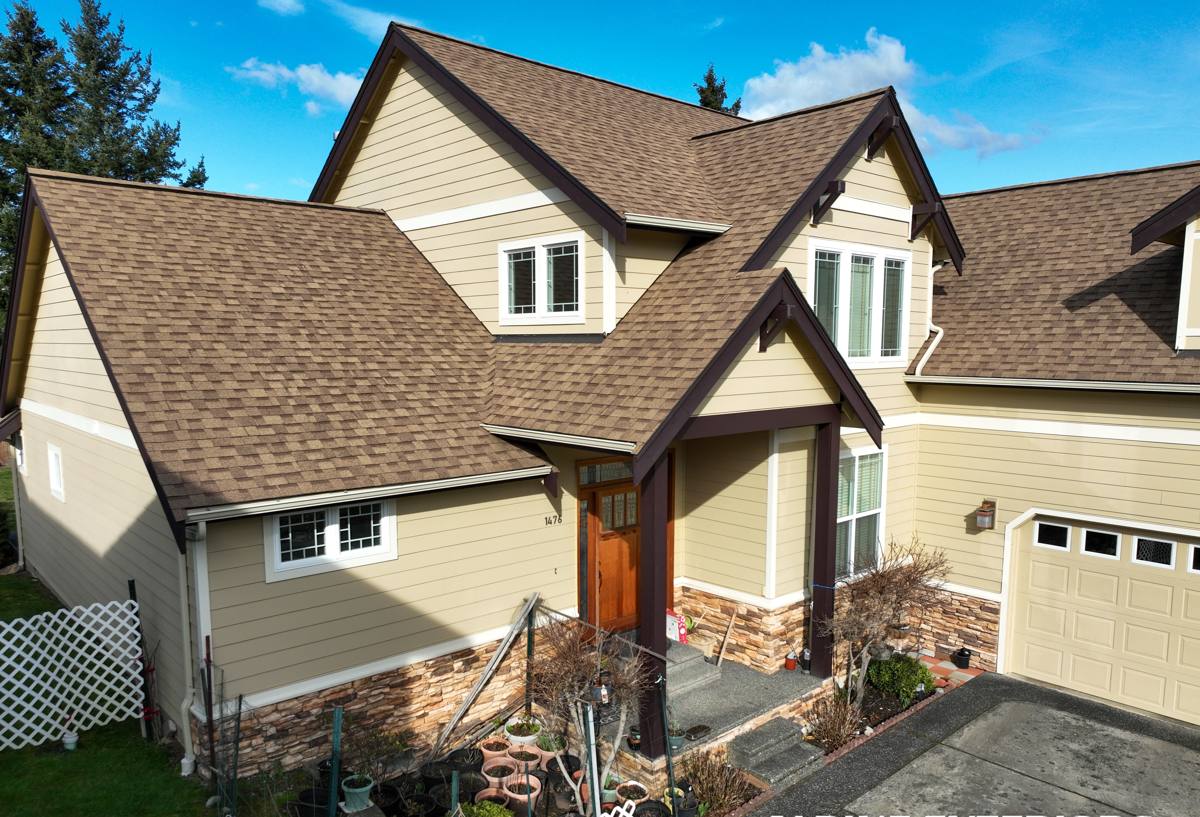
What a Correct New Roof Installation Actually Involves
"New roof" sounds simple, but the work that actually protects a South Hill home happens in layers most homeowners never see once it's done. Skipping or rushing any one of these steps is how a roof that looks fine on install day starts leaking within a few wet seasons.
Tear-Off and Deck Inspection
We remove the old roofing down to the deck rather than layering over it. That's the only way to actually see the plywood or OSB sheathing underneath, and in a climate like ours, hidden rot or soft spots around old flashing and vent penetrations are common enough that skipping this step is a real risk. Any damaged decking gets replaced before anything new goes down — installing new roofing over a compromised deck just hides a problem that will get worse.
Underlayment
This is arguably the most important layer for a house on South Hill. We use a water-resistant underlayment system, with self-adhered ice-and-water membrane at the eaves, valleys, and any low-slope transitions where wind-driven rain is most likely to be pushed backward under shingles. This is the layer that keeps the house dry even if wind gets under a shingle edge during a bad storm.
Flashing
Flashing around chimneys, skylights, vent stacks, and roof-to-wall transitions is where the majority of roof leaks actually originate — not through the shingle field itself. We install new flashing rather than reusing old, rusted, or improperly bent pieces, and we pay particular attention to step flashing at wall intersections, since that detail is frequently done wrong on older Bellingham homes.
Ventilation
A roof deck that can't breathe traps moisture from inside the house, which leads to rot from underneath — a problem that has nothing to do with rain and everything to do with attic airflow. We check and correct intake and exhaust ventilation as part of every install.
Finish Roofing Material
Whatever the finish material — architectural shingles, metal, or another system — it's installed to manufacturer specification with the correct nailing pattern, exposure, and fastener count for our wind and rain exposure, not just "close enough."
Choosing the Right Material for South Hill's Conditions
There's no single "best" roofing material — the right choice depends on the home's roof pitch, budget, and how much shade and moss exposure the roof sees. Here's how the common options compare for a home in this specific climate.
| Material | Moisture & Moss Resistance | Typical Lifespan Here | Maintenance Needs |
|---|---|---|---|
| Architectural asphalt shingles | Good with proper underlayment; algae-resistant granules help | 25–30 years | Periodic moss/debris removal |
| Standing seam metal | Excellent; sheds moisture and moss has little to grip | 40–50+ years | Low; occasional fastener/sealant check |
| Synthetic/composite shingles | Very good; resists moisture absorption | 30–40 years | Low to moderate |
| Basic 3-tab asphalt | Fair; thinner profile shows wear sooner in constant damp | 15–20 years | More frequent moss/algae maintenance |
For most South Hill homes, we recommend architectural (dimensional) asphalt shingles with algae-resistant granules as the practical middle ground — solid moisture performance and moss resistance at a reasonable cost. Metal roofing is worth strong consideration on homes with heavy tree cover or steep, hard-to-maintain roof planes, since moss has almost nothing to hold onto and the surface sheds water fast. We size these recommendations to the specific roof, not a one-size answer for the whole neighborhood.
Moss and Algae: The Slow Damage Nobody Notices Until It's Expensive
Moss on a Bellingham-area roof isn't just a cosmetic problem. As it establishes itself in shaded valleys and along north-facing slopes, moss holds moisture against the shingle surface far longer than the material was designed to tolerate, which accelerates granule loss and, over time, lets water work its way under shingle edges. Left long enough, moss growth can lift shingles and create pathways for water that a dry roof would never allow. Dark streaking from algae is a separate but related issue — it's a biological growth on the shingle surface itself, and while it's mostly cosmetic in its early stages, it's also a sign the roof surface is staying damp longer than it should.
A correctly installed new roof doesn't eliminate moss risk entirely — nothing does, on a shaded hillside lot in this climate — but it puts the odds in your favor: algae-resistant shingle granules, zinc or copper strips near the ridge where appropriate, and a roof plane free of the trapped debris and old growth that gave the previous roof trouble in the first place.
Ventilation and Moisture Control Matter as Much as the Shingles
It's easy to focus entirely on the visible roofing material and overlook what's happening underneath it, but in a climate this consistently damp, attic ventilation is doing as much work as the shingles themselves. Poor intake or exhaust airflow traps warm, moist air against the underside of the roof deck, which over time softens sheathing and can shorten the life of the roofing above it — independent of how much rain actually falls. As part of every new roof installation, we evaluate soffit intake vents, ridge or box exhaust vents, and whether the attic's insulation and airflow are working together rather than against each other. This isn't an upsell; it's a basic part of making sure the new roof actually lasts as long as the material's rated for.
Our Process, Start to Finish
- On-site evaluation — we inspect the existing roof, decking access points (like the attic if accessible), flashing details, and ventilation before quoting anything.
- Written estimate — a clear scope of work and material selection, explained in plain terms, with no pressure to decide on the spot.
- Scheduling around weather — we plan installs around forecast windows to keep the deck protected and minimize the time your home is open to the weather.
- Tear-off and deck inspection — old roofing removed, deck inspected and repaired as needed.
- Underlayment, flashing, and ventilation work — the layers that actually keep the house dry, installed before any finish material goes down.
- Finish roofing installed to spec — correct exposure, fastening, and detailing for wind and rain performance.
- Site cleanup and magnetic nail sweep — the property is cleared of debris and checked for stray fasteners before we consider the job done.
- Final walkthrough — we go over the finished roof with you before wrapping up.
Signs a South Hill Roof Needs Replacement, Not Another Repair
Not every roof problem means starting over, but there's a point where repeated repairs stop making financial sense. Some signs worth taking seriously:
- Granule loss heavy enough that shingles look bald or patchy in sunlight
- Multiple past repairs in different areas of the same roof
- Soft or spongy spots when walked on, suggesting deck damage underneath
- Persistent moss or algae growth that returns quickly after cleaning
- Daylight visible through the attic roof deck, or damp insulation below it
- Shingles curling, cracking, or lifting at the edges, especially on wind-exposed slopes
- The roof is approaching or past its material's expected lifespan for this climate
If a roof is showing two or more of these at once, a full replacement is usually the more cost-effective path — patch repairs on an aging roof tend to buy a year or two at a time, while the underlying material keeps degrading.
Why Hiring a Crew That Already Works This Neighborhood Matters
South Hill's mix of steep driveways, mature tree canopy, and older housing stock means a lot of roofs up here have quirks that a crew unfamiliar with the area might not anticipate — tricky access for equipment and material staging, roof planes shaded most of the day, or older flashing details that don't match current best practice. A crew that regularly works in this specific part of Bellingham has already worked through those logistics and knows what these roofs typically need before the tear-off even starts. That local familiarity also means we're not guessing at how a given material will actually hold up under Whatcom County's rain and moss conditions — we're basing material and detailing recommendations on what we consistently see perform well in this climate, not a generic national spec sheet.
What to Ask Before You Sign a Roofing Contract
- Is the estimate itemized, showing tear-off, materials, underlayment, flashing, and labor separately?
- Does the quote specify the underlayment type, not just the finish shingle brand?
- Will old flashing be replaced, or reused?
- Is attic ventilation being evaluated as part of the job?
- What's the manufacturer's warranty, and what's covered under workmanship separately from material defects?
- Is the contractor licensed and insured in Washington State, and can they provide proof?
- Who handles permitting with the local jurisdiction?
A contractor who answers these clearly and in writing, without hedging, is generally one worth trusting with the job.
Ready to Talk Through Your South Hill Roof?
If your roof is showing its age, or you just want an honest read on whether repair or replacement makes more sense, we're happy to take a look. The estimate is free, there's no pressure, and you'll get a clear, written breakdown of what we'd actually recommend for your home. Fill out the form below to get started.