 Bellingham Siding
 Storm Damage Roof Repair for the Puget Area
Homes in the Puget area of Bellingham take a specific kind of beating. You're close enough to the water to catch salt-laden air and wind-driven rain off the Sound, and far enough into the Pacific Northwest's wet season to spend months under low clouds and standing moisture. That combination is hard on roofs in ways that don't always show up right after a storm — sometimes the damage is obvious the next morning, and sometimes it's a slow leak that surfaces weeks later during the next heavy rain. Either way, getting it looked at and repaired correctly matters more here than it does in drier climates, because a small opening in a roof system doesn't stay small for long when it's exposed to Whatcom County's weather pattern.
This page is specifically about storm damage roof repair for homes in and around Puget — not a general roofing overview. We're covering what actually happens to roofs here, what a correct repair looks like, and how to tell a real fix from a patch job that'll fail again next season.
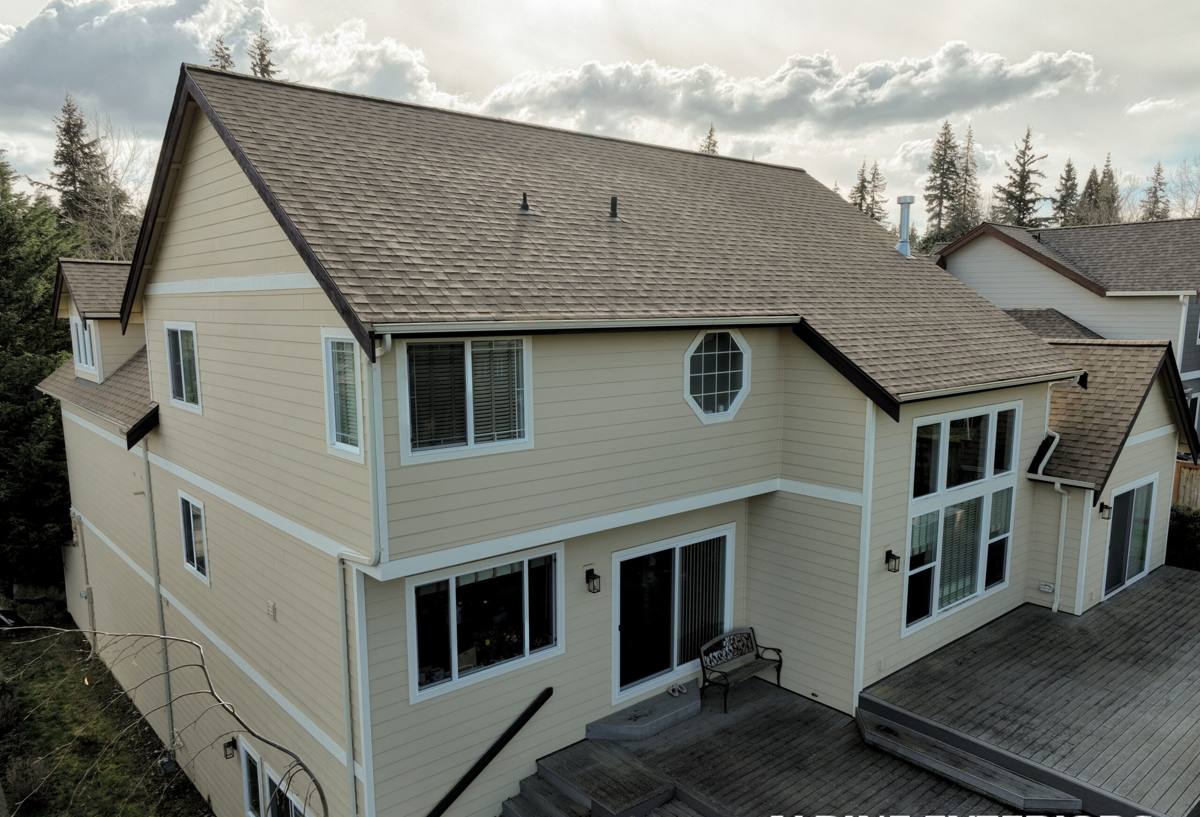
What Puget's Climate Actually Does to a Roof
Salt Air and Metal Fasteners
Proximity to the water means airborne salt settles on roofing materials over time. It's most noticeable on exposed metal — flashing, nail heads, vent caps, gutter hardware — where it accelerates corrosion. A fastener that would last decades inland can start rusting and losing grip years sooner this close to the Sound. After a storm, we always check fastener condition, not just whether shingles or panels are visibly displaced, because a corroded nail can let a shingle lift in wind well before it looks obviously damaged.
Driving Rain and Wind-Driven Water
Storms here don't just drop rain straight down — wind pushes it sideways and up under laps, flashing edges, and ridge caps that would shed water fine in a calm rain. This is why storm damage often shows up as water intrusion around penetrations (chimneys, vents, skylights) rather than as an obvious hole. A repair that only addresses the visible tear or missing shingle and ignores the flashing and underlayment underneath is a repair that's going to leak again in the next windstorm.
Moss and the Long Wet Season
Whatcom County's moss season runs long — moisture sits on roof surfaces for much of the fall through spring, and north-facing or shaded sections of a roof can stay damp for weeks at a stretch. Moss isn't just cosmetic. It holds moisture against the roofing material, works into laps and seams, and can lift shingle edges over time, which creates entry points for wind and rain during a storm. A storm-damaged roof with existing moss growth is at higher risk of underlying rot because the deck and underlayment have likely already been dealing with trapped moisture before the storm ever hit.
Signs Your Roof Took Storm Damage
- Missing, cracked, or curled shingles, especially on the side of the roof that faces prevailing wind
- Granules collecting in gutters or at downspout outlets after a storm
- Bent, lifted, or missing flashing around chimneys, vents, and skylights
- Water stains on interior ceilings or walls that appeared after a storm event
- Sagging or soft-feeling spots on the roof deck
- Debris punctures from wind-blown branches or gravel
- Gutters pulled loose or downspouts disconnected from wind load
- Visible daylight through the attic where there shouldn't be any
Some of these are easy to spot from the ground. Others — soft decking, lifted flashing, early-stage leaks — need someone up on the roof or in the attic to catch before they turn into a bigger repair.
What a Correct Storm Damage Repair Involves
A proper repair isn't just replacing what's visibly missing. It's a sequence, and skipping steps is how homeowners end up paying for the same repair twice.
1. Full Roof Assessment, Not Just the Damaged Area
We look at the whole roof, not just the spot that's obviously torn up. Storm damage often has a companion problem nearby — a lifted shingle three feet from the missing one, flashing that's been slowly working loose. If we only fix what's easy to see, we're leaving the next leak in place.
2. Deck Inspection Where Water Got In
If water made it past the roofing material, the deck underneath needs to be checked for softness or rot before anything gets reinstalled. Covering a damaged deck with new shingles is a short-term fix that fails within a season or two.
3. Flashing and Underlayment Repair, Not Just Surface Material
Given how much of Puget's storm damage involves wind-driven rain finding its way under laps and around penetrations, flashing and underlayment condition get as much attention as the shingles or panels themselves.
4. Matching Materials Correctly
Repairs should match the existing roofing material in type, profile, and as close to color/age as reasonably possible. A patch that doesn't match the surrounding material not only looks wrong, it can behave differently under thermal movement and wind load, which creates new weak points.
5. Moss and Debris Clearing as Part of the Job
Since moss and organic debris are part of what compromises roofs here, a real repair includes clearing growth and debris from the work area and checking whether the surrounding roof needs treatment to prevent the same damage pattern from recurring.
Our Process for Puget Storm Repairs
- Inspection. We assess the full roof, attic access where possible, and document what the storm actually did versus pre-existing wear.
- Written scope and honest pricing. You get a clear explanation of what needs to be fixed, why, and what it costs — no pressure to upgrade beyond what the storm damage actually requires.
- Insurance documentation, if applicable. If you're filing a claim, we document the damage in a way that's useful for your adjuster.
- Repair. Deck, flashing, underlayment, and roofing material addressed in that order — not just a surface patch.
- Final check. We walk the completed repair and confirm it's sound before we consider the job done.
Cost Factors for Storm Damage Repair
Every storm repair is different, but the price generally comes down to a handful of factors. Here's what tends to move the number up or down:
| Factor | Lower Cost | Higher Cost |
|---|---|---|
| Extent of damage | Isolated shingle or flashing repair | Multiple areas or whole-section replacement |
| Deck condition | Deck is sound underneath | Deck rot requires sheathing replacement |
| Roof access | Simple, low-slope, easy access | Steep pitch, multiple stories, obstructed access |
| Material match | Common material still available | Discontinued or specialty material needing sourcing |
| Moss/debris condition | Minimal buildup | Heavy moss requiring clearing and treatment |
We won't quote a number without seeing the roof first — but we will give you a straight answer about which of these factors apply to your situation and why, so the estimate makes sense.
Why Local Experience Matters for This Repair
A crew that regularly works roofs in the Puget area already knows what to look for beyond the obvious damage: which flashing details tend to fail first in wind off the Sound, how far moss has typically progressed on a roof of a given age in this specific microclimate, and which material choices hold up versus which ones create maintenance headaches near salt air. That local pattern recognition is the difference between a repair that addresses the storm and a repair that addresses the storm plus the three things that were quietly about to become the next problem.
It also matters for timing. Storm damage that sits exposed during Bellingham's wet season gets worse fast — a small opening can let in enough water over a few weeks of rain to compromise decking that would otherwise have been fine. A crew that's local and responsive can get eyes on the damage and a tarp up quickly if needed, rather than leaving your roof exposed while you wait.
Insurance and Storm Claims
Many storm damage repairs are covered under homeowners insurance, depending on your policy and the cause of damage. We're glad to document the damage thoroughly and explain what we're seeing in terms that are useful for a claim, but the decision to file, and communication with your insurance company, is between you and your carrier. We keep our documentation and our repair scope honest either way — we're not going to inflate a scope to match a claim budget, and we're not going to under-scope a repair to keep a bill low if it means the roof isn't actually fixed.
If your roof took a hit in a recent storm, or you're not sure whether what you're seeing is storm damage or ongoing wear from moss and moisture, we're happy to come take a look. The estimate is free, there's no pressure, and you'll get a straight answer about what actually needs fixing. Use the form below to get started.