 Bellingham Siding
 Building Decks That Hold Up in Blaine's Marine Climate
Blaine sits right on the water at the northern edge of Whatcom County, and that location shapes everything about how a deck should be built here. Salt air off the Strait of Georgia and Semiahmoo Bay accelerates corrosion on fasteners and hardware. Driving rain off the water finds every gap in flashing and end-grain that a less exposed deck might never see. And the long, wet moss season that runs from fall through spring turns any deck surface that doesn't shed water and light properly into a slick, green problem by February. A deck built to a generic spec sheet, without those conditions in mind, tends to show its age fast in Blaine. One built correctly for this specific environment doesn't.
We work on homes throughout Bellingham and Whatcom County, and Blaine's coastal exposure is its own animal compared to inland jobs. This page covers what that actually means for materials, structure, and process when we build a custom deck for a Blaine home.
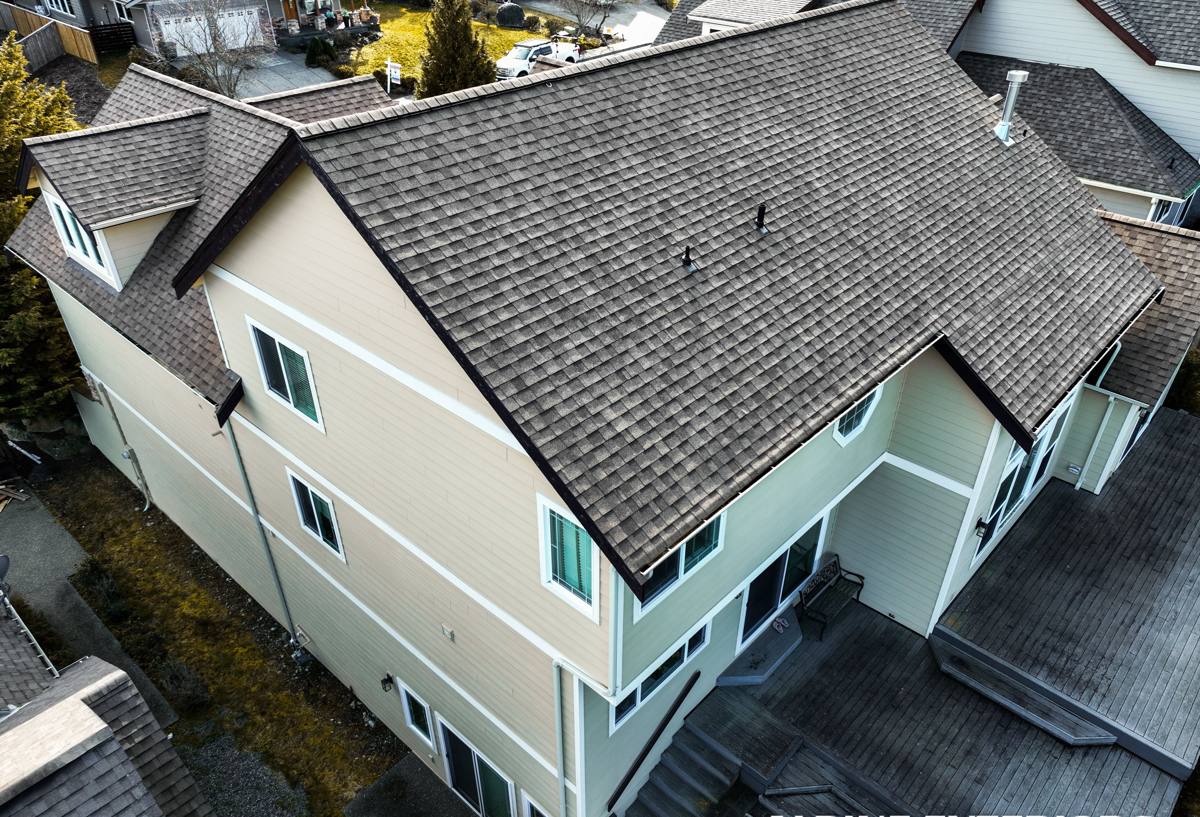
What Blaine's Climate Does to an Ordinary Deck
Salt Air and Hardware
Fasteners, brackets, and structural connectors that aren't rated for coastal exposure corrode faster near the water. That corrosion is often invisible until a board starts to feel loose or a ledger connection weakens. On a deck this close to the shoreline, hardware selection isn't a cosmetic choice — it's a structural one.
Driving Rain and Moisture Intrusion
Wind-driven rain off the water doesn't fall straight down; it gets pushed sideways into ledger boards, post bases, and any point where the deck attaches to the house. If flashing and water management aren't detailed correctly at that connection, water works its way behind siding and into framing over time, often without any visible sign until rot has already set in.
Moss, Algae, and Surface Traction
Whatcom County's wet season is long, and Blaine's proximity to the water keeps humidity and moisture on deck surfaces even longer than you'd see a few miles inland. Decking that stays damp and shaded grows moss and algae, which is both a maintenance headache and a real slip hazard on stairs and walking surfaces.
Decking Material Options for a Blaine Property
There's no single "best" decking material — the right choice depends on how much upkeep you want to do, your budget, and how much sun or shade the deck gets. Here's how the common options actually perform in this climate.
| Material | Moisture Performance | Maintenance | Typical Lifespan |
|---|---|---|---|
| Pressure-treated wood | Good if sealed regularly; end cuts need re-treatment | Annual cleaning and re-sealing recommended | 15-20 years with upkeep |
| Cedar | Naturally rot-resistant but still needs sealing near salt air | Sealing every 1-2 years | 15-25 years with upkeep |
| Composite decking | Excellent — doesn't absorb water or rot | Occasional washing, no sealing | 25-30+ years, manufacturer-warrantied |
| PVC/cellular decking | Excellent — fully synthetic, no organic material to feed moss | Lowest — soap and water | 25-30+ years, manufacturer-warrantied |
In a shaded, moisture-heavy Blaine yard, composite and PVC decking hold a real advantage: they don't give moss and algae the organic surface they need to take hold the way untreated wood does. Wood decking can still be the right call for homeowners who want that specific look and are willing to keep up with sealing — we'll walk through that trade-off honestly rather than push one product over another.
Why We're Selective About Certain Composite Products
Not every composite board on the market is built the same way. Some early-generation composite products used a capping process or core material that was more prone to moisture absorption at cut ends and fastener penetrations, which matters a lot in a climate this wet. We favor manufacturers with fully-capped boards, solid warranty backing, and a track record in Pacific Northwest coastal conditions specifically — not just decking rated for "outdoor use" in general. If a product has a maintenance burden or moisture behavior that doesn't hold up here, we'll say so plainly rather than install it and let you find out.
Framing and Structure: Where the Real Work Happens
The decking surface is what you see, but the framing underneath is what determines whether the deck is still solid in fifteen years. For Blaine homes, we pay particular attention to a few structural details that matter more here than in a drier, inland setting.
Ledger Attachment and Flashing
Where the deck attaches to the house is the single most common source of long-term water damage on any deck, and it's the point most exposed to driving rain off the water in Blaine. Proper flashing — installed so water is directed away from the house structure, not trapped against it — is non-negotiable on every ledger connection we build.
Post Bases and Footings
Posts that sit directly on or in concrete without a proper standoff base wick moisture up into the wood grain, which is a slow but steady path to rot in a climate that rarely gives wood a chance to fully dry out. We use elevated post bases that keep wood off wet concrete and allow drainage and airflow underneath.
Fastener and Hardware Grade
Given the salt air exposure this close to the water, we use corrosion-resistant, coastal-rated fasteners and structural hardware rather than standard-grade connectors. It costs a little more upfront and it's the difference between hardware that's still sound at year twenty and hardware that's failing at year eight.
Design Considerations Specific to This Location
- Water shedding on the deck surface itself: proper board spacing and a slight slope away from the house keep water moving instead of pooling, which limits how much moss and algae get a foothold.
- Railing hardware: like structural fasteners, railing brackets and cable or baluster hardware should be coastal-rated to avoid streaking and corrosion near salt air.
- Stair tread traction: in a climate where moss and damp surfaces are a near year-round concern, we look at grooved or textured surface options for stairs specifically, since that's where a slip actually matters most.
- Sun and shade patterns: a deck tucked under mature trees or on the north side of a home stays wetter longer; we factor that into both material choice and how much airflow the structure gets underneath.
Our Process for a Custom Deck Build
- On-site assessment: we look at your home's exposure to wind and water, existing structure if there's a deck to replace, and how the space will actually be used.
- Design and material selection: we walk through decking, railing, and structural options with honest trade-offs on cost, maintenance, and longevity for your specific site conditions.
- Permitting: most deck projects in Whatcom County require a permit depending on size, height, and attachment to the home — we handle that process as part of the job.
- Structural build: footings, framing, ledger flashing, and post bases are built to hold up under this region's moisture load, not just to code minimums.
- Surface and finish work: decking, railing, stairs, and any trim or lighting details are installed and finished.
- Final walkthrough: we go over the finished deck with you, including what maintenance (if any) the material you chose actually needs going forward.
What to Check Before Hiring Any Deck Contractor in Blaine
- Do they carry current Washington contractor licensing and adequate liability insurance?
- Will they pull the required permit rather than suggesting you skip it?
- Can they explain, specifically, how they'll flash the ledger connection to the house?
- Do they use coastal-rated or corrosion-resistant hardware as standard practice, not an upcharge?
- Have they built decks in Blaine or similarly exposed waterfront areas before, not just inland Bellingham?
- Do they give you a written estimate with material specifics, not just a total number?
A crew that already works in Blaine and along the water knows these details aren't optional extras — they're what separates a deck that lasts from one that needs major repairs inside a decade. That experience shows up in the small decisions made before a single board goes down.
Maintenance Realities by Material Choice
Whatever material you choose, a Blaine deck benefits from a simple annual check: clearing debris and standing moisture from between boards before it sits through the wet season, and checking railing and stair hardware for early signs of corrosion. Wood decking needs that plus periodic sealing; composite and PVC decking mostly need occasional washing to keep surfaces from getting slick. We'll go over exactly what your chosen material needs at the end of the project so there are no surprises.
Get a Straightforward Estimate
If you're planning a new deck or replacing one that's showing its age, we're happy to come take a look and walk through your options honestly — what materials make sense for your spot, what the structure actually needs, and a clear estimate with no pressure to decide on the spot. Use the form below to request a free estimate for your Blaine property.