 Bellingham Siding
 James Hardie Siding, Sized to What a Blaine Home Actually Faces
Blaine sits right at the water's edge at the northern tip of Whatcom County, and that location changes what a siding job needs to accomplish there compared to a house twenty minutes south in Bellingham. It's not that Blaine is a different climate zone on paper — it's that the same regional weather arrives with more force this close to open water. Salt-laden air is a daily condition rather than an occasional one, storms come ashore with more wind behind them, and the moss and mildew season runs longer on shaded, moisture-holding walls. Any siding installed on a Blaine home is signing up for a harder version of the test every Whatcom County exterior faces.
This page isn't a general introduction to siding, and it isn't a general introduction to Blaine. It's specifically about what James Hardie fiber cement siding needs to do on a Blaine property, what a correct installation looks like given that exposure, and how we run a Hardie project for homeowners in this part of the county. We're based in Bellingham and work Blaine regularly, not as an occasional detour between bigger jobs elsewhere.
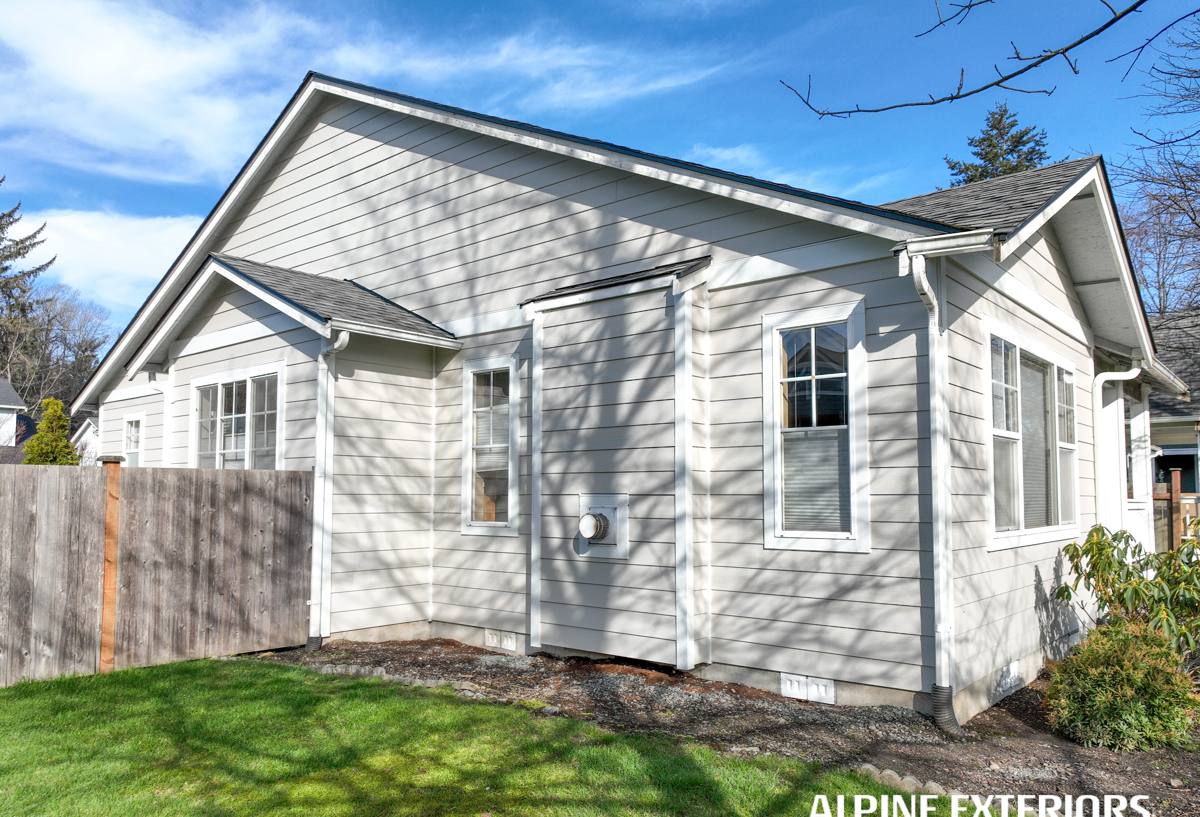
What Blaine's Exposure Actually Asks of a Siding System
Salt Air Off the Water
Salt-laden air accelerates corrosion in exposed fasteners, flashing, and trim hardware, and it breaks down lower-grade coatings faster than the same product would wear in a drier, inland market. Homes closer to the water take the steadier dose, but Blaine's compact size means very few properties in town are truly sheltered from it. That matters most at the details — the fastener, the cut edge, the joint — long before it matters at the surface of the siding itself.
Wind-Driven Rain
Storm systems moving in off the water rarely drop rain straight down on Blaine. Wind pushes it sideways, into lap joints, under trim, and into any seam where the water-management detailing behind the siding isn't right. A siding material can be excellent and still let water in if the flashing and joint work behind it wasn't built for rain that's coming in at an angle rather than falling.
A Moss Season That Runs Most of the Year
Mild temperatures and near-constant moisture mean moss and mildew stay active on shaded or north-facing walls for most of the calendar, not just the wettest months. Organic growth on a siding surface holds moisture against the wall behind it, and that trapped-moisture effect is where a lot of long-term siding failures actually start, regardless of what material is on the wall.
Why James Hardie Fiber Cement Is the Right Match
James Hardie siding is fiber cement — a cured blend of Portland cement, sand, and cellulose fiber. It's inorganic, so it doesn't have a wood-based or foam core that can absorb water and swell, rot, or feed pests the way organic siding materials can, and it's non-combustible. Those two properties matter anywhere, but they matter more on a property that's dealing with sustained moisture exposure as a baseline condition rather than an occasional storm.
The HZ5 Engineering
Hardie engineers its siding for different climate zones, and the HZ5 line is built for regions with sustained moisture exposure and freeze-thaw cycling — a closer match for Blaine's winters than a product line engineered primarily for hot, dry climates. That's a concrete, climate-specific reason we standardized on this manufacturer rather than treating fiber cement as one interchangeable category.
What We Don't Install, and Why
We don't install vinyl, LP SmartSide or other engineered wood siding, Cemplank, Allura, primed spruce, or cedar. Each has legitimate uses elsewhere. Our position is specific to this stretch of coastline: vinyl's lapped seams and heat sensitivity, engineered wood's dependence on an intact factory coating at every cut edge, and painted wood's ongoing maintenance schedule all ask a homeowner to manage more long-term risk than we're willing to install and stand behind on a property facing Blaine's exposure.
The James Hardie Product Lines That Fit a Blaine Home
James Hardie makes several distinct siding profiles, and picking the right one is as much a performance decision as a style decision.
| Product | What It Is | Where It Fits on a Blaine Home |
|---|---|---|
| HardiePlank lap siding | Horizontal overlapping boards, the most common fiber cement profile | Traditional look; performs well across most Blaine exposures when lap and clearance specs are followed exactly |
| HardiePanel vertical siding | Large-format vertical panels, often paired with battens | Fewer horizontal joints for water to work into; a common choice for garages, gables, and modern designs |
| Board and batten | Vertical boards with battens covering the seams | Strong water-shedding profile for the more exposed, wind-facing walls on a waterfront or near-waterfront lot |
| HardieTrim boards | Fiber cement trim for corners, window and door casing, fascia | Keeps the whole exterior in one non-combustible, moisture-stable material rather than mixing in painted wood trim |
On most Blaine jobs we walk through two or three of these options with the homeowner, because the right profile depends on how exposed a given wall is, not just on overall style preference. A wall facing open water can reasonably call for a different profile than the landward side of the same house.
ColorPlus Finish and Choosing a Color for This Exposure
Instead of a field-applied paint job, Hardie's ColorPlus technology bakes the finish onto the board in a controlled factory process, in multiple coats, before it ever reaches Blaine. That finish is backed by its own warranty, separate from the substrate warranty, and it's built to resist fading and hold color consistency under sustained UV and salt-air exposure better than a site-painted finish typically does. For a Blaine home, that factory-cured coating is doing real work every day, not just at installation.
Color choice has a practical side here too. Darker colors absorb more heat and can show dust and salt residue differently than lighter tones, and matte versus low-sheen finishes wear differently under direct water-facing sun exposure. We walk homeowners through actual ColorPlus samples on-site rather than a screen, because coastal light changes how a color reads compared to how it looks in a showroom photo.
What Correct Installation Involves on an Exposed Blaine Lot
Fiber cement's real-world performance depends heavily on installation quality, and that's especially true on a property taking direct wind and salt exposure. A rushed or out-of-spec install can undercut even the right product choice.
- Manufacturer-specified clearances at grade, roofline, and deck connections, to keep splash-back and standing moisture off the board edge
- A drainage plane or rain screen behind the siding, so any moisture that does get past the surface can drain and dry instead of sitting against the wall
- Correct fastener type, spacing, and depth — undersized or misplaced fasteners are one of the more common causes of early cracking
- Flashing detailed at every window, door, and penetration to direct wind-driven rain away from seams rather than trapping it
- Factory-cut edges used wherever the layout allows, with every field cut sealed per Hardie's published spec
- Extra attention to the most exposed elevations, where wind-driven rain and salt load are highest on the property
This is also why manufacturer certification matters, not just general siding experience. A crew used to installing siding in a calmer, more inland market can still make choices that hold up fine there and fall short on a Blaine property facing open water.
How a Hardie Project Runs, Start to Finish
Inspection and Estimate
We start by walking the property and looking at the current siding condition, any signs of trapped moisture or sheathing damage behind it, and how exposure varies wall by wall. A water-facing elevation and a sheltered, landward elevation on the same house often need different detailing, and that assessment shapes the estimate rather than a flat per-square-foot number.
Product and Profile Selection
We go through the relevant HardiePlank, HardiePanel, and trim options together, matched to the home's style and to each wall's actual exposure, and review ColorPlus samples on-site.
Installation
Our crews follow Hardie's published installation specifications on clearances, fastening, flashing, and drainage detail, with particular attention to the wind- and water-facing sides of the house.
Final Walkthrough
We walk the finished job with the homeowner, cover basic care and what to watch for over the first few seasons, and go over warranty registration.
Warranty and What It's Actually Worth Here
James Hardie backs its siding with a transferable, non-prorated limited warranty on the substrate, plus a separate finish warranty covering ColorPlus color retention. Transferability is worth taking seriously in a market like this: if the home sells before the warranty period ends, that coverage generally moves to the next owner, which matters to buyers who are increasingly asking pointed questions about exterior condition on coastal Whatcom County properties. That warranty depends on installation following Hardie's spec, which is another reason certification and correct field practice aren't optional extras.
If you're weighing a re-side or new siding install on a Blaine property, we're glad to walk the house, look at what's on the walls now, and give you a straight answer about what we'd recommend and why. Reach out using the form below for a free, no-pressure estimate.