 Bellingham Siding
 Siding Installation in Fairhaven: Built for Bellingham Bay, Not Just Bellingham
Fairhaven sits closer to the water than most of the rest of Bellingham, and that changes what a siding job actually needs to hold up. A house a mile inland deals with Whatcom County's wet winters and gray shoulder seasons like everywhere else in the region. A house near Bellingham Bay deals with all of that plus salt-laden air rolling off the water, wind-driven rain that hits walls sideways instead of falling straight down, and shaded, moisture-holding conditions that keep moss and mildew active for most of the year. None of that is dramatic on its own. It's the slow, cumulative kind of wear that shows up five or ten years later as failed caulk joints, swollen trim, corroded fasteners, or siding that never quite dries out between storms.
We install siding across Bellingham and Whatcom County, but Fairhaven jobs get planned with the water in mind from the first estimate. That means paying close attention to the product itself, the fasteners and flashing behind it, and the detailing at every seam, corner, and penetration — the parts of the job nobody sees once it's finished but that determine whether the siding is still doing its job in twenty years.
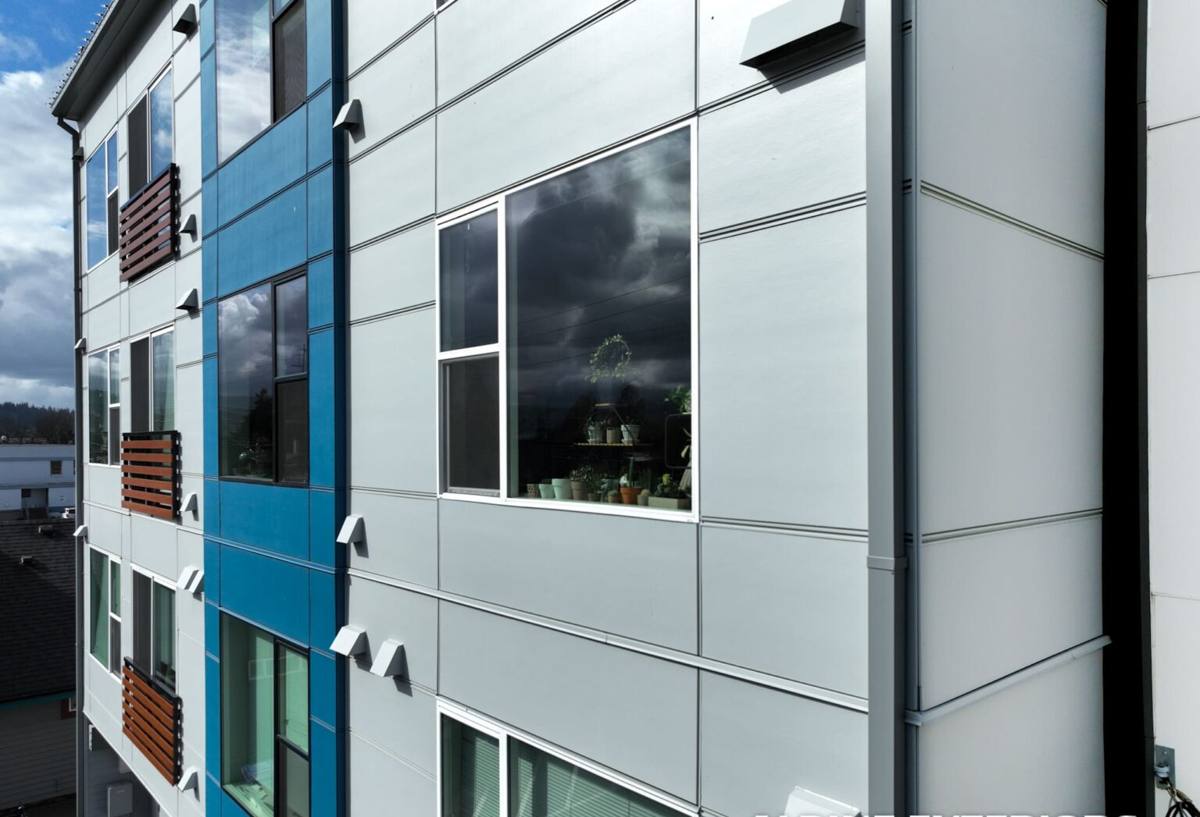
What Bellingham Bay's Climate Does to Siding Over Time
Salt Air and Corrosion
Homes closer to the water are exposed to airborne salt that settles on exterior surfaces and accelerates corrosion of exposed metal — fasteners, flashing, hardware, and trim accents. Standard fasteners or under-spec flashing can start showing rust streaks and pitting well before they would inland. This is why fastener selection and flashing material matter more here than they do a few miles away from the bay.
Driving Rain and Wind-Driven Moisture
Bellingham gets a lot of rain in a normal year, but Fairhaven's exposure to wind off the water means that rain often arrives sideways rather than straight down. Wind-driven rain finds weak points that vertical rain never reaches — under-lapped seams, poorly sealed penetrations, and butt joints that weren't given enough attention. A siding system that only handles vertical rainfall well isn't enough for a home in this location.
Moss, Mildew, and Extended Shade
Mature trees and the general cloud cover of a Pacific Northwest winter keep a lot of Fairhaven's housing stock in shade for long stretches, and shaded, damp surfaces are exactly where moss and mildew take hold. On some siding materials that's mostly cosmetic; on others, prolonged moisture retention against the surface can lead to swelling, delamination, or rot underneath the finish.
Why We Only Install James Hardie Fiber Cement Siding Here
We made a standard decision as a company: we install James Hardie fiber cement siding, and we don't install vinyl, LP SmartSide, Cemplank, Allura, or unfinished cedar or spruce. That's not a marketing position — it's a practical one, built around what actually performs in Whatcom County's climate and specifically in a location like Fairhaven where salt air and driving rain are part of daily exposure.
Fiber cement is made from cement, sand, and cellulose fiber, which means it doesn't absorb and swell with moisture the way wood-based products can, and it doesn't soften, warp, or become brittle the way some plastic-based products can under UV and temperature swings. James Hardie's HZ product lines are engineered for specific climate zones, including the wetter, milder conditions common to the Pacific Northwest, which matters directly for a coastal Bellingham neighborhood. The factory-applied ColorPlus finish is baked on under controlled conditions rather than field-applied, which gives it more consistent adhesion and weathering resistance than a coat of paint applied on site — a real advantage in a location where the finish is fighting salt air and UV reflection off the water for its entire life. Fiber cement is also non-combustible, which matters increasingly for insurance conversations and wildfire-adjacent building codes, even in a wet coastal climate.
None of this means other products are junk. It means that when we weighed maintenance burden, moisture behavior, installation sensitivity, and long-term warranty support against what a marine-influenced climate does to a wall over 20-plus years, fiber cement was the product we were willing to put our name behind — and the only one we install.
What a Correct Siding Installation Actually Involves
The siding itself is only part of the system. Most siding failures we get called to inspect trace back to what's behind or beneath the visible surface, not the panel or plank itself. A correct installation in a location like Fairhaven means getting every layer right:
- A continuous, properly lapped water-resistive barrier behind the siding, with no gaps at seams or fastener penetrations
- Correct flashing at every window, door, roofline, and deck ledger — sized and lapped to shed water downward and outward, not into the wall assembly
- Corrosion-resistant fasteners appropriate for a coastal-influenced environment, driven to the manufacturer's specified depth and pattern
- Proper clearances between siding and grade, decks, roofs, and other horizontal surfaces so water has somewhere to go instead of wicking upward
- Manufacturer-specified gaps and sealant at butt joints and trim intersections, using sealants rated for the exposure
- Ventilation behind the cladding where the assembly calls for it, so moisture that does get in can dry out instead of sitting against the wall
Skipping or rushing any one of these doesn't usually cause an immediate problem. It shows up years later as a soft spot near a window, a stain below a butt joint, or paint that keeps failing in the same spot no matter how many times it's repainted.
How Common Siding Materials Compare in a Bellingham Bay Environment
| Material | Salt Air / Moisture Resistance | Maintenance | Typical Lifespan | Fire Resistance |
|---|---|---|---|---|
| Vinyl | Doesn't absorb moisture, but seams and fasteners are vulnerable; can warp or become brittle over time | Low, but color fades and can't be repainted easily | 15-25 years | Combustible; can soften or melt near heat sources |
| Cedar / Untreated Wood | Absorbs moisture readily; prone to rot, cupping, and moss growth in shaded, damp conditions | High — regular refinishing, caulking, and moisture checks | Varies widely with upkeep; often 15-30 years | Combustible |
| LP SmartSide (OSB-based) | Engineered wood strand product; performance depends heavily on correct sealing and prompt repair of any damage | Moderate to high — edges and cut ends need ongoing attention | Manufacturer-rated, but moisture intrusion is the primary failure mode | Combustible |
| James Hardie Fiber Cement | Doesn't swell, rot, or support moss growth the way wood-based products can; factory finish resists salt and UV wear | Low — periodic washing and caulk checks | Manufacturer warranty-backed, commonly decades with correct install | Non-combustible |
Our Process, Estimate Through Finished Wall
Every Fairhaven job starts with a walk-around of the exterior, not just a measurement. We're looking at sun and shade exposure, proximity to the water and prevailing wind direction, existing moisture damage, deck and roof intersections, and the condition of the trim and window flashing underneath the current siding. That inspection shapes the actual scope of work — sometimes it's a straight re-side, and sometimes it means addressing sheathing damage or flashing problems we find once the old siding comes off.
From there, the process is straightforward: remove the existing siding and inspect the wall assembly, repair or replace any damaged sheathing, install a continuous water-resistive barrier and correct flashing at every penetration, install the James Hardie panels or planks to manufacturer spec with the correct fasteners and clearances, and finish with trim, caulking, and a final walk-through so you know exactly what was done and why.
What Affects the Cost of a Fairhaven Siding Project
Every home is different, but a few factors consistently move the price on siding jobs in this neighborhood:
- Condition of the existing wall assembly — hidden moisture damage or rot found after tear-off adds repair scope
- Home size, wall complexity, and story count — more corners, gables, and dormers mean more cutting, flashing, and labor
- Product selection within the Hardie line — plank profile, panel style, and factory color all affect material cost
- Access and site conditions — tight lots, retaining walls, and limited staging space common in older neighborhoods can slow the work
- Trim, soffit, and fascia scope — replacing or upgrading trim alongside the siding is often more efficient than doing it separately later
We give a written, itemized estimate before any work starts, so you know what's driving the cost rather than getting a single lump number.
Why Hiring a Crew That Already Works in Fairhaven Matters
Fairhaven has its own mix of older and newer homes, tighter lots in places, and a building stock that's seen decades of Pacific Northwest weather. A crew that regularly works this neighborhood already knows what to expect when the old siding comes off — where flashing tends to have been skipped in older construction, how the wind off the bay behaves against different wall orientations, and what kind of prep a given house is likely to need before the first piece of new siding goes up. That familiarity translates into fewer surprises mid-project and a more accurate estimate up front, instead of change orders once the wall is opened up.
Local experience also matters for something less visible: knowing which details actually matter for this specific stretch of coastline versus which ones are standard anywhere in Whatcom County. Not every home needs every upgrade, but every home near the water needs the moisture and corrosion details done right, and that's easier to get consistently correct when it's a crew's regular working environment rather than an occasional job.
Get a Straightforward Estimate
If your Fairhaven home's siding is past its best years, or you're planning ahead before the next wet season takes another toll, we're happy to take a look and give you a clear, no-pressure estimate. Use the form below to get started — there's no obligation, and you'll get a straight answer about what your home actually needs.