 Bellingham Siding
 Why Puget Roofs Wear Differently Than Roofs Inland
Ask any roofer who's worked both sides of the Cascades and they'll tell you the same thing: a roof in Puget doesn't fail the way a roof in Spokane or Yakima fails. Out here, the enemy isn't hail or blistering UV — it's water that never really stops, salt-laden air rolling in off the water, and moss that treats a north-facing roof slope like prime real estate. Asphalt shingles can handle all of that, but only when the roof underneath them is built correctly for this specific climate. A lot of roof problems we get called out for in this part of Whatcom County aren't shingle failures at all — they're the result of a roof that was installed to a generic spec instead of a Pacific Northwest one.
Puget sits close enough to the water that salt air is a real factor in how fast metal components corrode, and far enough into the marine weather pattern that "dry season" is a relative term. Add in tree cover that keeps parts of most roofs shaded and damp for weeks at a time, and you've got a recipe for moss, granule loss, and slow leaks that show up years after a bad install rather than immediately. Asphalt shingle roofing done right for this neighborhood accounts for all three of those pressures from the start.
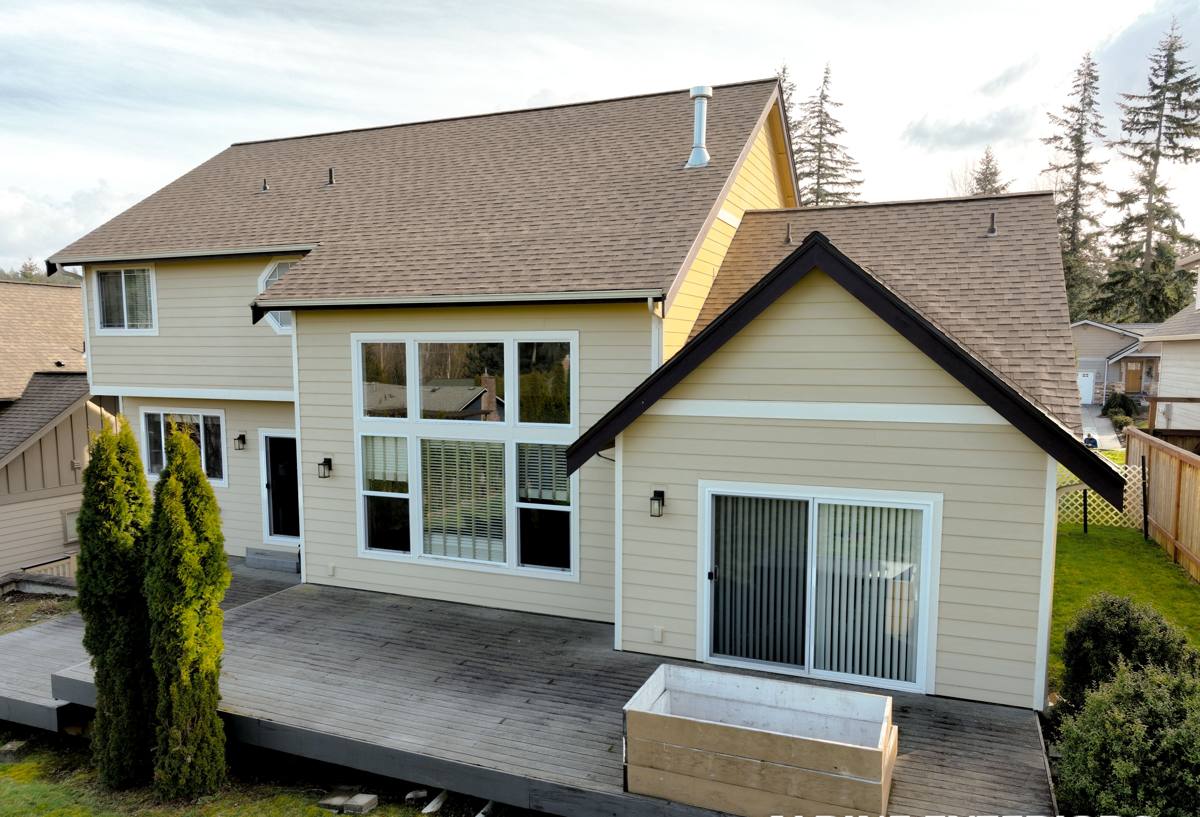
What a Correct Shingle Roof Actually Involves
A shingle roof is a system, not a single product. The shingles themselves get the attention, but they're the last layer of a stack that has to work together to shed water and vent moisture. On a Puget home, every layer in that stack matters more than it would in a drier climate.
The Layers Underneath
Underneath the shingles you need a deck in good condition, a synthetic or felt underlayment rated for the exposure the roof will see before shingles go down, and self-adhering ice-and-water membrane at the vulnerable spots — eaves, valleys, around penetrations, and up against any wall the roof ties into. In a climate that sees sustained, driving rain rather than short bursts, these transition points are where roofs actually leak. Shingles rarely fail in the open field; they fail at the edges and details.
Flashing and Fasteners
Flashing quality and fastener choice matter more here than most homeowners realize. Salt air off the Sound accelerates corrosion on cheap galvanized flashing and fasteners faster than it would twenty miles inland. We spec corrosion-resistant flashing and fastener materials on homes with meaningful salt exposure, because replacing rusted-through step flashing on an otherwise sound roof is an expensive way to find out the hardware was the weak link.
Choosing the Right Shingle for This Climate
Architectural vs. 3-Tab
Architectural (laminated) shingles are heavier, layered, and shed water more effectively than older-style 3-tab shingles, which matters on a roof that sees rain more days than not. They also tend to hold up better to the wind gusts that come through with winter storms off the water. 3-tab shingles are lighter and cost less up front, and they're still a legitimate option on a budget-conscious project or a secondary structure — we're not going to tell a homeowner their choice is wrong if it fits their needs and their roof's exposure. But for a primary residence in Puget, most homeowners get better long-term value out of architectural shingles.
Algae-Resistant Granules
Most major manufacturers now offer shingles with algae-resistant (AR) granules, usually copper-infused, that slow the growth of the blue-green algae responsible for those dark streaks you see on older roofs. This isn't a marketing gimmick — it's a real, measurable difference in a climate this wet and shaded. It's not a substitute for proper moss management, but it buys time between treatments and keeps a roof looking presentable longer.
Why We Don't Push the Cheapest Option
We won't install a shingle line that's a poor match for sustained moisture exposure just because it's the lowest bid. Lighter-weight, budget shingle lines can be a reasonable choice in the right application, but on a roof that's going to sit under tree cover and see near-daily moisture for months of the year, thin granule coverage and minimal algae resistance shorten the usable life of the roof. That's a maintenance burden we'd rather explain up front than let a homeowner discover in year eight.
Our Installation Process, Step by Step
- Inspection and estimate. We walk the roof (not just look at it from the ground), check the attic for existing moisture or ventilation issues, and give an honest read on what the job actually needs.
- Tear-off and deck check. Old material comes off down to the deck, and we inspect the sheathing for soft spots, delamination, or prior water damage — common on older Puget homes where a leak sat undetected for a while.
- Deck repair as needed. Any compromised sheathing gets replaced before anything else goes down. Shingles over a bad deck is a callback waiting to happen.
- Ice-and-water membrane and underlayment. Applied at eaves, valleys, and penetrations first, then full underlayment across the field.
- Flashing. New step, counter, and valley flashing installed or reused only where it's still sound and appropriately corrosion-resistant.
- Shingle installation. Installed to manufacturer nailing specs — not just "close enough" — because proper nailing pattern is what the wind and product warranties actually depend on.
- Ridge and attic ventilation. Ridge vent or equivalent installed or corrected to keep air moving through the attic.
- Cleanup and magnetic sweep. Debris and stray fasteners cleared from the yard and driveway.
- Final walkthrough. We go over the finished roof with the homeowner before calling the job done.
Ventilation and Moisture: The Part Nobody Sees
A shingle roof can look flawless from the curb and still be failing from the inside if the attic isn't ventilating properly. In a climate as consistently damp as Whatcom County's, trapped attic moisture leads to sheathing rot, reduced insulation performance, and premature aging of the shingles from underneath — none of which is visible until it's a real problem. Proper intake (usually at the soffits) balanced against exhaust (ridge or roof vents) keeps air moving and moisture from condensing where it can do damage.
This is one of the most common gaps we find on older Puget-area roofs: shingles replaced multiple times over the decades, but the ventilation never corrected. A reroof is the right time to fix it, because the cost of adding or correcting ventilation during a tear-off is a fraction of what it costs as a standalone project later.
What Drives the Cost of a Shingle Roof Here
Every roof is priced on its own specifics, but the same handful of factors move the number up or down on nearly every Puget-area job we quote. This isn't a price list — it's what to expect a contractor to walk you through before you sign anything.
| Factor | Why It Matters Locally |
|---|---|
| Roof pitch and access | Steeper roofs and limited access (tight lots, tall trees) increase labor time and safety setup |
| Number of existing layers | Tear-off of multiple old layers takes longer and generates more disposal cost than a single-layer strip |
| Deck condition | Hidden moisture damage under old shingles is common in a climate this wet — repair cost isn't known until tear-off |
| Shingle line chosen | Architectural and AR-granule products cost more up front but typically outlast basic 3-tab lines under constant moisture |
| Flashing and fastener material | Corrosion-resistant hardware costs more but matters more near salt air exposure |
| Ventilation corrections | Adding or fixing intake/exhaust venting during tear-off is far cheaper than as a separate project later |
| Valleys and roof complexity | More valleys and penetrations mean more flashing detail work, which is where leaks originate |
Maintenance Checklist for Puget Homeowners
A well-installed shingle roof still needs periodic attention in this climate. Most of what keeps a roof healthy here is simple and doesn't require a contractor every time — but a few things are worth having a professional eye on annually.
- Keep gutters clear of needles and debris so water isn't backing up under the shingle edge, especially before the fall rains set in
- Have moss growth treated before it takes hold — once it's established under the shingle tabs, it lifts them and lets water in
- Trim back overhanging branches to cut down on shade, debris buildup, and the moisture that lets moss and algae thrive
- Check flashing around chimneys, skylights, and vent pipes for rust or lifting, particularly on homes with salt air exposure
- Look for granule buildup in gutters and downspouts, which can signal a shingle surface that's aging faster than expected
- Confirm attic vents aren't blocked by insulation or debris, since blocked ventilation shortens roof life from the inside out
- Schedule a roof check after any significant windstorm rather than waiting for a visible leak
Why a Crew That Already Works Puget Matters
Roofing crews that work all over the region, or fly in from out of the area for a single job, don't carry the same feel for how this particular stretch of coastline behaves. A crew based in Bellingham knows which slopes in this neighborhood hold moss longest through the winter, understands how salt air off the Sound factors into hardware choices, and has already worked through the local permitting process enough times to not slow a job down. That local familiarity shows up in small decisions — flashing material, ventilation detail, timing a tear-off around the wettest stretches of the year — that a generic install spec doesn't account for.
It also matters after the job is done. A local crew is reachable if a question comes up two years later, and has a reputation in the community worth standing behind. That's a different relationship than a one-time crew that's moved on to the next region by the time any issue would surface.
Workmanship You Can Verify
We stand behind our installation work, and we'll walk any homeowner through exactly what that covers — separate from the manufacturer's own material warranty on the shingles themselves. Those are two different things, and a contractor who can't clearly explain the difference between installation warranty and product warranty isn't one we'd trust with our own roof either. Ask any contractor bidding your job to spell that distinction out in writing before you sign.
If your roof in Puget is due for a look — whether it's routine maintenance, a repair, or a full replacement — we're glad to come out, walk it with you, and give you a straight read on what it actually needs. The estimate is free, there's no pressure attached to it, and you can use the form below to get started.