 Bellingham Siding
 Composite Decking Built for South Hill's Climate
South Hill sits up on the elevated, tree-lined ground above downtown Bellingham, close enough to the bay to catch salt-laden air off the water and shaded enough by mature landscaping that decks here rarely get a full day of direct sun to dry out. That combination — salt air, driving rain off the Strait, and a long moss season that can run from October through May in a wet year — is hard on any outdoor structure, but it's especially hard on wood decking. Composite decking was designed to handle exactly this kind of exposure, but only when it's installed correctly. A composite deck that's framed, flashed, and fastened the right way will outlast a wood deck by decades in this climate. One that's installed carelessly will trap moisture, grow moss just as fast as wood, and fail from the substructure up long before the boards themselves wear out.
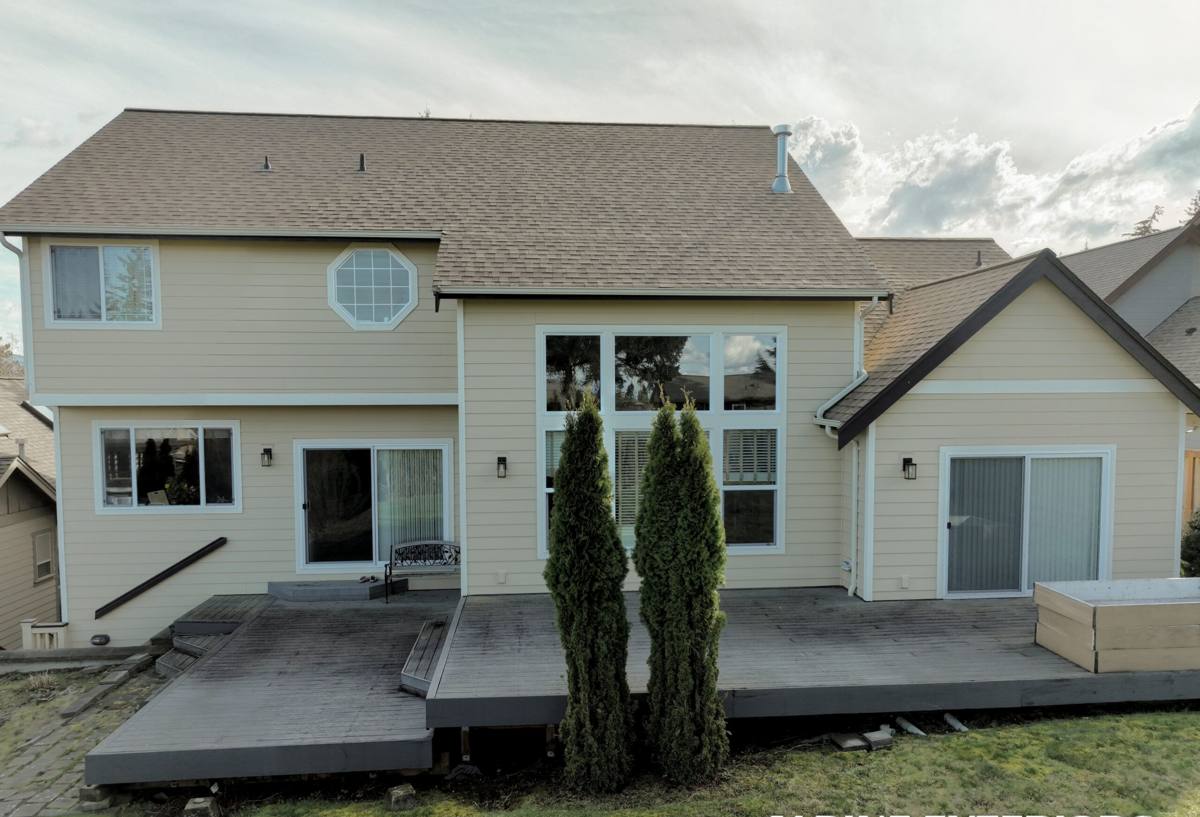
What Whatcom County Weather Actually Does to a Deck
It's worth being specific about the failure modes we see, because they shape how we build. In South Hill and the rest of Bellingham, three things do most of the damage:
- Prolonged dampness — long stretches of drizzle and low cloud cover mean decking surfaces and the framing underneath can stay wet for days at a time, especially on shaded lots.
- Salt air — proximity to Bellingham Bay accelerates corrosion on any exposed metal fasteners, brackets, and ledger hardware that aren't rated for coastal exposure.
- Moss and organic buildup — moss spores settle into any surface that stays damp and shaded, and once established, moss holds even more moisture against the decking and framing below it.
None of these are dealbreakers for a deck built the right way. But they explain why so many decks in this area — composite and wood alike — show problems around year 8 to 12: not because the decking material failed, but because water got where it shouldn't have and nobody caught it early.
What a Correctly Built Composite Deck Involves
The Substructure Comes First
The composite boards are the part homeowners see, but the framing underneath is what determines whether the deck lasts. In our climate, that means joists and beams sized for the actual span and load, hardware rated for exterior and coastal use (not standard interior-grade fasteners), and a ledger board — where the deck attaches to the house — that's properly flashed so water is directed away from the house framing instead of into it. Ledger flashing failures are one of the most common causes of hidden rot we find on older decks, and they're invisible until the damage is already significant.
Drainage and Airflow
Composite boards themselves don't rot, but the space underneath a deck still needs to shed water and breathe. We grade and, where needed, add ventilation or drainage detailing under low-clearance decks so moisture doesn't sit trapped against the joists. On sites with limited clearance to grade — common on the sloped and terraced lots around South Hill — this detail matters more than usual.
Fasteners and Hardware
We use stainless or coated fasteners rated for coastal exposure, hidden fastener systems where the product line supports it, and joist tape on framing members to add a moisture barrier at the connection points where composite boards contact wood. Cutting corners on hardware is invisible on installation day and expensive five years later.
Comparing Composite Decking Board Types
Not all composite decking is built the same way, and the differences matter more in a wet, shaded climate than they would somewhere dry. Here's how the main categories compare for a South Hill installation:
| Board Type | Moisture Behavior | Maintenance | Typical Warranty Structure |
|---|---|---|---|
| Capped composite (wood-plastic core, polymer shell) | Shell resists moisture and staining well; cut ends need sealing or capped trim | Occasional washing; resists moss better than wood but still needs cleaning in shaded areas | Often 25-50 year limited, prorated on fading/staining |
| Mineral-composite (higher mineral content core) | Very low moisture absorption; performs well in consistently damp conditions | Low; typically the easiest of the composite options to keep moss-free | Often longer limited warranties, less prorating |
| Uncapped or first-generation composite | More prone to moisture absorption and surface mold in shaded, damp spots | Higher; needs more regular cleaning and occasional sealing | Typically shorter, more limited coverage |
We steer homeowners toward capped or mineral-composite products for shaded South Hill lots specifically because of how much time these decks spend damp. It's not that older or uncapped composite products are bad — it's that they carry a higher maintenance burden in a climate that doesn't give a deck many chances to fully dry out between rain events.
Our Installation Process
- On-site assessment. We look at sun exposure, tree canopy, drainage slope, and how the deck will attach to the house before recommending a board type or layout.
- Structural plan. We size framing to the actual load and span, and plan ledger flashing and hardware to coastal-exposure standards.
- Permitting. Most new or replacement decks above a certain height or size require a permit through the City of Bellingham or Whatcom County, depending on the address. We handle that process rather than leaving it to the homeowner.
- Framing and flashing. This is the stage that determines the deck's lifespan, and it's the stage most visible on a finished deck that's least likely to get checked later — so we do it right the first time.
- Decking installation. Boards are installed per manufacturer spacing specs to allow for expansion and drainage, with hidden fasteners where the product supports them.
- Railing, stairs, and trim. Finished with matching or complementary composite trim and code-compliant railing.
- Final walkthrough. We go over care and cleaning specific to the board type installed.
Moss, Mildew, and Long-Term Maintenance
Composite decking is often marketed as maintenance-free, and compared to wood, it is dramatically lower-maintenance — no staining, no sealing, no sanding. But "low-maintenance" isn't "no-maintenance," especially on a shaded South Hill lot. Moss and mildew are surface conditions, not structural threats, on properly capped composite boards, but left alone they make a deck slick and unattractive. A periodic wash with a soft-bristle brush and a composite-safe cleaner keeps most decks looking new. We tell every homeowner up front which board type they're getting and what its actual maintenance rhythm looks like, rather than letting "low-maintenance" marketing set unrealistic expectations.
Permits and Structural Considerations
Deck permitting in Bellingham and unincorporated Whatcom County depends on the deck's height above grade, size, and whether it's attached to the house. Attached decks almost always require a permit given the structural connection to the home. We pull permits as part of the job and build to current code for guardrail height, stair geometry, and structural attachment — not because it's optional paperwork, but because it's what keeps the deck safe and keeps the homeowner covered if the property is ever sold or inspected.
Signs Your Current Deck Needs Replacing
Homeowners often ask whether a deck can be patched or resurfaced instead of replaced. Sometimes it can. Here's what we check before making that call:
- Soft or spongy spots in the decking surface, which usually indicate rot has already reached the boards
- Rust staining or corrosion around fastener heads and hardware
- Visible gaps, separation, or movement where the ledger board meets the house
- Persistent moss or dark staining that returns quickly after cleaning
- Joists or beams that show soft wood, discoloration, or insect damage when probed
- Railings that flex or feel loose under normal pressure
If the framing underneath is sound, sometimes a resurface with new composite boards is a reasonable option. If the substructure has been compromised by long-term moisture, a full rebuild is the honest recommendation — patching decking over failing framing just hides the problem for a year or two.
Why Hiring a Crew That Already Works South Hill Matters
South Hill's mix of elevation, tree cover, and older housing stock means decks here don't behave exactly like decks on an open, sunny lot elsewhere in Whatcom County. A crew that already builds and repairs decks in this neighborhood knows which lots need extra attention to drainage, which sites are more prone to moss buildup, and how to flash a ledger connection against driving rain off the bay. That local pattern recognition is the difference between a deck that needs attention again in eight years and one that's still solid in twenty-five.
If you're weighing a new composite deck or wondering whether your current one needs a repair or a rebuild, we're happy to take a look and give you a straightforward, no-pressure estimate — just fill out the form below.