 Bellingham Siding
 Why Decks Wear Out Faster in Birch Bay
Birch Bay sits right on the water, and that location cuts both ways. The views are part of why people love it here — but that same exposure is hard on a deck. Salt-laden air corrodes fasteners and hardware faster than it does a few miles inland. Wind-driven rain off the Strait of Georgia doesn't just fall straight down — it gets pushed sideways into ledger boards, railings, and any seam that isn't properly flashed. And Whatcom County's long, wet winters mean moss and algae get a real foothold on horizontal surfaces that don't dry out between storms.
None of that means a deck in Birch Bay can't last. It means the materials, fasteners, and detailing have to be chosen for this specific environment, not for a generic build. A deck that would hold up fine in a drier inland town can fail early here if it's built the same way.
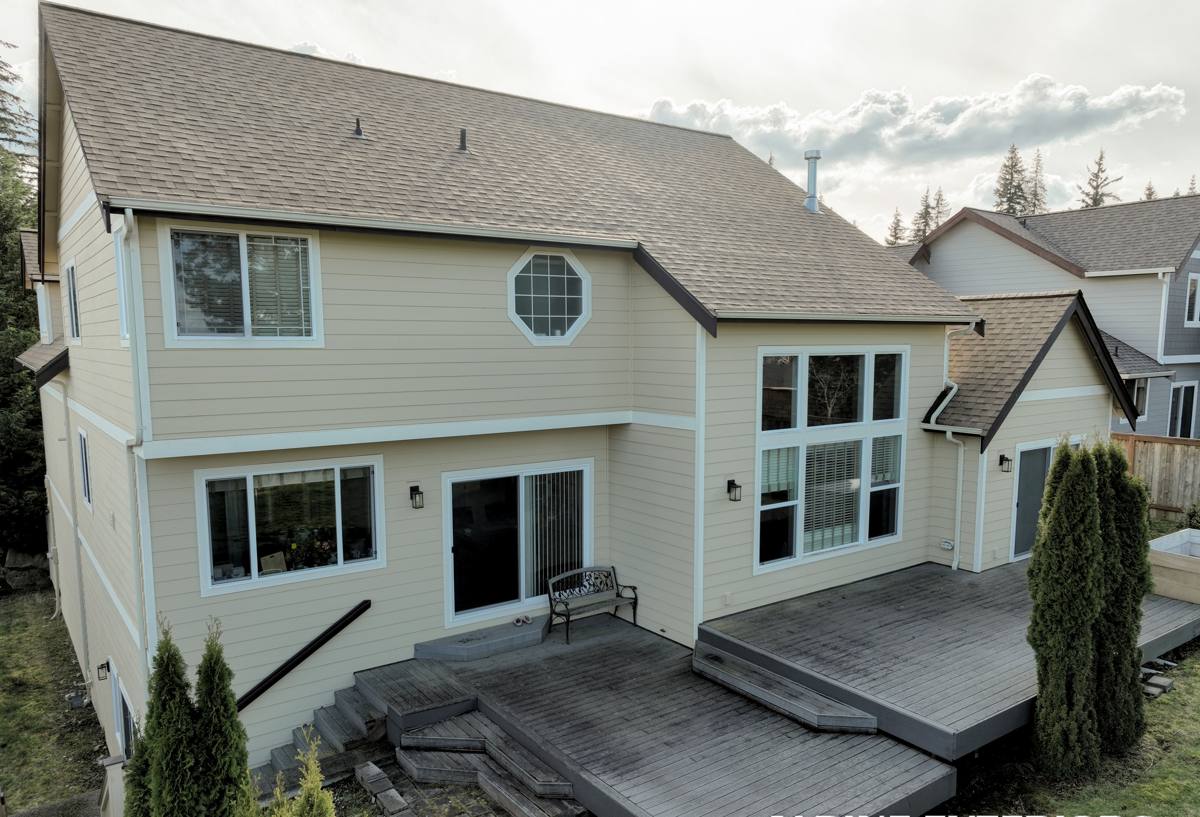
Signs a Deck Needs Replacement, Not Just Repair
We get calls from Birch Bay homeowners at every stage — some just want a few boards swapped, others already know the whole structure is done. The honest answer isn't always obvious from the surface, so here's what actually tells us which category a deck falls into.
- Soft or spongy decking, especially near the house or at board ends — usually means moisture has gotten into the wood fibers
- Rust streaks running down from fasteners or brackets, which points to corroding hardware underneath
- A ledger board that's separating from the house, or flashing that's visibly gapped or missing
- Persistent moss or black staining that comes back within weeks of cleaning
- Posts that feel loose or that show soft wood at the base, near grade
- A structure more than 20-25 years old that's never had the framing inspected
Surface staining or a few loose deck screws is a repair. Compromised framing, a failing ledger connection, or rot that's spread past the top boards into joists is a replacement — patching those issues just delays a bigger problem and adds cost to a rebuild you'll end up doing anyway.
What a Correct Deck Replacement Actually Involves
It starts underneath, not on top
A deck is only as good as what's hidden once the decking goes down. In a marine climate like Birch Bay, the framing and connection points deserve more attention than they'd get in a drier region, because that's where moisture damage actually starts.
- Ledger connection: proper flashing between the ledger and the house, with a water-resistant barrier behind it, is the single most important detail on an attached deck — this is the spot most failures trace back to
- Joist protection: joist tape or a comparable barrier over the top of each joist keeps standing water from soaking into end grain and fastener holes
- Fasteners and hardware: corrosion-resistant, rated hardware throughout — not just at the ledger, but every joist hanger, post base, and structural screw
- Post bases and footings: posts set on proper bases that keep wood off concrete and away from standing water, not buried or resting directly on grade
- Drainage and airflow: enough clearance and slope underneath that water and moss-friendly moisture don't just sit there year-round
A deck that looks great on top but skips these details will show problems again within a few years — often faster in Birch Bay than it would somewhere drier.
Choosing Decking Material for a Marine, Wet Climate
There's no single "right" decking material — it depends on budget, maintenance appetite, and how close the deck sits to salt air and standing moisture. Here's how the common options actually perform under Birch Bay conditions, as a practical baseline rather than a sales pitch.
| Material | Moisture Behavior | Maintenance | Typical Lifespan Here |
|---|---|---|---|
| Pressure-treated wood | Absorbs and releases moisture; prone to cupping and checking with repeated wet/dry cycles | Annual cleaning and re-sealing to control moss and rot | 10-15 years before boards need replacing |
| Cedar | Naturally rot-resistant but still absorbs moisture; needs a breathable finish, not a sealed coating | Periodic cleaning and refinishing to keep its color and resistance | 15-20 years with upkeep |
| Composite decking | Doesn't absorb water into the board itself, but surface can still hold moss film if not cleaned | Occasional washing; no sealing or staining required | 25+ years, manufacturer-warrantied |
| PVC/capped polymer | Fully sealed surface, best resistance to salt air and standing moisture | Lowest maintenance of the group | 25-30+ years, manufacturer-warrantied |
For homes right along the water where salt exposure and rain are constant, composite and PVC products earn their higher upfront cost through lower long-term maintenance. For homes set back further, a well-detailed wood deck with proper finishing is still a legitimate, lower-cost choice — as long as the maintenance schedule actually gets followed.
A note on wood alternatives we don't push
Some lower-tier composite products on the market use a wood-plastic blend without a fully capped surface. Those can absorb moisture at the edges and develop mold or swelling faster than a fully capped board, especially in a wet coastal climate. Our standard is to spec fully capped composite or PVC when a homeowner wants low-maintenance decking — it costs a bit more but avoids a callback in five years over a product limitation, not a workmanship issue.
Our Deck Replacement Process
- On-site assessment: we check the ledger connection, framing condition, post footings, and drainage before quoting anything — replacement scope depends on what we find, not a guess
- Material and layout discussion: we walk through decking options, railing style, and any changes to size or layout, with a straightforward cost range for each
- Permitting: we handle the permit application where one's required and coordinate any inspections tied to it
- Demolition and disposal: full removal of the old deck, including hauling away the old material
- Framing and structural work: new or reinforced framing, proper ledger flashing, corrosion-resistant hardware, and joist protection before a single deck board goes down
- Decking, railing, and stairs installed: to the layout and material agreed on up front
- Final walkthrough: we go over the finished deck together, along with a maintenance rundown specific to the material you chose
Permits and Shoreline Considerations Near Birch Bay
Because Birch Bay is a waterfront community, some deck projects — particularly larger rebuilds, decks close to the shoreline, or those changing footprint or height — can fall under Whatcom County shoreline or setback rules in addition to standard building permits. Requirements vary by exact location and project scope, so we check what applies to your property before work starts rather than assuming. If a permit is needed, we handle the application and any required inspections as part of the job, so it's not something you have to chase down yourself.
Maintaining a New Deck in Birch Bay's Climate
Whatever material you choose, a few habits make a real difference in how long it lasts against salt air and moss.
- Sweep off standing debris and organic buildup regularly — wet leaves and needles are what feed moss growth
- Rinse salt residue off railings and hardware a few times a year, especially after windy storms off the water
- Check that gaps between boards stay clear so water keeps draining instead of pooling
- For wood decks, keep to the re-sealing schedule — skipping a year is when moisture damage gets a foothold
- Inspect the ledger flashing and post bases annually for any sign of separation or corrosion
- Keep gutters and downspouts above the deck clear so runoff isn't dumping directly onto it
Why Hire a Crew That Already Works in Birch Bay
A deck built to a generic spec sheet doesn't account for what this specific stretch of Whatcom County coastline does to a structure over time. Crews who work Birch Bay regularly know which ledger and flashing details actually hold up against driving rain off the water, which fasteners hold up against salt air instead of streaking within a couple of seasons, and where moss takes over fastest if drainage isn't handled right the first time. That local familiarity shows up less in the finished look and more in whether the deck is still solid in ten years.
It also matters when it comes to permitting — knowing in advance whether a project is likely to touch shoreline rules saves time and avoids surprises partway through a job.
Get a Straightforward Estimate
If your deck is showing its age, feeling soft in spots, or just wasn't built for what Birch Bay's weather throws at it, we're happy to take a look and give you an honest read on repair versus replacement. Fill out the form below for a free, no-pressure estimate — no obligation, just a clear picture of what your deck actually needs.