 Bellingham Siding
 Why Blaine's Waterfront Climate Wears Out Decks Faster
Blaine sits right on the water at the northwest corner of Whatcom County, and that location comes with a specific set of problems for anything built outdoors. Salt-laden air off the bay accelerates corrosion on anything metal — fasteners, joist hangers, post bases, railing hardware. Add in the driving rain that comes through on winter storms, sideways enough to get up under flashing and behind ledger boards that weren't detailed correctly, and you've got two forces working against a deck at the same time: corrosion from the air and rot from trapped moisture.
Then there's moss. Whatcom County's damp, mild winters mean moss and algae get a long growing season on any horizontal wood surface that doesn't dry out quickly — deck boards included. Moss holds moisture against the wood, feeds rot at the board level, and turns stair treads and low spots on the deck surface slick and dangerous well before the structure underneath shows any obvious sign of trouble. A deck that looks "just needs cleaning" from the top is often hiding real structural decay underneath by the time a homeowner calls us.
None of this means a deck in Blaine can't last — it means it has to be built and detailed differently than a deck going up somewhere dry and inland. That's the standard we hold every replacement to.
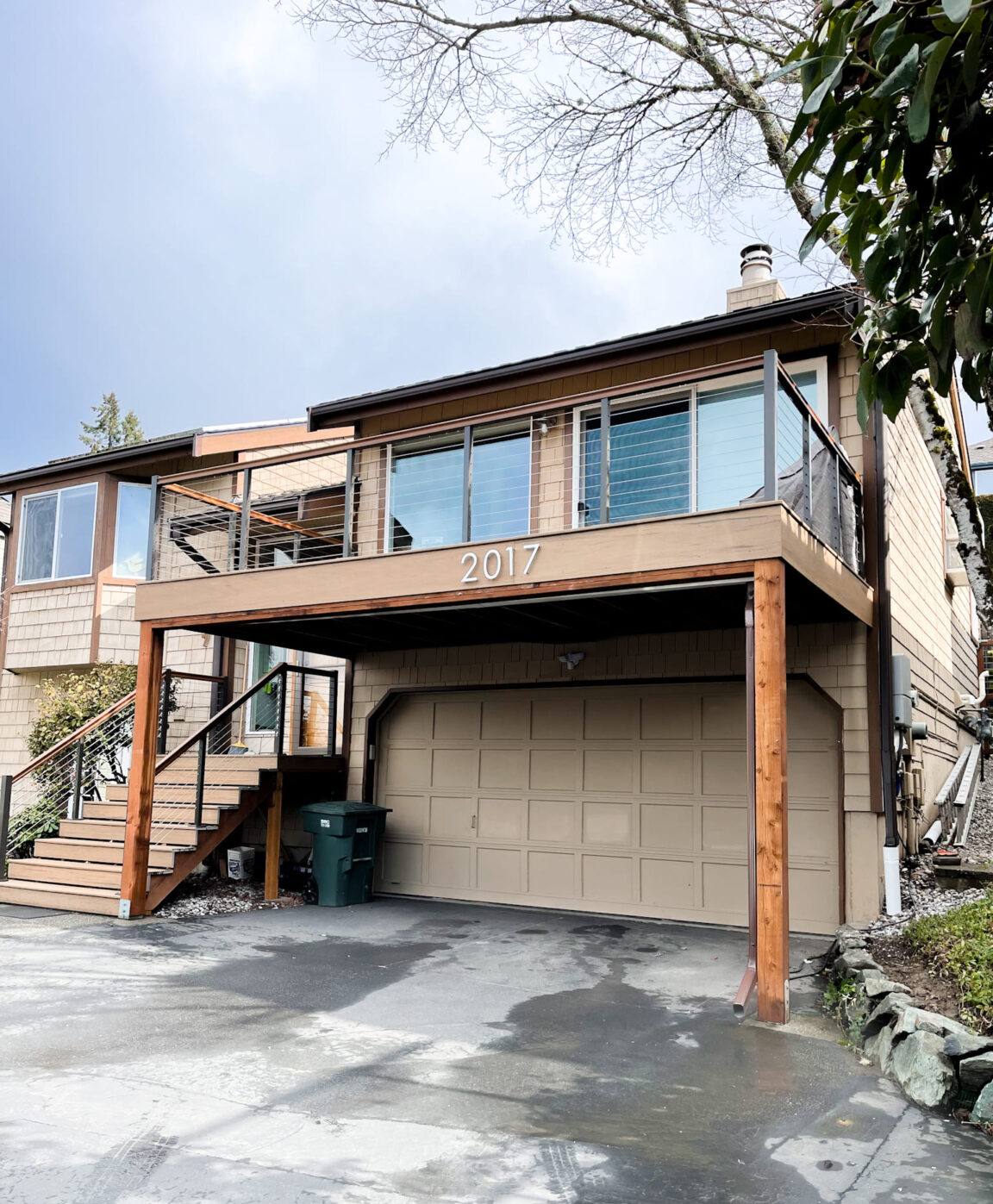
Signs Your Blaine Deck Needs Replacement, Not Another Repair
Plenty of decks get by for years on spot repairs — a board here, a post there. But past a certain point, patching a deck in this climate is just delaying the inevitable and spending money twice. Here's what tells us a full replacement is the honest answer:
- Soft, spongy, or spring-back decking boards, especially near the house or in low-sun areas that stay damp longest
- Rust streaking or visibly corroded fasteners, joist hangers, or post hardware
- Rot at the ledger board where the deck attaches to the house — often invisible until you pull the fascia or skirt board
- Wobble in railings or posts that shifts when you lean on it, not just cosmetic looseness
- Persistent moss or dark staining that comes back within weeks of cleaning
- Gaps opening between decking boards or boards cupping and splitting along their length
- A deck older than 15–20 years that has never had its structural connections upgraded to current hardware and flashing standards
If you're seeing two or more of these, it's worth a real inspection before spending more money on repairs that won't hold.
What a Correct Deck Replacement Actually Involves
Tearing Out and Assessing What's Underneath
A proper replacement starts with full demolition down to the ledger and footings, not just a re-deck over old framing. This is the point where problems that caused the original failure — rot, undersized joists, missing flashing, corroded connectors — actually get found and fixed instead of buried under new boards. We check the ledger board and rim joist condition, the footing depth and condition, and the framing layout against current span tables before anything new goes up.
Framing, Ledger Flashing, and Footings
The ledger board — where the deck bolts to the house — is the single most common failure point on decks in wet climates, because it sits at the exact spot where water runs off the house wall. A correct install uses proper flashing that directs water away from the ledger and the house sheathing behind it, not just caulk, which fails silently over a few winters. Footings need to sit below frost depth and bear on solid, undisturbed soil; in areas with poor drainage, that sometimes means going deeper or wider than the original footings ever were.
Choosing a Decking Material for Salt Air and a Long Moss Season
There's no single "right" decking material — it's a trade-off between upfront cost, maintenance commitment, and how the material actually behaves in wet, salty, moss-prone conditions. We walk every homeowner through this honestly rather than pushing whatever has the best margin.
| Material | Upfront Cost | Maintenance | How It Handles This Climate |
|---|---|---|---|
| Pressure-treated wood | Lowest | Annual cleaning, periodic staining/sealing | Needs regular upkeep to resist moss and moisture; skipped maintenance shortens life fast |
| Cedar or other natural wood | Moderate | Regular sealing to prevent graying and moisture uptake | Naturally more rot-resistant than treated pine but still needs sealed end grain and drainage gaps |
| Composite decking | Higher | Occasional washing, no staining/sealing | Resists rot but can still grow surface moss/algae in shaded, damp spots; needs airflow underneath |
| PVC/capped polymer decking | Highest | Lowest — mostly rinsing | Best moisture resistance of the options; still benefits from good under-deck ventilation |
Composite and PVC decking cost more up front but remove the maintenance burden that a lot of homeowners fall behind on — and in a climate where falling behind on sealing means the wood starts absorbing moisture and moss takes hold, that trade-off is worth discussing honestly rather than defaulting to whatever is cheapest per board foot. Whatever material you choose, ventilation underneath the deck matters as much as the decking itself; a deck built low to the ground with poor airflow will grow moss and hold moisture no matter what's on top.
Fasteners, Flashing, and Hardware — Where Salt Air Does the Most Damage
This is the part of a deck replacement that's invisible once the job is done, and it's exactly where corners get cut. In a saltwater-adjacent location, standard galvanized hardware corrodes faster than it would inland, and that corrosion weakens structural connections from the inside before it's ever visible from the outside.
- Stainless steel or high-grade coated fasteners for any hardware exposed to salt air, not the minimum-code galvanized option
- Joist hangers and structural connectors rated and coated for coastal/wet exposure
- Proper ledger flashing (not just caulk) at every point the deck meets the house
- Post bases that keep wood posts elevated off concrete footings so water doesn't wick up into the end grain
- Flashing tape or membrane on top of joists under composite or PVC decking, so screw penetrations don't become water entry points
These details cost more in materials and labor than the minimum code requires, but skipping them is exactly how a deck ends up needing full replacement again in half the time it should have lasted.
Permits and Code Considerations in Blaine and Whatcom County
Deck replacement in Blaine generally falls under Whatcom County or City of Blaine permitting depending on the property, and most full replacements — especially anything involving new footings, a raised deck, or a rebuilt ledger connection — need a permit and inspection. Key items that typically get checked:
- Guardrail height and baluster spacing on any deck more than 30 inches above grade
- Stair rise, run, and handrail requirements
- Footing depth and ledger attachment method
- Setbacks from property lines, which matter more on smaller in-town lots
Skipping the permit might save a little time up front, but it can create real problems at resale or with insurance if the work is ever questioned. We handle the permit and inspection process as part of the job rather than leaving it for the homeowner to sort out.
Our Deck Replacement Process
- Inspection and honest assessment — we look at the ledger, framing, footings, and hardware, not just the surface, and tell you what's actually driving the need for replacement.
- Material and design walkthrough — we go over decking options, railing style, and layout changes if you want them, with real cost and maintenance trade-offs explained.
- Permit and planning — we pull the required permit and schedule inspections as part of the project timeline, not as an afterthought.
- Demolition and structural rebuild — full tear-out, corrected ledger flashing, footings brought to code, framing sized correctly for the span and load.
- Decking, railing, and hardware installation — using fasteners and connectors specified for this climate, not the bare minimum.
- Final walkthrough and inspection sign-off — we don't consider the job finished until it's passed inspection and you've walked it with us.
What Drives the Cost of a Deck Replacement
Every deck is different, so we won't quote a number without seeing the site, but these are the factors that move the price up or down on most Blaine projects:
| Factor | Effect on Cost |
|---|---|
| Deck size and shape | Larger and multi-level decks need more framing, footings, and decking material |
| Existing structure condition | Rot at the ledger or footings adds rebuild scope beyond a simple deck-and-rail swap |
| Decking material chosen | Composite and PVC cost more up front than wood but reduce future maintenance spend |
| Height above grade | Taller decks need engineered railings, more substantial framing, and sometimes stairs |
| Access to the site | Tight side yards or waterfront lots with limited equipment access can add labor time |
Why a Crew That Already Works Blaine Matters
Deck construction rules don't change from town to town in the abstract, but the practical side of doing the work right does. A crew that's already pulled permits with Whatcom County and the City of Blaine knows what the inspectors actually look for on ledger flashing and guardrail spacing before the inspection happens, not after a failed one. A crew based out of Bellingham that regularly works the waterfront communities along the county's coast already knows to spec stainless hardware and coastal-rated connectors as a default, not an upsell — because we've seen what standard galvanized hardware looks like after a decade of salt air in this exact area. That local pattern recognition is worth more than it sounds like on paper; it's the difference between a deck that needs attention again in eight years and one that holds up for two or three decades.
If your deck in Blaine is showing its age — soft boards, rusting hardware, moss that keeps coming back, or a structure you're not fully sure about — we're glad to take a look and give you a straight answer about whether it needs repair or full replacement. Reach out for a free, no-pressure estimate using the form below.