 Bellingham Siding
 Edgemoor's Setting Is Beautiful — and Genuinely Hard on Exterior Cladding
Edgemoor sits close to the water, under a heavy tree canopy, in one of the wetter, greener corners of Whatcom County. That combination is exactly what makes it a demanding place to keep siding looking good and performing well. Homes here deal with three things at once, year-round: salt-laden air off the bay, wind-driven rain that hits walls at an angle instead of just falling straight down, and a moss and algae season that can run eight or nine months out of the year under mature trees and persistent shade.
Any one of those factors is manageable on its own. Together, they punish cladding that isn't dimensionally stable, isn't finished to resist organic growth, or isn't installed with real attention to water management. We've worked on enough homes in this part of Bellingham to know which failures show up here first — and they're rarely dramatic. They're slow: paint that chalks and fades early, seams that open up and let moisture behind the wall, or a north-facing wall that stays damp long after the rest of the house has dried out.
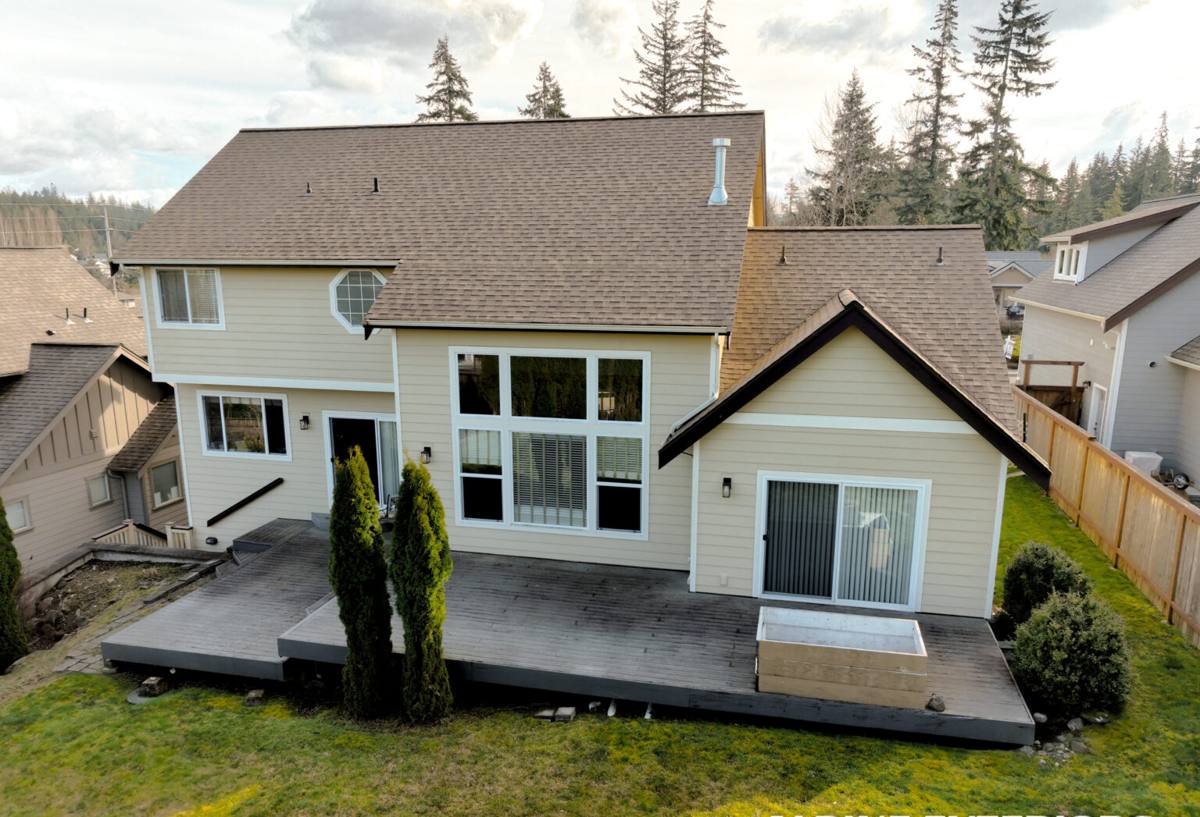
What Edgemoor Homes Actually Need From Their Siding
Resistance to Salt Air
Proximity to Bellingham Bay means airborne salt settles on exterior surfaces more than it would further inland. Salt accelerates the breakdown of cheap paint films and can corrode poor-quality fasteners and trim over time. Siding material and finish quality both matter more here than they would on a home twenty minutes east.
Driving Rain, Not Just Rainfall Totals
What matters for siding isn't just how much rain Whatcom County gets — it's how it arrives. Wind off the water pushes rain sideways into walls, corners, and window openings. That's a water-management problem as much as a material problem, which is why flashing details and drainage planes matter as much as the panel you choose.
A Long, Real Moss and Algae Season
Mature trees and shaded, damp walls are a perfect environment for moss, algae, and mildew growth. Untreated wood-based products and low-grade finishes stain and streak in this environment faster than most homeowners expect, especially on shaded elevations and under eaves.
A Long Ownership Horizon
Many Edgemoor homes are owned for decades, not flipped. A cladding decision here isn't a five-year decision — it's a twenty- or thirty-year one, which changes the math on what's worth paying for up front.
Why We Only Install James Hardie Fiber Cement
We don't install vinyl, LP SmartSide, cedar, primed spruce, or other fiber cement brands like Cemplank or Allura. That's a deliberate standard, not a sales pitch, and it matters more in a climate like Edgemoor's than almost anywhere else in the county.
- Vinyl expands and contracts with temperature swings and can warp or crack from wind-driven impact; its seams and butt joints are also a weak point for wind-driven rain intrusion.
- Wood-based siding (cedar, primed spruce, LP SmartSide) is organic material at its core. In a shaded, damp, salt-air environment it needs more frequent recoating and inspection to stay ahead of moisture and organic growth than most homeowners want to keep up with.
- Other fiber cement brands may be dimensionally similar to Hardie, but Hardie's ColorPlus factory finish and HardieZone engineering are built specifically around the kind of climate exposure this region has — that's the differentiator we install to.
James Hardie fiber cement is non-combustible, doesn't rot, and holds its factory-applied ColorPlus finish far longer than field-applied paint on wood or composite products. It's engineered in HZ5 and HZ10 zone formulations specifically for regions like the Pacific Northwest, where moisture exposure is the dominant durability factor. That engineering, plus a strong transferable warranty, is why it's the only product we put our name behind.
How Cladding Options Compare in Edgemoor's Climate
| Material | Salt Air Resistance | Moss/Algae Resistance | Wind-Driven Rain Behavior | Typical Maintenance |
|---|---|---|---|---|
| James Hardie Fiber Cement | Strong (ColorPlus finish holds up well) | Strong (dense, non-organic substrate) | Excellent when correctly flashed and lapped | Occasional washing; no repainting for years |
| Vinyl | Moderate; fasteners and trim can corrode over time | Moderate; grows algae in shaded areas | Weak at seams and butt joints | Low, but panels can warp or crack |
| Cedar / Primed Spruce | Weak without diligent upkeep | Weak; organic material feeds growth | Poor if coatings fail or joints open | High — recoating and inspection cycles |
| LP SmartSide / Other Fiber Cement Brands | Varies by product and finish | Varies; engineered wood needs edge sealing | Depends heavily on installation quality | Moderate to high depending on brand |
What Correct Installation Looks Like on a Property Like This
Fiber cement performs exactly as well as its installation. A poorly installed Hardie job in a wet, wind-exposed neighborhood will still fail early — usually at the seams, the fastener pattern, or the flashing details, not the panel itself. On Edgemoor properties specifically, we pay extra attention to:
Drainage Plane and Water-Resistive Barrier
A continuous, properly lapped weather-resistive barrier behind the siding gives water a path to escape if it does get behind the cladding — which, in a driving-rain environment, it eventually will at some point over the life of the house. This is the single most important layer most homeowners never see.
Flashing at Every Penetration
Windows, doors, hose bibs, light fixtures, and deck ledgers all need proper flashing integrated with the water-resistive barrier, not just caulk. Caulk is a maintenance item; flashing is the actual water-management system.
Fastener Selection and Placement
In salt-air exposure, fastener quality and placement matter more than usual. We follow Hardie's fastening specifications precisely — correct fastener type, spacing, and embedment — because under-driven or over-driven fasteners are one of the most common causes of premature siding problems.
Proper Clearances and Gaps
Fiber cement needs the manufacturer-specified gap at trim, foundations, and roof-to-wall intersections to manage moisture and allow for material movement. Skipping these clearances is a common shortcut that causes problems years later, often after the crew that installed it is long gone.
Caulking and Joint Treatment
Butt joints and seams get treated according to Hardie's application guide — this is where a lot of production-focused installers cut corners, and it's exactly where wind-driven rain finds its way in.
Our Process for an Edgemoor Project
- On-site assessment — we look at sun exposure, tree cover, wind exposure toward the water, existing moisture damage, and the condition of the wall assembly underneath the current siding.
- Product selection — profile, exposure, and ColorPlus color chosen for the home's elevation and the neighborhood's aesthetic, from Hardie's climate-engineered HZ5 lineup.
- Tear-off and sheathing check — we don't side over rot or hidden water damage; problem areas get repaired before anything new goes up.
- Water-resistive barrier and flashing — installed and inspected before a single piece of siding goes on.
- Installation to Hardie spec — correct fastening, clearances, and joint treatment throughout.
- Final walkthrough — caulking, trim, and touch-up checked against Hardie's installation standards before we call the job done.
What Drives the Cost of a Project Like This
| Factor | Why It Matters in Edgemoor |
|---|---|
| Home access and staging | Wooded lots and waterfront setbacks can limit equipment and material staging space |
| Existing wall condition | Homes with prior moisture intrusion may need sheathing repair before re-siding |
| Siding profile and trim complexity | Multi-story, multi-gable homes with detailed trim take more labor than a simple rectangle |
| Product line | HardiePlank lap, HardiePanel, and HardieShingle carry different material and labor costs |
| Tree and shade management | Some sites need trimming or protection to keep debris and moisture off fresh siding |
We don't quote a number without seeing the house — every one of these factors moves the estimate, and a fair quote reflects the actual site, not a generic per-square-foot figure.
Questions Worth Asking Before You Hire
- Does the crew install to James Hardie's written fastening and clearance specifications, not just "how we've always done it"?
- Will the water-resistive barrier and flashing be inspected before siding installation begins, and can you see photos of that stage?
- Does the estimate specify the HardieZone product line (HZ5) appropriate for this climate?
- What does the transferable warranty actually cover, and who backs it — the manufacturer or just the installer?
- Has the crew worked on homes with similar tree cover and water exposure before, and can they speak to how that affected the job?
Why a Crew That Already Works Edgemoor Matters
Siding installed correctly for a dry, sunny lot in another part of Whatcom County isn't automatically installed correctly for a shaded, wind-exposed, waterfront-adjacent property. The flashing details, product line, and even the timing of the work — avoiding installation during the wettest stretches of the moss season — change based on site conditions. A crew that regularly works in and around Edgemoor and greater Bellingham has already made the adjustments that matter here, instead of learning them on your house.
If you're weighing a siding replacement or a new-construction project in Edgemoor, we're happy to walk the property, look at your specific exposure, and put together a straightforward, no-pressure estimate — fill out the form below to get started.