 Bellingham Siding
 Metal Roofing in Columbia Faces a Different Set of Problems Than Most of the Country
Columbia sits close enough to Bellingham Bay that salt-laden air is a daily fact of life for anything metal on a roof — fasteners, flashing, panel seams, gutters. Add Whatcom County's long wet season, wind-driven rain that gets pushed sideways under poorly lapped panels, and a moss season that can run eight or nine months out of the year, and you have a climate that is genuinely harder on a roof than the sales brochures for most metal roofing products assume. A roof designed and installed the way it would be in a dry inland climate will not hold up the same way here. That's the gap we work in.
This page is specifically about metal roofing for homes in the Columbia area of Bellingham — what the local climate actually does to a roof over time, what a correctly installed system looks like, and what to expect from our process if you're considering it.
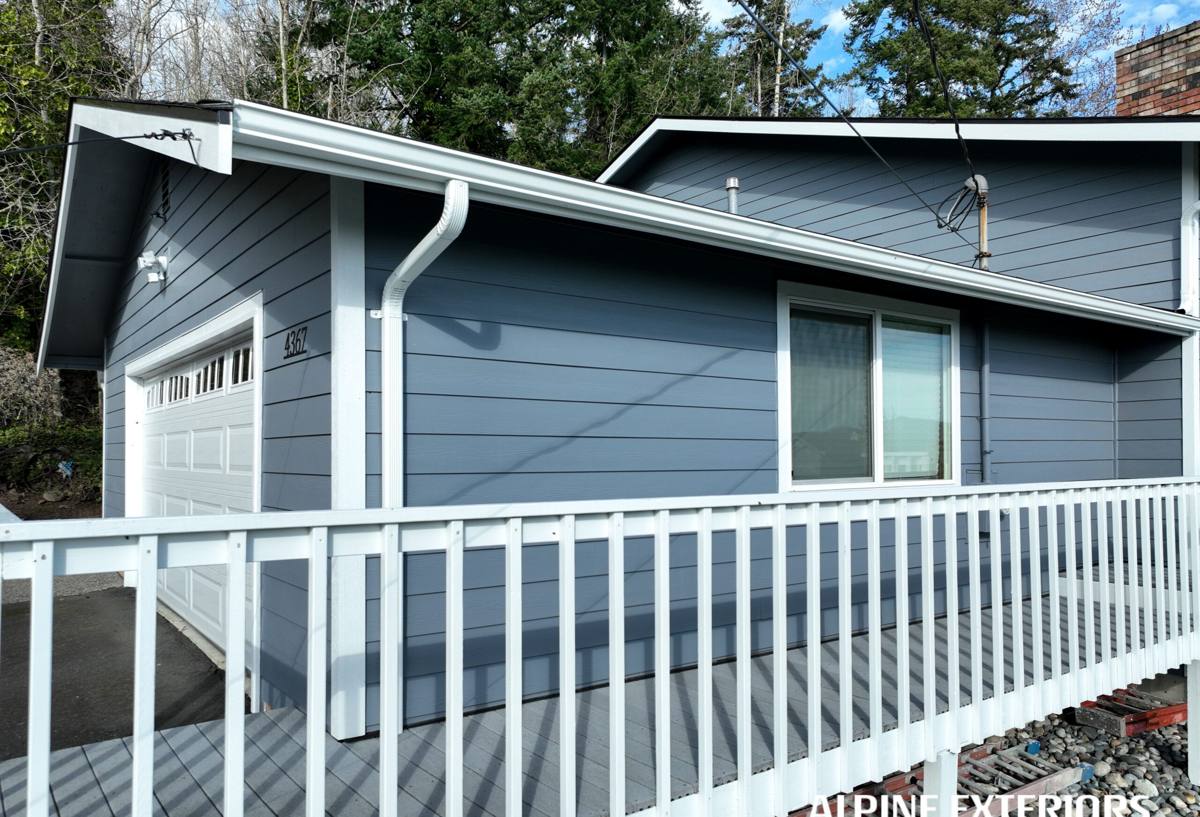
What Salt Air, Driving Rain, and Moss Actually Do to a Metal Roof
Salt Air and Corrosion
Airborne salt doesn't need to be visible or smelled to be doing damage. It settles on exposed metal in a fine film, and every time that film gets wet and dries again, it accelerates oxidation. On a metal roof, the weak points are almost never the panels themselves — factory finishes are generally good at resisting this. The failures show up at cut edges, exposed fasteners, and any spot where two dissimilar metals touch and start a galvanic reaction. A screw with a marginal coating, or flashing made from a metal that doesn't match the panel, can start rusting years before the roof field does.
Driving Rain
Bellingham doesn't just get a lot of rain — a good share of it comes in sideways off the water during winter storms. That matters because metal roofing sheds water differently than composition shingle. Lap and seam spacing that would be fine in a calmer climate can let wind-driven rain work backward under a panel edge or through an under-lapped seam. This is an installation issue, not a product issue — it's about how the panels are run and lapped for this specific site's wind exposure.
Moss Season
Whatcom County's mild, wet, shaded conditions are close to ideal for moss growth, and Columbia's tree cover doesn't help. Moss is less of a direct threat to metal panels than it is to shingles, since it can't root into painted steel or aluminum the way it does into asphalt granules. But moss and the organic debris that comes with it hold moisture against the roof surface, clog valleys and gutters, and create the damp, dark conditions where any weak point — a scratched finish, an exposed fastener — starts to fail faster than it would on a clean, dry roof.
Choosing the Right Panel and Finish for This Climate
Not every metal roofing product performs the same way in a marine climate. The two biggest decisions are panel style and finish system, and both affect how the roof holds up here specifically — not just how it looks on day one.
| Option | How it performs in Columbia's climate | Trade-off |
|---|---|---|
| Standing seam (concealed fastener) | Fasteners are hidden under the seam, out of direct weather — the single biggest corrosion risk is removed from exposure | Higher material and labor cost than exposed-fastener panels |
| Exposed-fastener panel | Every fastener penetration is a maintenance point that needs periodic inspection and eventual re-seating or gasket replacement | Lower upfront cost, more long-term upkeep in a wet, salty environment |
| PVDF (Kynar-type) finish | Best resistance to chalking, fading, and coating breakdown from UV and salt exposure over decades | Higher cost than SMP finishes |
| SMP finish | Acceptable performance but tends to chalk and fade noticeably faster in coastal, high-UV-cycling conditions | Lower cost, shorter service life for color and gloss retention |
| Steel (Galvalume or similar coated steel) | Strong, cost-effective, performs well when the coating and cut edges are properly sealed | Cut edges and scratches need touch-up to prevent rust starting points |
| Aluminum | Naturally corrosion-resistant, a strong choice for homes closest to the water | Softer metal, more prone to denting, higher material cost |
For most Columbia homes, we recommend standing seam in a PVDF finish specifically because it removes the two most common failure points — exposed fasteners and coating breakdown — in a climate that punishes both. That said, exposed-fastener panels aren't wrong for every project; on a detached garage or outbuilding where budget matters more than a 40-plus-year finish, they can be the honest call. We'll walk through the real trade-offs for your specific roof rather than defaulting to the most expensive option.
Fasteners, Flashing, and Roof-Wall Details — Where Metal Roofs Actually Fail
Because we're a siding and exterior crew as much as a roofing crew, we pay close attention to the places where the roof meets the walls — that's usually where problems show up first, and it's a detail that roofing-only crews sometimes treat as an afterthought.
- Fastener material: Stainless steel or high-grade coated fasteners matched to the panel metal, not generic hardware-store screws that will start streaking rust within a few seasons in salt air.
- Kickout flashing: Where a roof edge meets a sidewall, water needs to be diverted out and away from the siding below — a missing or undersized kickout is one of the most common causes of hidden wall rot we find on older homes.
- Valley construction: Closed or open valleys need enough width and the right underlayment to handle the volume of water Whatcom County winters actually produce, not just code minimums.
- Panel-to-wall transitions: Step flashing and counterflashing need to be sequenced correctly with any siding or trim work so water sheds outward at every layer, never trapped behind it.
- Underlayment: A synthetic, high-temperature underlayment with ice-and-water shield at eaves, valleys, and penetrations gives the panels a real backup layer if wind-driven rain ever gets past a seam.
Moss and Long-Term Maintenance in Whatcom County
Metal roofing needs less maintenance than shingle roofing, but "less" isn't "none," especially under Columbia's tree cover. A simple annual routine keeps a metal roof performing the way it's supposed to:
- Clear needles, leaves, and moss buildup from valleys and gutter lines before the wet season sets in each fall.
- Check gutters and downspouts are draining freely — clogged gutters back water up under the drip edge.
- Look for any scratched or bare-metal spots after storms or fallen branches, and touch them up before they start to rust.
- Confirm fasteners on exposed-fastener panels are still snug and their washers haven't cracked or compressed.
We're happy to walk a homeowner through what to look for themselves, or handle periodic checks as part of broader exterior maintenance.
How We Approach a Metal Roofing Project in Columbia
- On-site assessment: We look at the existing roof structure, deck condition, ventilation, and the specific exposure your home has to wind and rain off the bay.
- Panel and finish selection: Based on that assessment and your budget, we recommend a panel style, gauge, and finish — with the trade-offs explained plainly, not upsold.
- Tear-off or overlay decision: We evaluate whether the existing roof deck and structure support a metal overlay or whether a full tear-off is the right call for the roof's condition.
- Underlayment and flashing detail: Every eave, valley, penetration, and roof-wall transition gets addressed before a single panel goes down.
- Panel installation: Panels are run, seamed, and fastened to spec for this climate's wind and rain exposure, not generic manufacturer minimums.
- Final walkthrough: We go over the finished roof with you, including what maintenance to expect and what a normal service life looks like for the system installed.
What Drives the Cost of a Metal Roof in Columbia
We won't quote a fixed number without seeing the roof, but these are the real factors that move the price up or down on most Columbia projects:
| Factor | Effect on cost |
|---|---|
| Panel style — standing seam vs. exposed fastener | Standing seam typically runs higher due to panel cost and installation labor |
| Finish system — PVDF vs. SMP | PVDF costs more upfront but holds color and gloss significantly longer |
| Roof complexity — valleys, dormers, roof-wall intersections | More cuts, seams, and flashing detail means more labor |
| Tear-off vs. overlay | Tear-off adds disposal and deck-repair cost but is often the right call on an older roof |
| Deck or structural repair needed | Rot or sagging discovered during tear-off adds cost but shouldn't be skipped |
| Access and roof pitch | Steep or hard-to-access roofs take longer and cost more to work safely |
In general, metal roofing costs more upfront than composition shingle but is meant to be a decades-long investment rather than a 20-to-25-year one — that math only works out if the installation is done right the first time.
Why It Matters to Hire a Crew That Already Works in Columbia
A lot of what goes wrong with metal roofing in this area isn't a product failure — it's a mismatch between a generic installation approach and the specific conditions Columbia homes actually face: the salt exposure off the bay, the volume and direction of winter rain, and how long moss has to establish itself under the tree canopy. A crew that works this neighborhood regularly already knows which fastener grades hold up here, how wide to run valleys for Whatcom County's rain volume, and where roof-wall details tend to get missed on homes with this area's typical construction. That local pattern recognition is worth more than a lower bid from a crew unfamiliar with the area.
Questions to Ask Before You Sign a Metal Roofing Contract
- What panel gauge and finish are being quoted, and why is that the right fit for this roof's exposure?
- What fastener material and grade will be used, and are they rated for coastal/marine exposure?
- What underlayment is specified at eaves, valleys, and penetrations?
- How will roof-to-wall transitions and kickout flashing be handled where the roof meets siding?
- What does the warranty cover — the panel finish, the installation workmanship, or both — and for how long?
If you're weighing metal roofing for a home in Columbia, we're glad to walk the roof with you, explain what we're seeing, and put together a straightforward, no-pressure estimate — no obligation, no pressure to upgrade beyond what your roof actually needs. The form below gets you started.