 Bellingham Siding
 Why Birch Bay Roofs Take More Punishment Than Roofs Further Inland
A roof in Birch Bay works harder than a roof ten or fifteen miles inland. The shoreline setting means more direct exposure to salt-laden air, which speeds up corrosion on any exposed metal — fasteners, flashing, vents, and drip edge all take the hit first. Add in wind-driven rain that comes off the water at an angle instead of falling straight down, and you get water finding its way into laps, seams, and fastener penetrations that would stay dry on a roof in a more sheltered location.
Then there's moss. Whatcom County's long wet season, combined with the shade from mature evergreens common on Birch Bay lots, keeps roof surfaces damp for extended stretches of the year. Moss doesn't just look bad — it holds moisture against the roofing material, works its way under shingle tabs, and lifts them just enough to let wind-driven rain in underneath. Over years, that's how a roof fails from the inside out rather than all at once.
None of this means a roof in Birch Bay needs to be replaced more often than one anywhere else in Whatcom County. It means the installation has to account for these conditions from the start — the right underlayment, the right fastener and flashing metal, and ventilation that actually keeps the deck dry. A roof installed without that in mind will show problems years before it should.
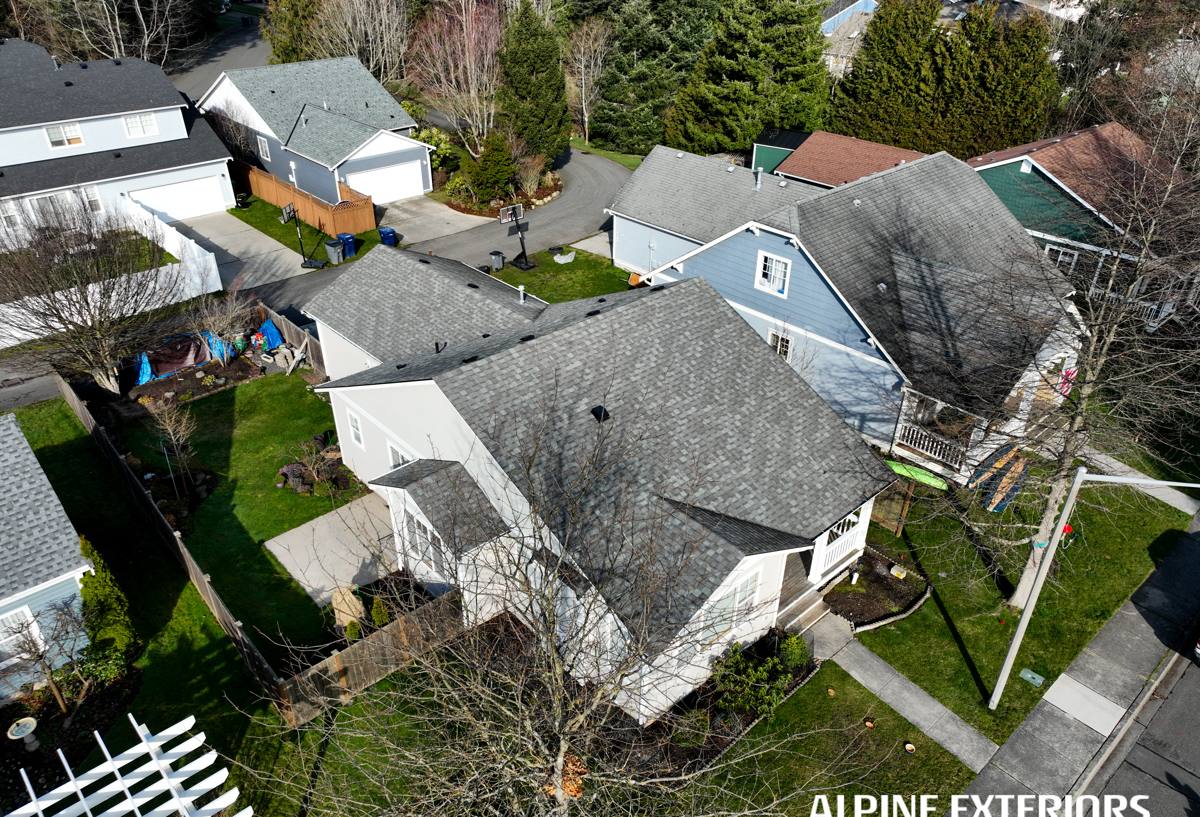
Signs a Birch Bay Roof Needs Replacing, Not Just Repair
Not every roof problem calls for a full replacement, but a few signs point toward it rather than a patch job:
- Granule loss heavy enough that you can see bare, shiny patches on shingles, especially on south- and west-facing slopes that catch the most weather
- Shingles that are cupping, curling at the edges, or cracking when you walk the roof
- Moss or algae covering large sections rather than isolated spots, especially on shaded north-facing slopes
- Soft spots in the decking you can feel underfoot, or daylight visible through the roof deck from the attic
- Repeated leaks in different spots after previous repairs, which usually means the underlayment has failed, not just the surface material
- A roof at or past the end of its expected service life combined with any of the above
If you're only dealing with one or two of these on a roof that's otherwise in decent shape, a repair may still make sense. Once several show up together, patching becomes a short-term fix on a roof that's already telling you it's done.
What a Correct New Roof Installation Actually Involves
Tear-Off and Deck Inspection
A proper replacement starts with a full tear-off down to the deck — not a layover on top of existing shingles. That's the only way to actually see the plywood or OSB underneath and find soft, delaminated, or water-damaged sections before they're covered up again. Any deck damage gets replaced with matching sheathing before anything else goes down. Skipping this step is the single most common shortcut that leads to early failure.
Underlayment and Ice-and-Water Protection
Given how much wind-driven rain a Birch Bay roof deals with, underlayment choice matters more here than it would on a more sheltered inland roof. Self-adhered ice-and-water shield belongs at eaves, valleys, and around every penetration — chimneys, vents, skylights — where water is most likely to be pushed backward under normal roofing material. The rest of the deck gets a synthetic underlayment that holds up to wind and foot traffic better than old-style felt.
Flashing Details
Flashing is where most roof leaks actually start, not in the field of the roof itself. Step flashing at wall intersections, counter-flashing at chimneys, and properly lapped flashing in valleys all need to be installed correctly and, in a salt-air environment, made of a metal that won't corrode out well before the roofing material does. This is not an area to cut corners to save a little on materials.
Ventilation
An attic that can't breathe properly traps moisture, which shortens the life of the decking and the roofing material from underneath — and it's a major contributor to moss growth on the surface above. A correct installation includes intake ventilation at the eaves and exhaust at the ridge, sized to the attic space, not just whatever vents happened to be there before.
Choosing a Roofing Material for Birch Bay's Climate
There's no single "best" roofing material for every home — it depends on budget, roof pitch, and how much long-term maintenance you're willing to do. Here's how the common options compare for a coastal Whatcom County home:
| Material | How it handles salt air & rain | Moss resistance | Typical lifespan | Maintenance |
|---|---|---|---|---|
| Asphalt composition shingle | Good when installed with corrosion-resistant fasteners and flashing; the shingle itself is not affected by salt air | Moderate — benefits from algae-resistant granules and periodic cleaning | 20-30 years | Low to moderate; occasional moss/debris removal |
| Standing seam metal | Excellent when the panel and fastener coating is specified for coastal exposure | Very good — smooth surface sheds moss more easily | 40-60+ years | Low; occasional inspection of fasteners and seams |
| Synthetic/composite shingle | Good; resists moisture absorption well | Moderate to good, varies by product | 30-50 years | Low to moderate |
We install and stand behind all three when they're specified correctly for the exposure and installed with the right underlayment and flashing details underneath. Our standard is to steer clients away from any material or fastener spec that isn't rated for this level of salt exposure — not because a product is bad in general, but because an inland-grade spec on a shoreline roof is asking for early corrosion and leaks, and that's a maintenance burden we don't want to hand a homeowner.
Ventilation and Moss: The Two Issues That Shorten a Roof's Life Here
These two problems are connected. A roof surface that stays damp because of poor airflow underneath, combined with shade and a wet climate on top, is the exact combination that grows moss fastest. Trimming back overhanging branches to let more sun and air reach the roof helps, but it only goes so far on a heavily treed lot — the ventilation has to do the rest of the work.
During a new roof installation, this is the point to fix ventilation problems for good rather than working around them. If the old roof had blocked soffit vents, undersized ridge vents, or no real balance between intake and exhaust, we correct that as part of the job — not as an upsell afterward.
Our New Roof Installation Process
- On-site inspection and estimate — we walk the roof, check the attic for ventilation and moisture issues, and give you a written estimate with no pressure to sign on the spot
- Material selection — we go over the trade-offs above based on your budget, roof pitch, and how the home is exposed to wind and rain
- Scheduling around the weather — we watch the forecast and plan tear-off days for a stretch of dry weather so the deck isn't exposed longer than necessary
- Tear-off and deck inspection — full removal down to the sheathing, with any damaged decking replaced before we move forward
- Underlayment, flashing, and ventilation installed — the parts of the job that determine whether the roof lasts fifteen years or forty
- Final roofing material installation — installed to manufacturer specification, not just "close enough"
- Cleanup and walk-through — magnetic sweep for stray nails, hauling away old material, and a final walk-through so you know what was done and why
Why Hiring a Crew That Already Works in Birch Bay Matters
A roofing crew that mostly works further inland doesn't necessarily think about salt-air fastener corrosion, wind-driven rain angles, or moss-heavy shaded lots as default considerations — they're used to a different set of conditions. A crew that regularly works the Birch Bay area treats those factors as standard practice, not an afterthought.
There's also the practical side: knowing how weather moves in off the water and planning tear-off days around it, understanding what Whatcom County permitting requires for a full roof replacement, and having relationships with suppliers who stock the corrosion-resistant fasteners and flashing metal this kind of job calls for. None of that shows up on an invoice, but it shows up in how the roof holds up ten and twenty years down the road.
What Affects the Cost of a New Roof in Birch Bay
We don't quote prices without seeing the roof, but these are the factors that move the number up or down on most jobs:
| Factor | Why it matters |
|---|---|
| Roof size and pitch | More square footage and steeper pitches take more material and more labor time, and steep pitches require more safety equipment |
| Number of existing layers | A roof with more than one layer of old shingles takes longer to tear off and generates more disposal cost |
| Deck condition | Rotted or delaminated sheathing found during tear-off needs to be replaced, which adds material and labor not visible before the old roof comes off |
| Material choice | Asphalt, synthetic, and metal roofing carry different material and installation costs, reflected in the lifespan and maintenance differences above |
| Ventilation upgrades | Adding or correcting soffit and ridge ventilation adds some cost but reduces moss and moisture problems for the life of the roof |
| Roof complexity | Valleys, dormers, chimneys, and skylights each add flashing work and labor time compared to a simple, open roof plane |
| Access | Roofs that are hard to access with equipment, or surrounded by landscaping that needs protecting, can add setup time |
Getting an accurate number means having someone walk the roof and the attic in person — a phone estimate on a roof replacement isn't worth much either way.
Get a Straight Answer on Your Roof
If your roof is showing granule loss, heavy moss, curling shingles, or leaks that keep coming back, it's worth having someone take a real look before you decide whether it needs a patch or a full replacement. We'll walk the roof, check the attic, and give you a straightforward, no-pressure estimate — use the form below to get started.