 Bellingham Siding
 Siding Installation in Sudden Valley: A Different Set of Problems Than Downtown Bellingham
Sudden Valley sits up in the hills along Lake Whatcom, and that setting changes what a siding job has to survive. Homes here tend to sit under heavy stands of Douglas fir and cedar, on lots with more shade and less direct sun than a lot in town, and closer to a large body of water that keeps ambient humidity higher for more of the year. Add in Whatcom County's long wet season and the salt-tinged marine air that moves through the whole region off the Sound, and you get siding conditions that are noticeably tougher than the county average — even though the drive from downtown Bellingham is short.
None of that means Sudden Valley homes need something exotic. It means the installation has to take moisture and shade seriously from the first planning decision to the last caulk line, and the material has to be one that doesn't quietly fail when it spends months at a time damp. This page covers what that actually looks like, house by house.
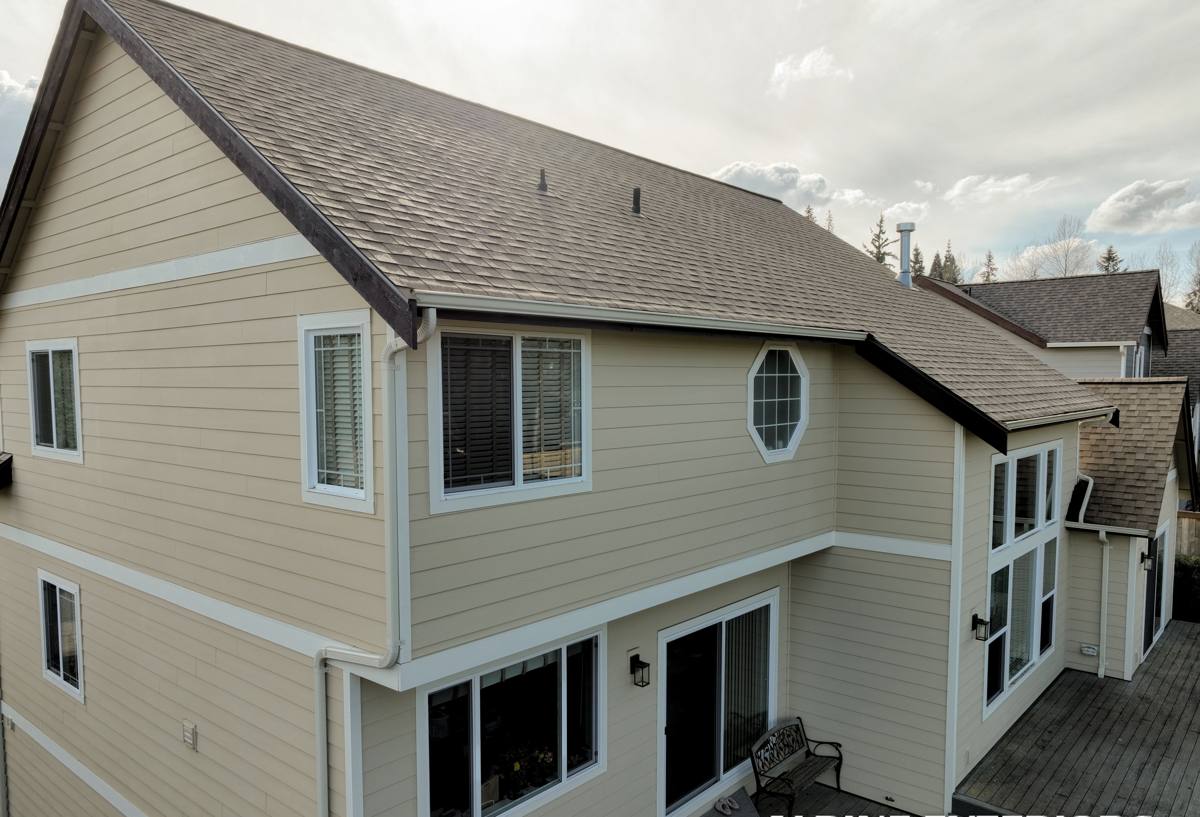
What the Local Climate Actually Does to Siding Here
Moss and Algae Have More Time to Establish
Where a south-facing wall in an open subdivision dries out within a day or two of a storm, a shaded, tree-covered wall in Sudden Valley can stay damp for a week or more. That extra dry-time gap is the difference between a siding surface that self-cleans in the sun and one that slowly builds a film of moss, lichen, and algae — especially on north- and west-facing elevations and anywhere a roofline or deck blocks airflow.
Driving Rain Finds Every Gap
Bellingham's storms come in wind-driven, not just straight down, and Sudden Valley's elevation and exposure to weather moving off the water mean wind-driven rain is a real design factor, not a hypothetical one. Any seam, unflashed penetration, or gap in the water-resistive barrier behind the siding is an opportunity for water to get pushed in rather than run off.
Constant Dampness Behind the Cladding
Tree cover reduces wind and sun exposure to the wall assembly itself, not just the surface. That means less drying potential for whatever moisture does get behind the siding, which is exactly why the assembly behind the cladding — not just the cladding itself — has to be built to manage water rather than hope it never shows up.
Debris and Organic Buildup
Mature tree canopy sheds needles, cones, and leaf litter that collect in gutters, at wall-to-roof transitions, and along ledges. Left in place, that organic debris holds moisture directly against trim and siding edges, which is where a lot of hidden rot problems start.
What Correct Installation Involves in a Shaded, Wet Setting
A siding job that looks fine going up can still fail in a few years if the water-management fundamentals are skipped. In a setting like Sudden Valley, we treat these as non-negotiable, not upgrades:
- A drainage gap (rainscreen) behind the siding so any moisture that gets past the surface has somewhere to go, and airflow to help the wall dry.
- Correctly lapped, code-compliant weather-resistive barrier with no upside-down laps or exposed staple holes.
- Kick-out flashing at every roof-to-wall intersection, so runoff is diverted away from the wall instead of running down behind the siding.
- Proper flashing and sealant at every window, door, and penetration — the majority of siding moisture failures start at these transitions, not in the field of the wall.
- Manufacturer-specified fastener placement and clearance from grade, decks, and roof lines, so the siding itself isn't sitting in a moisture trap.
- Butt joints and corners detailed to shed water outward rather than wick it inward.
Skip any one of these and the siding can look correct for a season or two while water quietly does damage behind it — the kind of damage that's expensive to find and expensive to fix.
Why We Install Only James Hardie Fiber Cement
This company installs James Hardie fiber cement siding exclusively — not vinyl, not LP SmartSide, not Cemplank or Allura, not primed spruce or cedar. That's a deliberate standard, not a sales preference, and it matters more in a shade-and-moisture environment like Sudden Valley than it does almost anywhere else in the county.
Fiber Cement's Moisture Behavior
Fiber cement doesn't absorb and swell the way wood-based products can, and it doesn't trap moisture against the wall the way some vinyl assemblies can when installed tight. In a location where surfaces stay damp longer, that dimensional stability matters — it's less prone to cupping, splitting, or the fastener back-out that shows up on wood siding after repeated wet-dry cycles.
ColorPlus Factory Finish
James Hardie's ColorPlus finish is baked on in a factory-controlled process, which gives it more consistent resistance to fading, staining, and the kind of surface breakdown that gives moss and algae something to grip. It's not moss-proof — nothing left outdoors in a wet climate is — but a dense, factory-cured finish holds up to washing and resists staining better than field-applied paint on wood or composite substrates.
Climate-Engineered Product Lines
Hardie manufactures HZ (HardieZone) product formulations engineered for specific climate zones, including wetter, cooler regions like ours. That's a meaningful difference from a one-size-fits-all product — the plank composition is matched to the moisture and freeze-thaw conditions it will actually face here.
Non-Combustible Construction
James Hardie siding is non-combustible fiber cement. For homes surrounded by dense tree cover, as many Sudden Valley properties are, that's a real consideration for wildfire defensible-space planning, not just a marketing point — it's one less combustible material on the exterior of a home sitting close to fuel-heavy vegetation.
Warranty Backing
Hardie's product warranty is transferable and among the strongest in the fiber cement category, which matters on a 30-plus-year exterior product — you want the paper trail to mean something if the home changes hands.
How Materials Compare in This Kind of Setting
| Material | Moisture/shade tolerance | Moss & algae resistance | Long-term maintenance |
|---|---|---|---|
| James Hardie fiber cement | Dimensionally stable when wet; engineered HZ formulations for wet climates | Factory ColorPlus finish resists staining better than field-painted surfaces | Periodic washing; no repainting on ColorPlus finish for the warranty term |
| Cedar / primed spruce | Absorbs moisture; prone to cupping and splitting in prolonged damp conditions | Untreated wood surfaces are highly hospitable to moss and mildew in shade | Regular refinishing/painting; more frequent inspection for rot |
| Vinyl | Doesn't absorb water, but can trap moisture behind it if installed tight to the wall | Smooth surface resists some growth, but seams and laps still collect debris and grime | Low upkeep, but limited repair options if panels warp or fade |
| LP SmartSide (engineered wood) | Wood-strand substrate is more moisture-sensitive than fiber cement | Coating quality and edge-sealing are critical in constant shade | Manufacturer maintenance requirements to preserve warranty coverage |
This is a general comparison of how these material categories tend to behave, not a claim about any specific product failing — it's exactly why we chose to standardize on one system rather than install several and hope the site conditions cooperate.
Our Installation Process
- On-site assessment. We walk the property, note shade patterns, tree proximity, drainage paths, and existing moisture damage before quoting anything.
- Tear-off and sheathing check. Old siding comes off and the sheathing underneath gets inspected for rot or soft spots — this is where hidden problems from a previous install usually turn up.
- Water-resistive barrier and rainscreen. A correctly lapped barrier goes on first, followed by a drainage gap system so the wall assembly can dry.
- Flashing details. Windows, doors, roof-to-wall intersections, and penetrations get flashed before a single piece of siding goes up.
- Hardie plank installation. Installed to manufacturer fastener spacing, clearance, and joint-treatment specifications — not shortcuts that speed up the job but compromise the assembly.
- Trim, caulking, and final inspection. Every joint and transition gets checked before we call the job finished.
Site-Specific Considerations for Sudden Valley Homes
Access and Logistics
Many Sudden Valley properties sit on private, community-managed roads with longer driveways and more limited staging space than a typical in-town lot. A crew that has already worked in the community knows to plan material delivery and dumpster placement around that ahead of time, rather than figuring it out on the first morning.
Working Around Mature Trees
Root zones, low branches, and drip lines all affect where scaffolding and ladders can safely go, and we plan around protecting the trees as much as protecting the house. It also affects sequencing — some elevations may need to wait for a dry window that a shaded wall gets less often.
Defensible Space Awareness
For homes backed up against dense tree cover, we're mindful of how the exterior assembly fits into a broader wildfire-conscious approach — fiber cement's non-combustibility is one piece of that, alongside gutter and debris management.
What Drives Cost on a Job Like This
| Factor | Why it matters here |
|---|---|
| Tear-off vs. overlay | Full tear-off is usually the right call when there's existing moisture damage, which is more common on shaded elevations |
| Hidden moisture repair | Rotted sheathing or framing found during tear-off adds scope that can't be quoted until the old siding is off |
| Trim and detail complexity | Homes with more window/door transitions and roof intersections need more flashing labor |
| Access difficulty | Steep, wooded, or narrow-access lots take longer to stage and scaffold safely |
| Number of stories | Multi-story walls require more scaffolding and safety setup time |
We give a written, itemized estimate after the on-site assessment rather than a ballpark over the phone — on a lot with tree cover and elevation changes, guessing at scope without seeing the walls does homeowners a disservice.
Maintaining Hardie Siding in a Shaded, Wet Setting
- Rinse siding periodically to remove moss, pollen, and organic film before it builds up, especially on north- and west-facing walls.
- Keep gutters clear of needles and debris so water isn't overflowing onto siding and trim.
- Trim back branches and foliage that keep a wall surface shaded and damp longer than necessary.
- Re-caulk joints and trim as needed over time — caulk has a shorter service life than the siding itself.
- Have flashing and butt joints checked periodically, particularly after major wind or rain events.
Why a Crew That Already Works in Sudden Valley Matters
Siding installation done to a generic standard can pass a quick visual inspection and still be wrong for this specific setting — wrong flashing at a roof intersection, no drainage gap behind the cladding, or a product that wasn't built for a climate that stays wet this long. A crew that already understands what shaded, lakeside, wooded lots demand plans for that from the estimate forward, instead of treating it as a surprise halfway through the job.
If you're considering new siding for a Sudden Valley home, we're happy to walk the property, look at your specific shade and moisture exposure, and put together a straightforward, no-pressure estimate using the form below.