 Bellingham Siding
 Siding Repair Built for Edgemoor's Bluff and Bay Exposure
Edgemoor sits along Bellingham Bay on wooded, elevated terrain, and that combination creates a specific set of siding problems. Homes closer to the water take on salt-laden air and wind-driven rain off the bay, while homes tucked under the neighborhood's mature tree canopy deal with near-constant shade, moss, and slow-drying siding. Some properties get both. When we're called out for a siding repair in Edgemoor, we're rarely looking at one simple problem — it's usually a combination of moisture intrusion, coating failure, and organic growth that's been working on the siding for a season or two before anyone noticed.
This page covers what siding repair actually means for this neighborhood specifically: what Whatcom County's coastal, tree-shaded climate does to siding over time, what a correct repair looks like versus a cosmetic patch, and why a crew that already knows Edgemoor's housing stock gets better results than a general handyman or a repair-only outfit passing through.
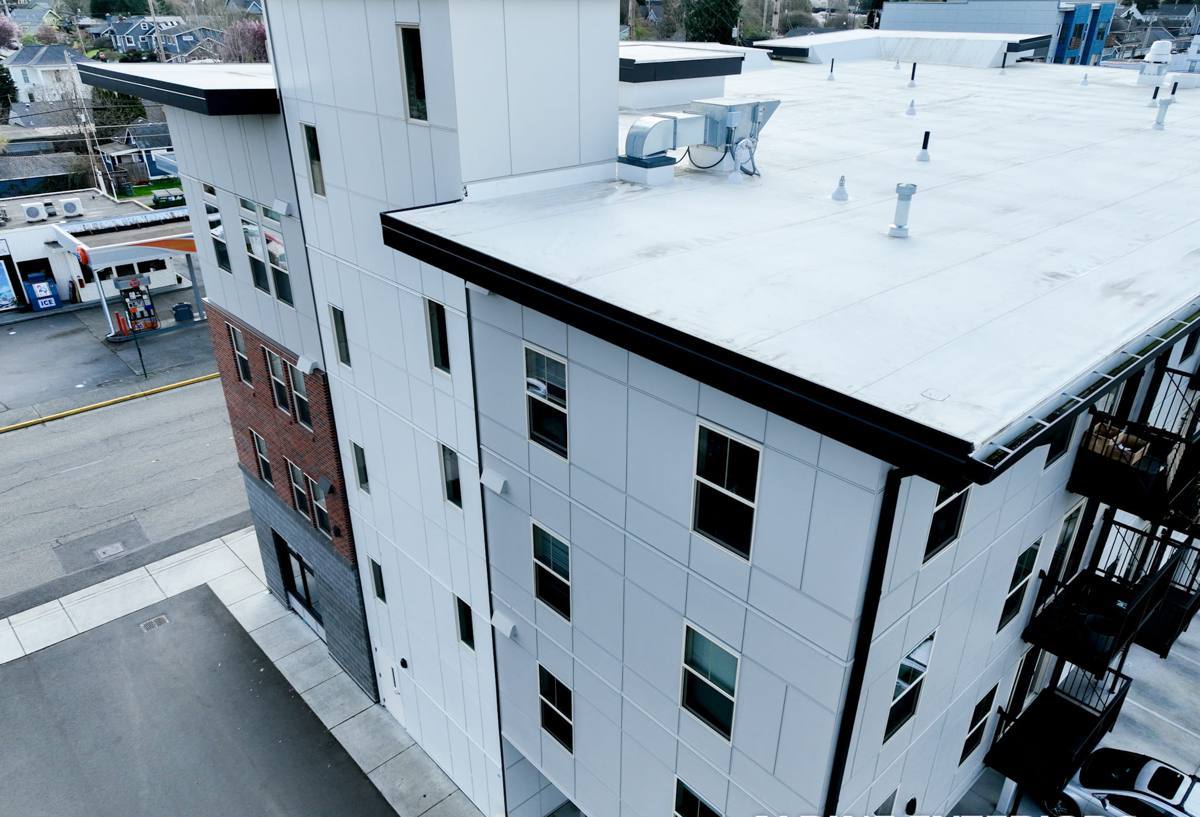
What Bellingham's Climate Does to Siding in a Neighborhood Like Edgemoor
Salt Air and Driving Rain
Bellingham Bay pushes salt-carrying moisture inland, and it settles on exterior surfaces year-round. Salt air accelerates the breakdown of paint and caulk faster than inland exposure does, which means seams, fastener heads, and trim joints on bay-facing elevations tend to fail years ahead of the same details on a home a few miles inland. Combine that with the driving rain that comes through on southwest storms, and any gap in the siding envelope — a cracked caulk line, a popped nail, a hairline split at a butt joint — becomes an entry point for water rather than just a cosmetic flaw.
Moss, Shade, and Slow Drying
The tree cover that makes Edgemoor attractive also means many homes have elevations that rarely see direct sun. Siding in constant shade dries slowly after every rain event, and Whatcom County gets a lot of rain events. That extended damp window is exactly what moss and algae need to establish. Once moss takes hold at a butt joint, under a window sill, or along a lower course near grade, it holds moisture against the siding continuously — which is a different, more damaging problem than surface staining. It's a slow but steady driver of rot underneath whatever the outer material is.
Why This Combination Matters for Repair Work
A repair approach that works fine in a dry, sunny neighborhood can fail in Edgemoor because it doesn't account for extended dampness or salt exposure. That's why we don't treat siding repair here as a generic service — the details of flashing, caulking, and drainage have to match what this specific microclimate throws at a house.
What a Correct Siding Repair Actually Involves
A lot of "siding repair" in this region is really just cosmetic patching — caulk over a crack, paint over a stain, a new board face-nailed over rot without ever checking what's behind it. That approach buys a year or two of appearance and does nothing for the underlying problem, which usually keeps getting worse behind the patch.
Our process starts with diagnosis, not a quote
- Identify whether the damage is surface-level (coating failure, moss, minor cracking) or has reached the substrate (soft spots, delamination, rot at the sheathing)
- Check flashing and drainage paths at every window, door, and roof-to-wall intersection near the damaged area — most siding failures start with a flashing detail, not the siding itself
- Probe for moisture intrusion behind the siding in the affected zone and a reasonable margin around it, not just at the visible damage
- Confirm what material is currently installed and whether it's compatible with a proper, code-correct repair
- Document findings before recommending a scope of work
Then the actual repair
Once we know what's really going on, the repair itself follows the same standards as new installation: correct fastening, proper clearances at grade and other hard surfaces, house wrap and flashing integrated correctly at every penetration, and factory-finished material installed to the manufacturer's specifications. A repair that skips any of these steps isn't a repair — it's a delay.
Why We Only Repair With James Hardie Fiber Cement
We install and repair exclusively with James Hardie fiber cement siding. We don't install or patch in vinyl, LP SmartSide, Cemplank, Allura, primed spruce, or cedar, and in a climate like Edgemoor's, that standard matters more than it would somewhere drier.
Why fiber cement holds up here
James Hardie's fiber cement is non-combustible and dimensionally stable — it doesn't expand and contract with moisture the way wood-based products do, which matters directly in a neighborhood where shade and salt air keep siding damp longer than average. It resists moss and algae growth far better than wood-based siding, and it doesn't delaminate the way some engineered wood products can when water gets behind the face. The ColorPlus factory finish is baked on under controlled conditions, which gives it better resistance to fading and coating failure from salt air and UV than field-applied paint.
Why we don't repair other materials with mismatched patches
When a home has an existing non-Hardie product — cedar, LP SmartSide, older vinyl — we'll be honest about the trade-offs of patching it versus doing a targeted section replacement in Hardie. Wood-based siding in particular can be sensitive to how it's repaired; a mismatched patch that doesn't handle moisture the same way as the surrounding material can create a new problem instead of solving the old one. We'll always tell you what we're seeing and what the real options are, rather than just matching whatever's already on the wall.
Common Edgemoor Repair Scenarios
| Symptom | Likely Cause | What We Check |
|---|---|---|
| Dark green or black staining along lower courses | Moss/algae growth from shade and slow drying | Grade clearance, gutter overflow, drainage path, whether moisture has reached the substrate |
| Soft or spongy siding near window sills | Failed flashing or caulk allowing water behind the siding | Window flashing integration, sealant condition, sheathing moisture |
| Peeling or chalky paint on bay-facing walls | Salt air and UV breaking down field-applied coatings | Coating type and age, whether the substrate underneath is still sound |
| Cracked or split boards at butt joints | Moisture cycling and material movement at unsealed joints | Joint treatment, whether the material itself is failing or just the seam |
| Visible gaps or warping at corners and trim | Fastening or clearance issues from original installation | Fastener pattern, trim clearance, whether a full section needs correction |
Repair vs. Replace: How We Help You Decide
Not every damaged section needs a full re-side, and not every repair is worth doing in isolation. The honest answer depends on how much of the wall is affected and what's driving the damage.
Repair usually makes sense when
- Damage is isolated to one elevation or a small section
- The substrate underneath is still sound once probed
- The rest of the siding is in reasonable condition for its age
- The root cause (flashing, drainage, clearance) can be corrected as part of the repair
Replacement is usually the better call when
- Moisture damage has spread across multiple elevations
- The existing material is a product we don't stand behind (see above) and repeated patching has become the pattern
- The home is old enough that the remaining siding is near the end of its service life anyway
- Rot has reached structural sheathing in more than a spot repair's worth of area
We'll give you a straight recommendation either way. A repair-only company has an incentive to always say "repair." A full-replacement company has the opposite incentive. We do both, and we tell you which one actually fits what we find on your house.
Why a Crew That Already Works Edgemoor Matters
Edgemoor's terrain isn't uniform — bluff-top homes, wooded lots, waterfront-adjacent properties, and homes further back from the bay all see different combinations of salt exposure, shade, and wind. A crew that's worked in this neighborhood before knows which elevations on a given lot are likely to be the trouble spots before they even get on a ladder, and knows how the local moss and moisture patterns typically show up compared to a drier or more open Whatcom County property. That local pattern recognition speeds up diagnosis and helps us avoid guessing.
It also matters for access and site conditions — tree cover, slope, and setback distances affect how a repair crew stages material and equipment, and knowing that in advance keeps a repair job from turning into a longer, more disruptive project than it needs to be.
What to Expect From Our Repair Process
- On-site inspection and diagnosis, including moisture checks and a look at flashing and drainage near the damaged area
- A written scope that explains what we found, what's causing it, and what repair (or replacement) addresses it
- A clear, honest cost range before work starts — no surprise change orders for problems we should have caught during inspection
- Repair work performed to the same fastening, flashing, and clearance standards as new installation
- A final walkthrough so you can see exactly what was done and why
If your Edgemoor home is showing moss buildup, soft siding, peeling paint, or cracked boards, it's worth having someone look at the cause, not just the symptom. We offer free, no-pressure estimates for siding repair in Edgemoor and throughout Bellingham — fill out the form below and we'll take a look.