 Bellingham Siding
 Deck Building in York: Designed for the Weather You Actually Get
A deck in the York area of Bellingham lives outside year-round in conditions that are harder on wood and fasteners than most homeowners realize. This isn't a climate of occasional storms followed by long dry stretches — it's a climate of steady, low-grade moisture exposure, punctuated by driving rain off the water and a moss season that can run for months. A deck built to a generic national spec, without those specifics in mind, tends to show its age fast: soft spots at the ledger, streaking and slime on the boards, corroded hardware, and railings that loosen before their time.
Building decks correctly for York means treating moisture management as the central design problem, not an afterthought. Everything from footing depth to fastener choice to the gap between deck boards gets decided with drainage and drying time in mind, because in this part of Whatcom County, a deck that can't shed water and dry out between storms is a deck that's already on a shorter clock.
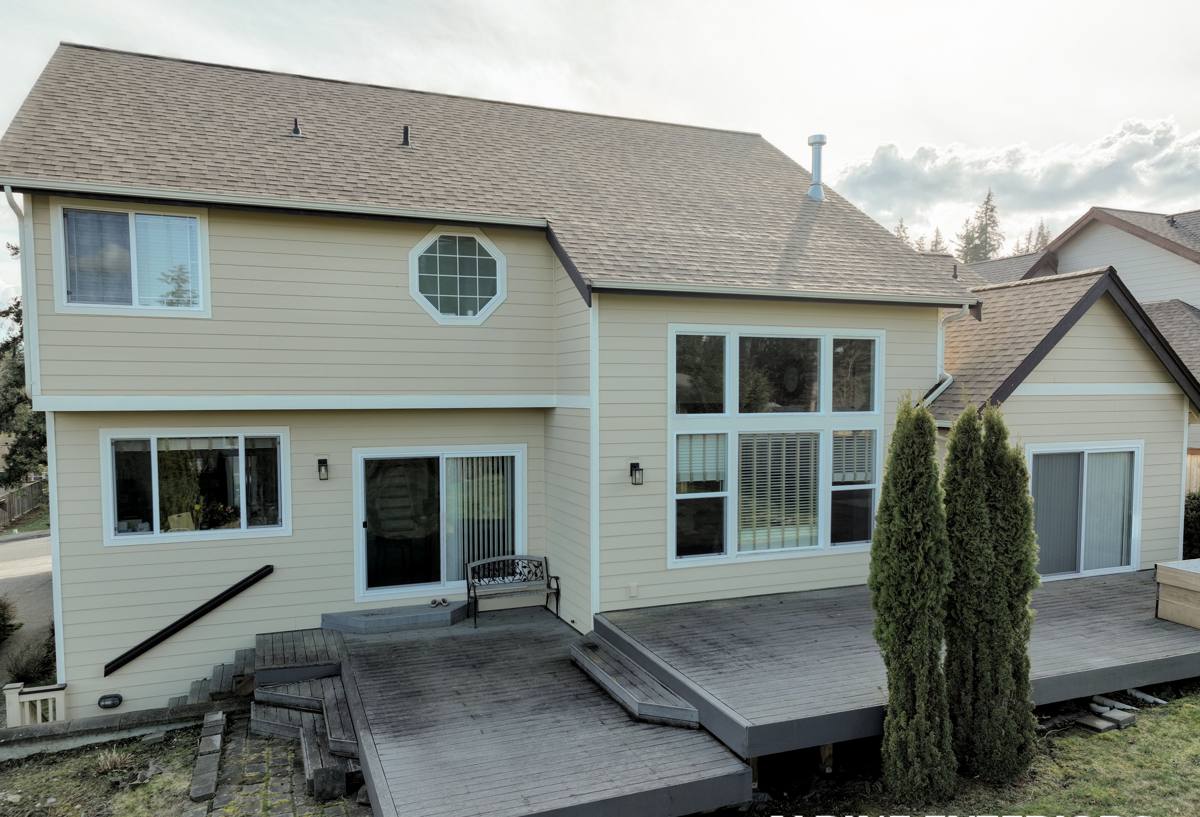
What This Climate Does to a Deck
Driving Rain and Standing Moisture
Rain here rarely falls straight down. Wind-driven rain gets pushed sideways and up under railings, into fastener heads, and along the underside of boards where it doesn't evaporate quickly. Over time, that trapped moisture is what causes rot at the ledger board, at post bases, and at any spot where two pieces of wood sit tight against each other without room to dry.
Salt Air and Metal Fatigue
Proximity to Bellingham Bay means a steady low level of salt in the air, even away from the immediate waterfront. Salt air accelerates corrosion on anything less than fully rated hardware — screws, joist hangers, post brackets, and railing connectors. Standard interior-grade or mismatched fasteners will rust, stain the wood around them, and eventually weaken well before the structure itself would otherwise need attention.
Moss, Algae, and Surface Buildup
Whatcom County's long wet season gives moss and algae months of ideal growing conditions on any horizontal wood surface that stays damp. Beyond looking bad, moss holds moisture against the decking, and on stairs or ramps it becomes a real slip hazard. A deck that isn't detailed for airflow and drainage underneath will grow moss faster than one that is, regardless of what material sits on top.
Choosing Decking Material for a York Property
There's no single "right" material for every home — the right choice depends on budget, how much upkeep you're willing to do, and how the deck sits relative to sun, shade, and drainage. Here's how the common options actually compare in this climate:
| Material | How It Handles This Climate | Maintenance | Typical Lifespan |
|---|---|---|---|
| Pressure-treated fir/hem-fir | Affordable, but needs consistent sealing to resist the wet season; prone to moss without regular cleaning | Annual cleaning, re-sealing every 1-3 years | 10-20 years with upkeep |
| Cedar | Naturally rot- and insect-resistant, weathers well, but still benefits from periodic sealing to hold its color and resist moss | Cleaning plus occasional oil or sealant | 15-25 years with upkeep |
| Composite decking | Doesn't absorb water or rot, resists moss buildup better on the surface, but still needs proper under-deck airflow | Periodic washing; no sealing or staining | 25-30+ years, manufacturer-warrantied |
| PVC decking | Fully synthetic, most resistant to moisture and staining, performs well in salt-air exposure | Occasional washing | 25-30+ years, manufacturer-warrantied |
Composite and PVC products cost more up front but remove sealing and staining from your maintenance routine entirely, which matters a lot in a climate where that work needs to happen more often than the label on a can of sealer might suggest. Wood costs less initially and can look excellent, but it only performs as well as the maintenance schedule behind it — skip a couple of years of sealing here and the wood knows it.
Framing and Structure: Where Decks Actually Fail
The decking surface is what you see, but the framing underneath is what determines whether the deck is safe and how long it lasts. Most deck failures we get called out to inspect or repair trace back to a handful of structural details:
Ledger Board Attachment
Where the deck attaches to the house is the single most common failure point in this climate. Proper flashing that directs water away from the house sheathing, correct fastener spacing, and a code-compliant connection method are non-negotiable — a poorly flashed ledger is how water gets behind siding and into framing that's expensive to fix later.
Footings and Post Bases
Footings need to be sized and set to the depth Whatcom County code requires, and post bases should hold the post up off the concrete rather than letting end grain sit in standing water. This one detail is a common shortcut on lower-quality builds and a common cause of soft, failing posts years down the road.
Joist Hardware and Fasteners
Every hanger, screw, and bolt exposed to the weather should be rated for exterior and, ideally, coastal/salt-air use. Mixing metals (for example, an incompatible fastener in a treated-lumber connector) causes galvanic corrosion that can compromise hardware well before the wood around it fails.
Airflow Underneath
Decks built low to the ground or over poorly graded soil trap moisture underneath, which speeds up both rot and moss growth on the underside of the boards. Grading, gapping, and in some cases venting are part of a correctly built deck here, not an upgrade.
Our Deck Building Process
1. Site Visit and Design
We walk the property, look at drainage patterns, sun/shade exposure, and how the deck will tie into the house, then talk through material options honestly — including the maintenance trade-offs above — so you're choosing based on real information, not a sales pitch.
2. Permitting
Most new decks and many deck replacements in Bellingham and unincorporated Whatcom County require a permit. We handle the permitting and inspection process as part of the job so the structure is documented and code-compliant, not something you have to sort out later if you sell the house.
3. Demolition and Site Prep
If we're replacing an existing deck, we remove the old structure and check what's underneath — ledger condition, soil, existing footings — before building anything new on top of it.
4. Framing
Footings, posts, beams, and joists go in to code, with corrosion-rated hardware and ledger flashing detailed for this climate specifically, not a generic spec.
5. Decking, Railing, and Stairs
Decking is installed with proper gapping for drainage and expansion, railings are set to current code height and baluster spacing requirements, and stairs are built with consistent rise and run for safety.
6. Final Walkthrough
We go over the finished deck with you, including what maintenance it needs (if any) and roughly when, so there are no surprises in year two or three.
Permits and Code in Whatcom County
Deck height, guardrail requirements, footing depth, and ledger attachment are all governed by building code, and inspectors in this area pay particular attention to ledger flashing and footing depth given how much damage improper drainage can cause over time. Skipping the permit process might save a little time up front, but it leaves you with an unpermitted structure that can complicate insurance claims, resale, or future additions. We build to pass inspection, not just to look finished.
Maintenance in a Moss-Prone Climate
Whatever material you choose, a little seasonal attention goes a long way toward keeping a York-area deck safe and looking good through the wet months. A simple maintenance routine:
- Clear leaves and debris from the deck surface and between boards before fall rains set in
- Rinse or lightly scrub the surface periodically during moss season to keep growth from taking hold
- Check stairs and walking surfaces for slickness after long wet stretches, especially in shaded areas
- Inspect railings and stair connections annually for looseness
- For wood decking, re-seal on the schedule appropriate to the product — don't wait until it visibly needs it
- Keep gutters and downspouts near the deck clear so runoff isn't draining directly onto or under it
Why a Crew That Already Works in York Matters
Deck building isn't just carpentry — it's carpentry that has to survive a specific set of weather conditions. A crew that regularly builds and repairs decks in and around Bellingham has already seen which details hold up here and which ones fail early: which fasteners actually resist the salt air, how deep footings need to go in local soil conditions, and how much airflow a deck really needs underneath to keep moss from taking over by its second wet season. That local track record is worth more than a lower bid from a crew building to a generic spec that wasn't written with this coastline in mind.
If you're planning a new deck or need to replace one that's showing its age, we're happy to take a look and talk through honest options for your property. Request a free, no-pressure estimate using the form below.