 Bellingham Siding
 Building Decks That Hold Up in Birchwood
Birchwood sits close enough to the water and low enough in the tree canopy that decks here take a beating most inland Whatcom County neighborhoods never see. Salt-laden air moves in off Bellingham Bay, driving rain comes sideways more often than straight down, and the moss season stretches from late fall well into spring. A deck built without those three factors in mind will look fine the first summer and start showing problems by year two — soft spots near the ledger board, green film on the walking surface, corroded fasteners bleeding rust streaks into the wood or composite decking.
We build and repair decks in this neighborhood regularly, and the design choices that matter here aren't exotic — they're just specific. Right structural grade of lumber or the right composite profile, correct flashing at the house connection, drainage that actually moves water off the surface instead of pooling it, and fasteners rated for coastal exposure. Get those right and a deck in Birchwood lasts as long as one anywhere in Bellingham. Skip them and you're rebuilding sooner than you should.
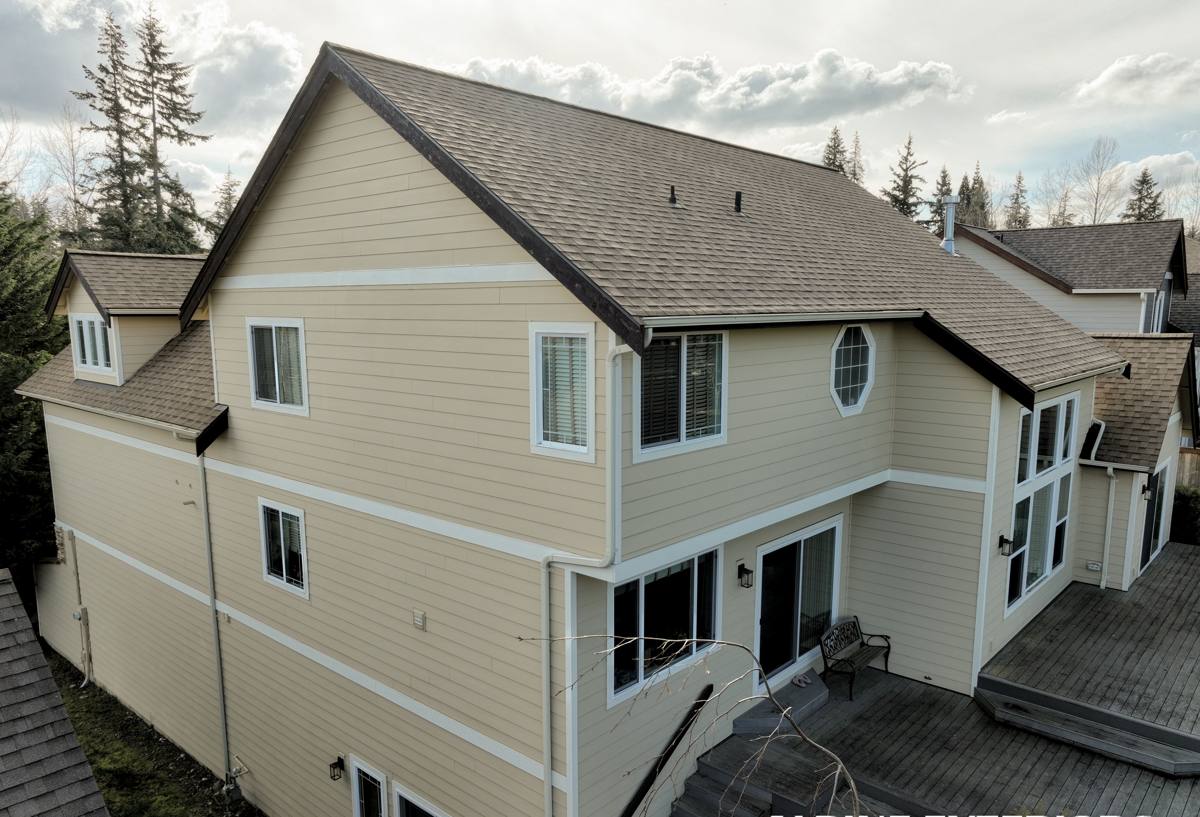
What Salt Air, Rain, and Moss Actually Do to a Deck
Salt Air and Metal Fasteners
Proximity to the bay means airborne salt settles on every exposed surface, including the screws, nails, and structural hardware holding your deck together. Standard galvanized fasteners can start corroding within a few seasons in this kind of exposure. Once a fastener starts to rust, it weakens at the exact point where it's doing the most work — holding boards to joists or joists to the ledger. That's not a cosmetic issue; it's a structural one.
Driving Rain and Water Intrusion
Rain that comes in at an angle finds its way into joints, under railings, and behind ledger boards more aggressively than straight-down rain does. The most common failure point on any deck attached to a house is the ledger connection — where the deck meets the wall. If that flashing detail isn't done correctly, water gets behind the siding and into the rim joist, and you end up with rot in a spot that's hard to see until it's already serious.
Moss and a Long Wet Season
Moss doesn't just grow on roofs. On a deck surface that stays shaded or doesn't drain well, moss and algae build up on the walking surface, on stair treads, and in the gaps between boards. Beyond looking bad, a mossy deck surface is genuinely slick — a real slip hazard on stairs and ramps. It also holds moisture against the wood or decking material longer than it should, which accelerates whatever decay process is already underway.
What a Correctly Built Deck Looks Like Here
- Ledger board flashed and sealed correctly where it meets the house, with proper step flashing under the siding — not just caulk over the top
- Structural fasteners and connectors rated for coastal/high-moisture exposure, not generic galvanized hardware
- Joist spacing and beam sizing that meet current code for your specific deck dimensions and load
- A gap and slope built into the decking surface so rain sheds off instead of pooling
- Stair treads and any high-traffic surfaces detailed to shed water and resist moss buildup
- Railings and posts anchored with hardware that won't corrode and loosen over time
- Ventilation underneath the deck so the framing can dry out between rain events
None of this is unusual construction — it's standard deck building done with the right materials for this specific climate. The mistake we see most often isn't bad workmanship, it's using materials and fasteners that were fine for a drier, more sheltered lot but aren't matched to a Bellingham Bay-adjacent site like Birchwood.
Decking Material Options for This Climate
There's no single "best" decking material — the right choice depends on your budget, how much upkeep you want to do, and how exposed your deck is to sun, rain, and salt air. Here's how the common options compare for a Birchwood property specifically.
| Material | Moss/Algae Resistance | Maintenance | Typical Lifespan Here |
|---|---|---|---|
| Pressure-treated wood | Needs regular cleaning and sealing to resist moss | Annual cleaning, re-sealing every 2-3 years | 15-20 years with upkeep |
| Cedar | Naturally more rot-resistant, still needs cleaning | Cleaning and oiling every 1-2 years to hold color and resist moss | 15-20 years with upkeep |
| Composite decking | Better resistance, but still needs washing off in shaded areas | Occasional washing, no staining or sealing | 25-30+ years, manufacturer-dependent |
| PVC decking | Best moisture resistance of the common options | Occasional washing | 25-30+ years, manufacturer-dependent |
We don't push one product over another as a rule — we walk you through the honest trade-offs. Wood costs less up front but asks more of you every year. Composite and PVC cost more initially but hand you back a lot of maintenance time, which matters if your deck sits in a shaded, moss-prone spot. Whatever material you choose, the fastening, flashing, and drainage details underneath matter more to long-term performance than the decking surface itself.
Repair, Rebuild, or New Build — How to Tell Which You Need
Signs a Repair Is Enough
If the framing underneath is sound and the problems are limited to surface boards, railings, or a section of flashing, a repair or partial rebuild can solve it without touching the whole structure. Soft or discolored boards in one area, a wobbly railing, or moss buildup on the surface alone usually fall into this category.
Signs You Need a Rebuild
Soft or spongy spots near the ledger board, visible rot in joists or beams, rusted-through hardware, or a deck that feels like it's moving or flexing under normal weight are signs the structural integrity is compromised. At that point, patching the surface just hides a problem that's still active underneath. We'll always tell you honestly which situation you're in — there's no reason to sell a full rebuild when a repair will genuinely hold up, and no reason to patch something that's going to fail again in a year.
Our Process for a Birchwood Deck Project
- On-site assessment. We look at your existing deck (if there is one), the house connection point, sun and shade exposure, drainage, and how the site sits relative to prevailing wind and rain direction.
- Honest scope and options. We walk you through material choices, structural needs, and a realistic budget range — no upsell, just what the site actually calls for.
- Permitting. Most deck projects in Bellingham require a permit, especially anything attached to the house or above a certain height. We handle that process so it's not on you to figure out.
- Build with climate-matched materials. Coastal-rated fasteners, correct ledger flashing, and drainage detailing are standard on every deck we build here — not an upgrade option.
- Walkthrough and care guidance. Before we're done, we go over what maintenance (if any) the material you chose actually needs, so you're not guessing later.
Why It Matters to Hire a Crew That Already Works Birchwood
A deck built to a generic spec sheet can still fail in this neighborhood if the crew building it hasn't accounted for what the site sees over a full year — not just a dry install day in July. Knowing which fasteners hold up under salt exposure, how to detail a ledger connection so driving rain doesn't get behind it, and where moss tends to build up on a shaded lot near the bay isn't something you learn from a manual. It's something you learn from doing the work here, season after season, and seeing what comes back for repair versus what doesn't.
We're a Whatcom County crew, and Birchwood is part of our regular service area. That means when we quote a deck project, we're not guessing at what the site will face — we already know what Bellingham Bay-adjacent lots deal with and we build accordingly from day one.
Maintenance Checklist for Your Deck's First Few Years
- Sweep debris and standing leaves off the surface regularly, especially in fall
- Wash down shaded areas and stair treads at least once a year to prevent moss buildup
- Check the ledger board and flashing area annually for any signs of moisture staining
- Inspect railing posts and structural hardware for rust or looseness
- Reseal or restain wood decking on the manufacturer or trade-standard schedule — don't wait until it looks bad
- Keep gutters and downspouts near the deck clear so runoff isn't draining directly onto it
If you're planning a new deck, replacing an aging one, or just want an honest read on whether yours needs repair or a full rebuild, we're happy to take a look. Reach out for a free, no-pressure estimate using the form below.