 Bellingham Siding
 Decking Built for Barkley's Weather, Not Against It
Barkley sits close enough to Bellingham Bay and the surrounding wetlands that homeowners here deal with a specific combination of conditions: salt-tinged air moving in off the water, long stretches of driving rain through fall and winter, and a moss season that can run from October well into May. A deck that looks fine in a showroom photo can start showing problems within a year or two if it wasn't built with this climate in mind. We've worked on decks throughout Whatcom County long enough to know which details matter here and which ones are just marketing.
This page is specifically about composite decking for homes in and around Barkley — what the climate asks of the material, what a correct installation looks like, and how we approach the work differently than a crew that's never dealt with a Pacific Northwest wet season.
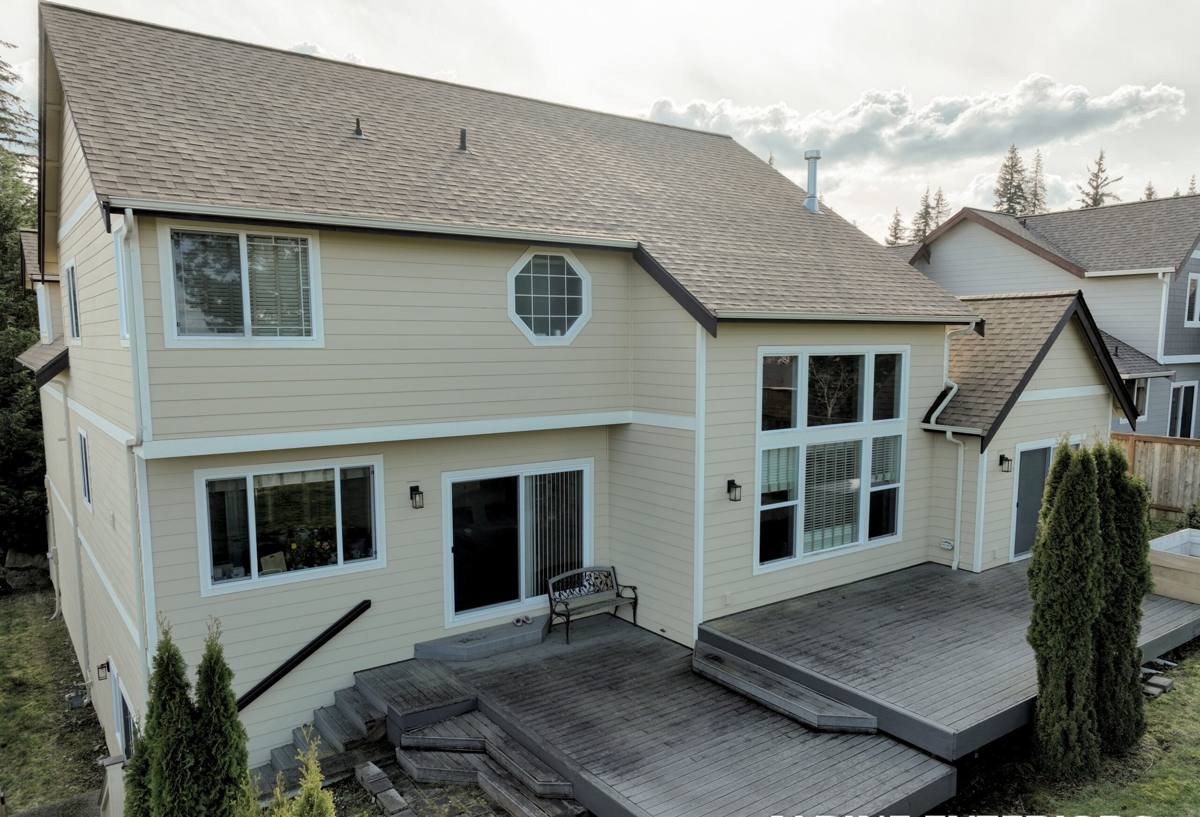
Why Composite Makes Sense for This Neighborhood
Salt Air and Corrosion
Homes closer to the bay deal with airborne salt that accelerates corrosion on fasteners, hardware, and any exposed metal. Composite decking itself doesn't corrode, but a deck is only as good as what holds it together. We use stainless or coated fasteners and hardware rated for coastal exposure, because the boards can be maintenance-free while the screws underneath quietly rust out in five years if the wrong ones were used.
Driving Rain and Moisture Cycling
Bellingham doesn't get flash floods, it gets weeks of steady, wind-driven rain. That means deck surfaces, ledger boards, and framing go through constant wet-dry cycling for much of the year. Wood decking swells, dries, and checks under that cycling. Composite boards are dimensionally more stable, but they still need proper drainage and airflow underneath — composite resists rot itself, but the framing behind and under it does not.
Moss and Algae Growth
Shaded decks, north-facing decks, and anything under tree cover in this area will grow moss and algae if the surface stays damp and doesn't get airflow or occasional sun. This isn't a defect in the material — it's just biology in a wet climate. The board profile, the gap spacing between boards, and the ventilation underneath the deck all affect how fast that growth shows up and how easy it is to keep off.
What a Correct Composite Deck Installation Actually Involves
Composite decking is more forgiving than wood in some ways and less forgiving in others. The board itself doesn't need staining or sealing, but it will telegraph problems in the substructure faster than people expect, because there's no wood surface hiding minor rot or movement underneath.
- Ledger board flashing: where the deck attaches to the house, correct flashing (not caulk alone) keeps water from getting behind the siding — a common failure point on older Bellingham homes.
- Joist tape: a self-adhering membrane over the top of every joist protects the wood framing from the moisture that inevitably gets through gaps between boards.
- Proper drainage slope: the deck surface should pitch slightly away from the house so water sheds instead of pooling near the foundation or door thresholds.
- Ventilation underneath: low-clearance decks need enough airflow beneath the frame to let the structure dry out between rain events, which matters more here than in drier climates.
- Hidden fastener systems: most composite lines are designed for clip-based hidden fasteners rather than face-screwing, which also helps drainage between boards.
- Expansion gaps: composite boards expand and contract with temperature more than people assume; gapping them wrong causes buckling or unsightly gaps within a season or two.
Any one of these done wrong won't necessarily show up on install day — it shows up two winters later as a soft spot, a stain on the siding, or boards that have started to cup.
Composite Decking Options: How They Compare
"Composite decking" covers a range of products with real differences in how they hold up to a wet, shaded, salt-air climate. Here's how the main categories generally compare:
| Type | Moisture Resistance | Moss/Algae Resistance | Maintenance | Relative Cost |
|---|---|---|---|---|
| Uncapped composite | Good, but can absorb moisture at cut edges over time | Moderate — more porous surface | Occasional cleaning; edges need sealing at cuts | Lower |
| Capped composite | Very good — polymer shell resists moisture intrusion | Good — smoother, less porous surface | Periodic rinse and light scrub | Mid to upper-mid |
| Solid PVC | Excellent — no wood fiber content at all | Good, though still needs cleaning in shade | Low — rinse and occasional scrub | Higher |
| Pressure-treated wood | Fair — needs regular sealing to perform | Poor without upkeep — moss takes hold quickly | Annual staining/sealing recommended | Lowest upfront |
We generally steer Barkley homeowners toward capped composite or PVC for anything shaded, north-facing, or close to grade, simply because those decks stay wetter longer and benefit most from a low-absorption surface. That's a maintenance and moisture judgment, not a knock on wood decking as a product — it's a fine choice for homeowners willing to keep up with sealing on a schedule.
What Actually Drives the Cost of a Barkley Deck Project
| Factor | Why It Matters |
|---|---|
| Existing structure condition | Reusing sound framing costs less than a full tear-off and rebuild |
| Deck size and shape | Multi-level decks and non-rectangular layouts increase labor and waste |
| Board tier (capped vs. PVC vs. uncapped) | Material cost per square foot varies significantly by product line |
| Railing style | Composite or metal railing systems cost more than basic wood rail |
| Stairs and landings | Each added run of stairs adds both material and labor |
| Permit and inspection | Most decks over a certain height or size require a permit through the local jurisdiction |
| Site access | Sloped lots or limited equipment access common in parts of Barkley can add labor time |
We walk through these factors on-site rather than quoting off a phone call, because two decks that sound identical over the phone can have very different framing conditions underneath.
Our Process for Barkley Deck Projects
- On-site assessment: we look at the existing structure (if any), grading, shade exposure, and how water currently moves around the area.
- Structural evaluation: ledger connection, footings, and joist condition get checked before we talk materials.
- Permit handling: we confirm what the local jurisdiction requires for the project size and pull permits before work begins.
- Tear-off or reframe: old decking is removed and framing is repaired or rebuilt to current standards where needed.
- Flashing, joist tape, and drainage detailing: the parts that don't show but determine how the deck ages.
- Composite board installation: hidden fastener systems, correct gapping, and manufacturer-specified spacing around the perimeter.
- Railing and finish work: railing, fascia, post caps, and stair details completed to match the home.
- Final walkthrough: we go over care and cleaning specific to the board line installed, so there are no surprises about what "low maintenance" actually means.
Living With a Composite Deck Through a Whatcom County Winter
Composite decking is genuinely lower-maintenance than wood, but "low-maintenance" doesn't mean "no maintenance" in a climate that stays wet for half the year. Homeowners who keep up with a short annual routine get noticeably better long-term results than those who ignore the deck until it looks bad.
- Sweep leaves and debris regularly in fall — trapped organic matter is what feeds moss and algae growth on any decking surface.
- Rinse the deck a few times a year with plain water, more often in shaded or north-facing areas.
- Use a soft-bristle brush and a composite-safe cleaner on any green or black staining before it spreads — pressure washing on the highest settings can damage some board surfaces.
- Keep planters and rugs off the deck during the wettest months, or move them periodically, since anything sitting in one spot traps moisture underneath.
- Check that gutters and downspouts near the deck are directing water away rather than onto or under it.
- Inspect railing posts and stair connections once a year for any movement, since hardware is often the first thing to show wear even when the boards themselves look fine.
Railings, Fascia, and Finish Choices That Hold Up Locally
The details around the decking often matter as much as the decking itself. Composite or aluminum railing systems generally outperform painted wood rail in this climate, since they don't need repainting every couple of years to keep moisture out of end grain. Fascia boards — the trim along the outer edge of the deck — take direct rain exposure and benefit from the same capped or PVC material as the decking itself, rather than painted wood that will need attention sooner. Post bases and any structural connections at grade should be set to avoid standing water contact, which is a common oversight on decks built before current best practices.
Why a Crew That Already Works in Barkley Makes a Difference
A deck built by a crew unfamiliar with this specific area is more likely to guess on things a local crew already knows: how the City of Bellingham and Whatcom County permitting process works for residential decks, how local soil and drainage patterns behave on sloped or newer-development lots, and how much shade and moisture a given orientation typically sees through the wet season. That local pattern recognition doesn't replace a proper site assessment, but it means fewer surprises and fewer callbacks. We're not driving in from out of the area for one job — we're building something we'll likely be asked to service or discuss again down the road, which changes how carefully the work gets done the first time.
Questions to Ask Before You Hire a Deck Contractor
- Do they pull permits themselves, or leave that to the homeowner?
- Do they use joist tape and proper ledger flashing as standard practice, or only "if you ask"?
- Can they explain the difference between the composite lines they offer, in plain terms?
- Do they specify corrosion-resistant fasteners and hardware for this climate?
- Will they put the scope, materials, and warranty terms in writing before work starts?
- Have they worked on other decks in Bellingham or nearby, and can they speak to local conditions specifically?
Get a Straightforward Estimate for Your Barkley Deck
If you're weighing composite decking for a home in Barkley, we're happy to come take a look, walk through what your specific site and exposure call for, and give you a clear, no-pressure estimate — no upsell script, just an honest read on what the job actually needs. Use the form below to get started.