 Bellingham Siding
 Why Board & Batten Suits Edgemoor
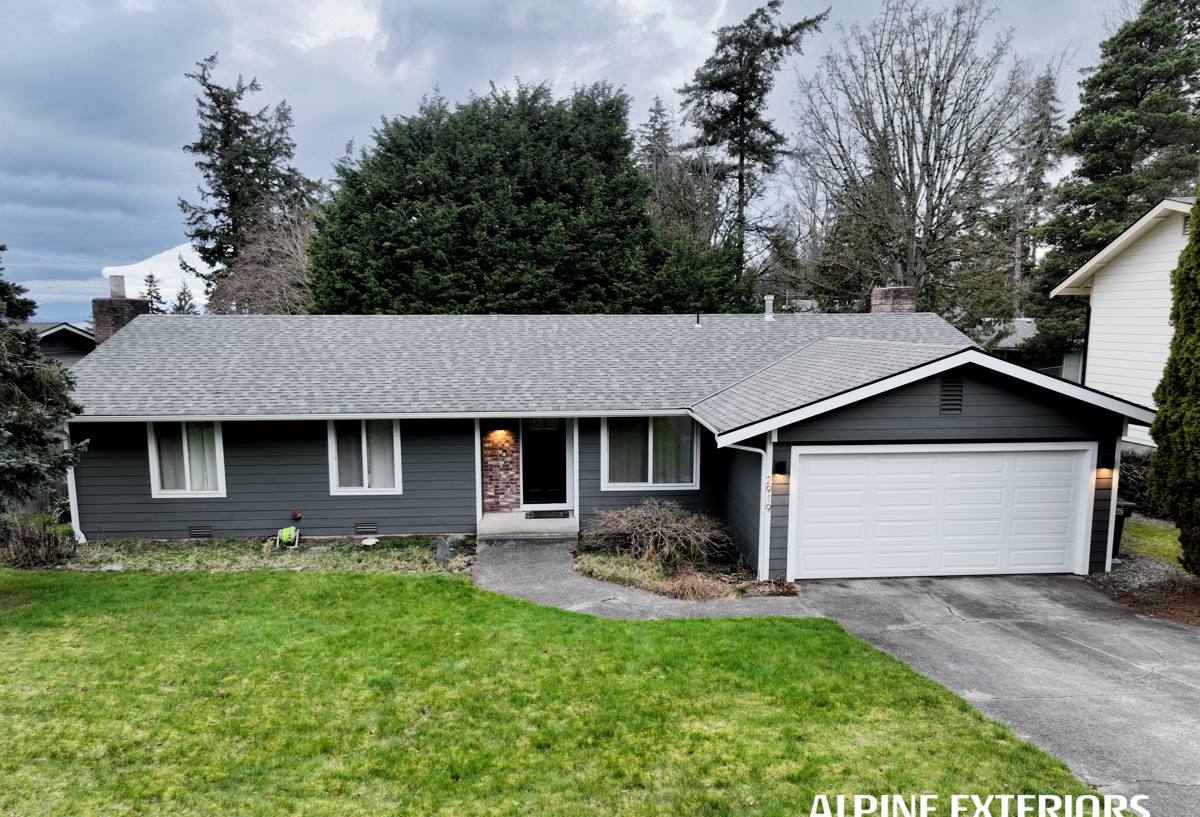
Edgemoor sits on the wooded bluffs above Bellingham Bay, and the housing stock reflects that setting — craftsman, Northwest contemporary, and shingle-style homes with generous rooflines and a lot of vertical wall area between windows. Board and batten reads well against that architecture. The vertical lines echo the tree trunks around the lots, and the deep shadow lines the battens throw work especially well under the soft, filtered light most of these homes get from mature tree cover.
It's not just a style choice, though. Board and batten is one of the older siding profiles in the Pacific Northwest for a reason: done correctly, it sheds water well and gives you a wide, flat wall plane with fewer horizontal laps for water to catch on. Done incorrectly — and we see this on tear-offs regularly — it's one of the profiles most likely to trap moisture behind it, because the batten strips create dozens of extra seams and fastener penetrations compared to lap siding.
What Edgemoor's Climate Actually Does to a Wall
Three things work against siding here, and Edgemoor gets all three at once:
Salt Air Off the Bay
Homes close to the water take a steady, low-level dose of salt-laden air. Over years, that air degrades bare and thinly coated fasteners, and it's hard on finishes that aren't formulated to resist it. Any board and batten job here needs corrosion-resistant fastening and a factory finish that isn't going to chalk or fade from the salt exposure the way a field-applied paint job will.
Driving, Wind-Driven Rain
Storms moving in off the Strait of Georgia and Bellingham Bay don't just fall straight down — wind pushes rain sideways into walls, and bluff-top lots get more of that wind than sheltered inland streets. Vertical siding with battens has more seams than horizontal lap siding, and every one of those seams is a potential entry point if the caulking, flashing, or batten spacing isn't handled correctly.
A Long Moss Season
Whatcom County's wet season stretches from fall through spring, and Edgemoor's tree canopy keeps walls shaded and slow to dry between rains. That combination — shade plus moisture plus a long stretch of mild, damp weather — is exactly what moss and algae need. Siding on the north and west-facing walls under tree cover will grow moss faster than the same siding on an open, sunny lot across town.
What a Correct Board & Batten Job Involves
The style is simple to look at, but there are real technical requirements behind a board and batten wall that actually performs in this climate:
- A drainage plane (weather-resistant barrier) installed continuously behind the panels, lapped correctly at every seam and penetration
- A rainscreen gap — vertical furring strips behind the panels — so water that does get behind the wall has somewhere to drain and air can circulate to dry the wall assembly
- Correct batten spacing over the panel joints, wide enough to cover the seam fully with room for material movement
- Stainless or hot-dip galvanized fasteners sized and spaced to manufacturer specification — not whatever is left over from the last job
- Proper flashing at every window, door, and roofline intersection, installed before the siding goes on, not caulked in after
- Factory-finished panels and trim, so the color coat isn't relying on a field paint job to hold up to salt air and UV
Skip any one of these and the wall will look fine for a season or two. The problems — moisture intrusion behind the panels, rot at the battens, premature paint failure — usually show up two to five years out, well after the crew that did the shortcut work is gone.
Why We Install James Hardie for This Application
We install James Hardie fiber cement exclusively — we don't offer LP SmartSide, vinyl, Cemplank, Allura, primed spruce, or cedar board and batten, and Edgemoor is a good example of why we made that call.
Fiber cement is non-combustible, which matters on wooded bluff lots with real tree cover close to the house. It doesn't absorb water the way wood-based siding can, so it isn't feeding the rot cycle that wet, shaded walls invite. And Hardie's ColorPlus finish is baked on at the factory and warranted against fading and chipping — that's a real advantage in salt air, where a field-applied paint job is going to chalk and fade faster than a factory finish engineered to hold color.
Hardie's HZ5 product line is also formulated for regions like ours, with freeze-thaw and moisture cycling in mind, though Whatcom County's marine climate is milder than the true freeze zones the HZ10 line targets. For vertical board and batten applications we use HardiePanel with HardieTrim battens, which gives the same look homeowners want from a traditional board and batten wall with a fiber cement panel and trim system behind it.
How the Products Compare
| Material | Behavior in Salt Air / Wet Shade | Finish | Long-Term Maintenance |
|---|---|---|---|
| James Hardie fiber cement | Non-combustible, dimensionally stable, doesn't rot or feed moss the way wood fiber can | Factory ColorPlus finish, warranted | Occasional soft wash; no repainting cycle with ColorPlus |
| Cedar / primed spruce board & batten | Absorbs moisture, prone to rot and moss growth in shaded, damp walls | Field-applied paint or stain | Repainting/restaining every few years; ongoing rot inspection |
| LP SmartSide | Engineered wood strand product; more moisture-sensitive at cut edges and panel joints than fiber cement | Factory primed or finished, depending on line | Edge sealing and caulk maintenance is more critical over time |
| Vinyl vertical siding | Doesn't rot, but can warp or fade with sun and temperature swings; more seams to manage water at | Color molded through, not baked-on coat | Low maintenance but limited repair options if a panel is damaged |
Our Process for an Edgemoor Board & Batten Job
- On-site assessment — we look at wall orientation, tree cover, existing moisture damage, and how exposed the house is to wind off the bay before we spec anything.
- Tear-off and sheathing check — we remove the old siding and inspect the sheathing underneath for rot or soft spots before covering anything back up.
- Weather barrier and rainscreen installation — the drainage plane and furring strips go on correctly the first time; this is the step that determines how the wall performs for the next 30 years, and it's invisible once the job is done.
- Flashing at every penetration — windows, doors, hose bibs, light fixtures, roof-to-wall transitions — done before panels go up.
- Panel and batten installation — HardiePanel set to spec, HardieTrim battens fastened correctly and spaced to fully cover each seam.
- Final detailing — caulking only where Hardie specifies it (not as a substitute for proper flashing), touch-up paint matched to the ColorPlus finish where field cuts expose raw edges.
- Walkthrough — we go over the finished wall with the homeowner and explain what routine care, if any, the siding needs going forward.
Maintenance Checklist for Board & Batten in This Climate
- Rinse walls under tree cover once or twice a year to knock back moss and algae before it takes hold
- Keep gutters clear so roof runoff isn't sheeting down the wall face during heavy rain
- Trim back branches and shrubs that keep a wall section shaded and damp longer than the rest of the house
- Check caulking at trim joints and penetrations annually — this is the one maintenance item every siding type shares
- Watch for any soft spots or discoloration at the base of the wall, where splashback and standing moisture are most common
Why a Crew That Already Works Edgemoor Matters
Edgemoor's bluff-top and wooded lots come with practical challenges that don't show up on a flat, open lot: steep or narrow driveways that limit material staging and lift access, mature trees close to the house that require careful protection during tear-off, and wall orientations where one side of the house dries out fine while another stays damp for days after a storm. A crew that has worked this neighborhood before plans for those conditions before the job starts, instead of discovering them mid-project.
There's also a practical matter of matching what's already on the street. Board and batten spacing, reveal, and trim proportions vary, and a crew that's done several of these homes has a feel for what reads right on this style of house without it looking like an add-on.
Getting an Accurate Estimate
Every Edgemoor property is a little different — how much tree cover it has, how exposed it is to wind off the bay, what condition the existing siding and sheathing are in. We'd rather look at the actual house than quote a number over the phone. If you're considering board and batten siding for a home in Edgemoor, we're happy to walk the property, look at what's there now, and put together a straightforward, no-pressure estimate using the form below.