 Bellingham Siding
 Why Sehome Homes Need Siding Built for This Climate
Sehome sits close enough to Bellingham Bay that salt-laden air is a daily fact of life, and close enough to the hills and tree cover around it that moisture lingers longer than it does in drier parts of Whatcom County. Add in a wet season that stretches across most of the year and a shoulder season where moss and algae get a real foothold on north-facing walls, and you have a set of conditions that will find every weakness in a home's exterior. Siding here isn't just a cosmetic choice — it's the first line of defense against a climate that never really lets a house dry out completely.
Older homes in this neighborhood were often sided with whatever was standard at the time of construction: cedar, primed spruce, early vinyl, or in some remodels, LP SmartSide. All of those products can look fine for a few years. The problem shows up later, when moisture that's been getting in slowly finally causes rot, delamination, or paint failure that can't be spot-repaired. We install James Hardie fiber cement exclusively because it's engineered to handle exactly this kind of long-term, low-grade moisture exposure without the maintenance treadmill that wood-based and vinyl products require.
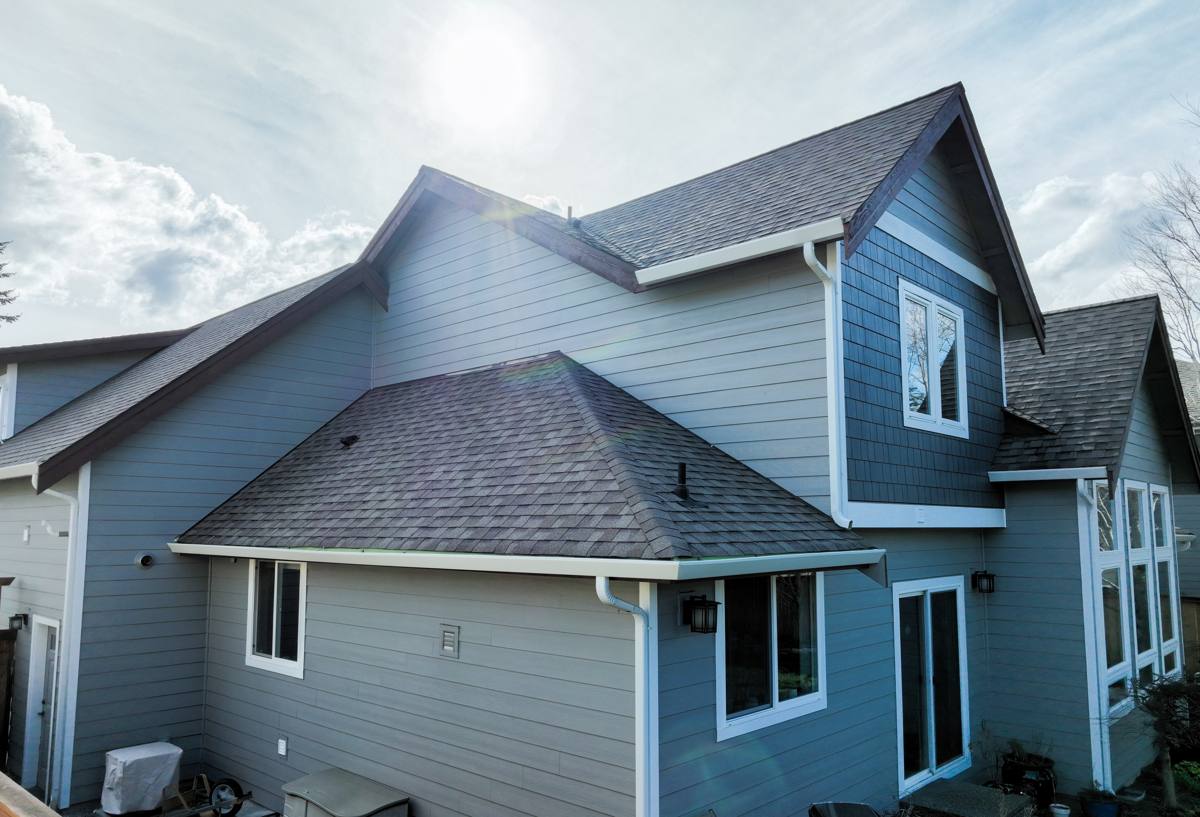
What Bellingham's Weather Actually Does to Siding Over Time
It helps to understand the specific mechanisms at work, because they explain why some materials hold up here and others don't.
Salt Air
Airborne salt from the bay accelerates corrosion on fasteners, trim, and any exposed metal flashing. It also breaks down cheaper paint finishes faster than inland exposure would, leading to chalking and fading years ahead of schedule.
Driving Rain
Wind-driven rain doesn't just fall straight down — it gets pushed sideways into laps, seams, and butt joints. Any siding system with weak water-shedding details (or that relies on caulk to do the real work of keeping water out) will eventually let moisture behind the cladding.
Moss and Algae
Shaded, moisture-retentive surfaces in this area grow moss and algae readily, especially on north and east elevations and anywhere tree cover blocks direct sun. Porous or textured surfaces give moss more to grip onto, and once established, it holds moisture directly against the siding face.
Put those three together over a decade or two, and you get the failure patterns we see most often on Sehome tear-offs: soft or delaminated panel edges, paint that's failed at the laps first, and corrosion streaking below fastener heads.
Why We Install Only James Hardie in Sehome
We get asked fairly often why we don't offer vinyl, LP SmartSide, Cemplank, Allura, or cedar as options. It's a fair question, and the honest answer is a professional judgment call, not a knock on every homeowner who has one of those products on their house today.
- Vinyl expands and contracts significantly with temperature swings, can warp or crack in cold snaps, and its color is baked into the material — once it fades, there's no refinishing it.
- LP SmartSide is engineered wood (strand-based, resin-bonded). It performs well when detailing is perfect, but any breach in the factory coating exposes the wood substrate to exactly the kind of chronic moisture Sehome sees, and edge swelling is a known vulnerability.
- Cedar and primed spruce are natural wood — beautiful, but they require ongoing refinishing, and in a marine climate with heavy moss pressure, that maintenance interval only gets shorter.
- Cemplank and Allura are also fiber cement, and reasonable products in general. We standardized on James Hardie specifically because of its ColorPlus factory finish warranty, its HZ climate-engineered formulations, and the depth of installation documentation and local supply support behind it.
None of this means those products can't work anywhere — it means that after years of tear-offs and repairs in this exact climate, we decided we'd rather stand behind one system we trust completely than offer five and hope each one gets installed perfectly.
How Hardie Compares on the Factors That Matter Here
| Factor | James Hardie Fiber Cement | Vinyl | Wood / Engineered Wood |
|---|---|---|---|
| Non-combustible | Yes | No (melts/deforms) | No |
| Moisture / rot resistance | Engineered for it (HZ product lines) | Doesn't rot, but traps moisture behind it | Vulnerable if coating is breached |
| Salt air / coastal durability | Strong, factory-cured finish | Fades and chalks over time | Finish degrades faster in salt air |
| Moss/algae resistance | Good with correct clearances and maintenance | Can trap moisture that feeds growth | Porous surface holds moisture, feeds growth |
| Refinishing needs | ColorPlus finish rarely needs repainting; field-painted Hardie repaints like any solid surface | Cannot be refinished — replace to change color | Regular repainting/staining required |
| Typical warranty | Long-term, transferable manufacturer warranty | Varies widely by product tier | Limited, often coating-only |
The James Hardie Lines That Fit This Climate
James Hardie makes region-specific formulations, and Bellingham falls into their HZ5 climate zone designation, engineered for freeze-thaw cycling and sustained moisture exposure rather than the drier, hotter conditions other HZ zones are built for. For Sehome homes, the products we specify most often are:
- HardiePlank lap siding — the standard horizontal siding, available in several exposure widths and textures, and the most common match for the traditional home styles found throughout this neighborhood.
- HardiePanel vertical siding — used for board-and-batten sections, accent walls, or gable ends where a vertical line makes sense architecturally.
- HardieTrim — matched trim boards for corners, window and door casing, and fascia, so the whole exterior envelope is the same non-combustible, moisture-engineered material rather than mixing in wood trim that will fail on a different timeline.
ColorPlus factory-finished options remove one of the biggest maintenance line items on a Bellingham home: repainting a rain-exposed exterior every several years. The finish is baked on and cured before the boards ever reach the jobsite, which gives more consistent, longer-lasting color than field-applied paint — a real advantage in an area that gets this much sustained precipitation.
What a Correct Installation Actually Involves
James Hardie's product warranty is only as good as the installation behind it, and this is where a lot of siding jobs — regardless of material — quietly go wrong. In a climate like Sehome's, these details aren't optional extras; they're the difference between siding that lasts and siding that fails from the inside out.
- Proper clearances — siding held up off decks, patios, and grade per manufacturer spec, so splash-back and standing moisture don't sit against the bottom course.
- Correct flashing at every penetration — windows, doors, hose bibs, light fixtures, and vents all need integrated flashing, not just a bead of caulk.
- Rainscreen or drainage plane behind the siding — giving incidental moisture a path to drain and dry rather than sitting trapped against the sheathing.
- Correct fastener type and placement — corrosion-resistant fasteners set to Hardie's nailing pattern, not overdriven or underdriven, which affects both water-shedding and long-term panel integrity.
- Properly sealed and back-primed cut edges on any field cuts, since factory-finished edges are only protected before the saw touches them.
Any one of these done wrong can undercut an otherwise premium material. It's a big part of why the installing crew matters as much as the product on the wall.
Our Process for a Sehome Project
Every project starts with a walk-around assessment of the existing exterior — looking specifically for moisture damage patterns, moss growth locations, existing flashing condition, and any structural sheathing concerns before a single board is ordered. From there:
- We remove the old siding and inspect the sheathing underneath, repairing or replacing any water-damaged sections before anything new goes on.
- We install or verify a proper weather-resistive barrier and drainage plane suited to this climate.
- We flash every window, door, and penetration before siding installation begins — this step gets inspected, not assumed.
- We install the specified James Hardie product line to manufacturer clearance and fastening specs.
- We finish with matched HardieTrim detailing and a final walk-through against the original assessment.
Nothing here is unusual or proprietary — it's simply doing every step to spec instead of skipping the parts that don't show up until years later.
Maintenance in a Moss-Prone, Marine Climate
James Hardie siding is low-maintenance compared to wood or vinyl, but "low-maintenance" doesn't mean "no maintenance," especially in Whatcom County's wet, shaded conditions. A short annual routine keeps a correctly installed system performing for the long haul:
- Rinse siding annually (garden hose pressure, not a pressure washer aimed at close range) to clear pollen, salt residue, and early moss growth.
- Keep gutters clear so overflow doesn't run down the wall face and feed algae growth.
- Trim back vegetation and tree limbs that keep shaded wall sections perpetually damp.
- Check caulking at trim joints and penetrations every year or two, and re-caulk where it's cracked or pulled away.
- Look at the bottom courses near grade, decks, and downspouts for any signs of splash-back staining or moss buildup, since those areas take the most sustained moisture.
Why Local Experience in Sehome Matters
A siding crew that only occasionally works in Bellingham can install a product correctly on paper and still miss the details that matter for this specific climate — how much clearance to leave given the wet season, where moss pressure tends to concentrate on a given lot's orientation, or how much drainage capacity a wall assembly really needs given the rainfall this area gets. A crew that works Whatcom County regularly has already seen what fails here and builds around it as a matter of habit, not an afterthought.
If you're weighing a siding replacement or repair on a Sehome home, we're happy to take a look and give you a straightforward, no-pressure assessment of what your exterior actually needs. There's no obligation — just an honest read on your home's condition and what a correct James Hardie installation would involve, using the form below.