 Bellingham Siding
 Windows Built for Sudden Valley's Lake-and-Forest Setting
Sudden Valley sits tucked into the trees along Lake Whatcom, and that setting is exactly why window replacement here needs a different game plan than it does on an open, sunny lot across town. Heavy tree cover means less direct sun to dry out a house after a storm, more shade holding moisture against siding and trim, and a longer window each year where moss and algae get a foothold on anything that stays damp. Add in the driving rain that comes through this part of Whatcom County most of the year, and you've got a climate that's hard on cheap glass, hard on poorly flashed frames, and hard on any installation that cuts corners on sealing.
We're not talking about swapping glass for the sake of a lower heating bill, although that's a real benefit. We're talking about windows that hold up to years of shaded dampness without rotting the framing around them, fogging between the panes, or letting cold, wet air creep in around the edges. That's the standard we hold every Sudden Valley window job to.
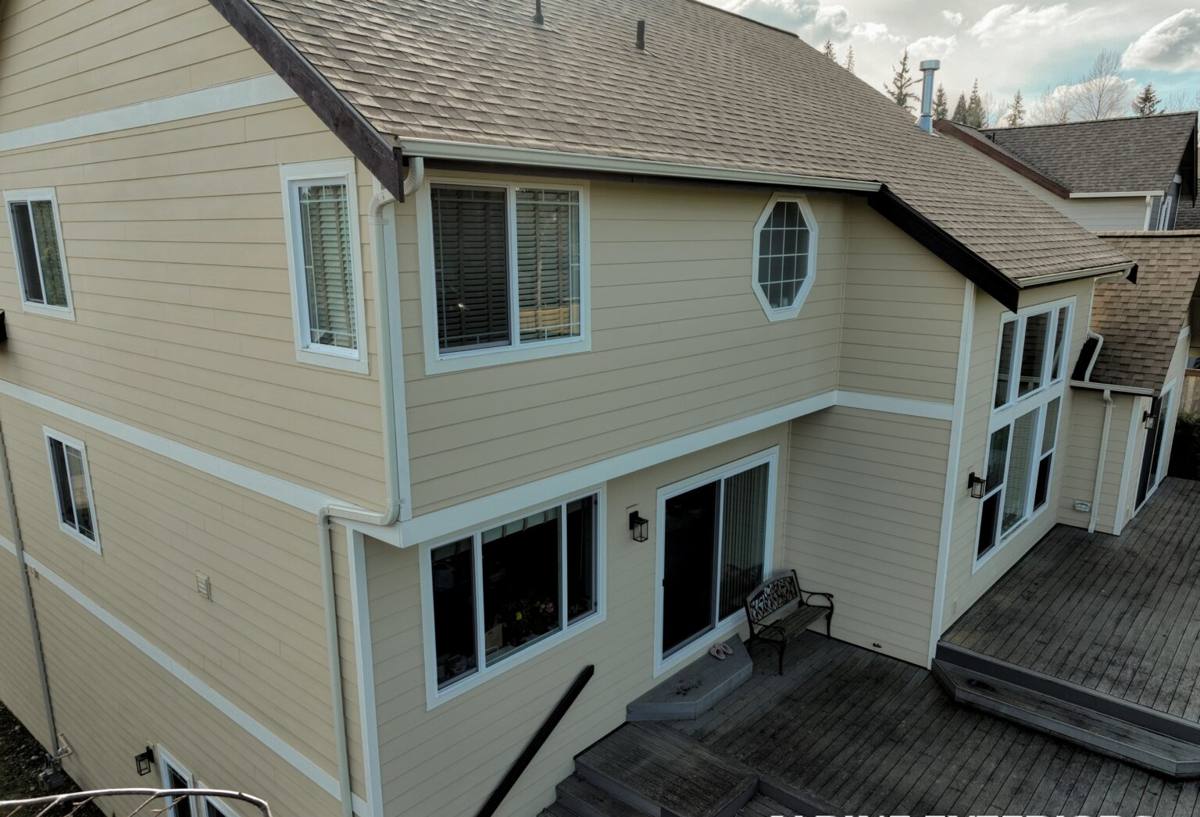
The Climate Factors That Actually Wear Down Windows Here
A Long Moss Season
Between the tree canopy and the lake-side humidity, Sudden Valley properties stay damp longer after every rain than homes out in open sun. Moss doesn't just grow on roofs and north-facing siding — it works its way into window sills, tracks, and trim joints where water sits instead of draining. Once moss and the moisture it holds get behind a poorly sealed window flange, wood trim and sheathing start to soften long before anyone notices a problem from inside.
Driving Rain and Wind-Driven Water
Storms coming off the water don't fall straight down — wind pushes rain sideways into window faces and up under poorly lapped flashing. A window that's fine in a light shower can still leak in a sideways downpour if the flashing detail, sill pan, or sealant bead wasn't done right the first time. This is one of the most common failure points we find on older homes in this area, and it's almost always an installation issue, not a product defect.
Whatcom County's Marine-Influenced Climate
Being this close to Bellingham Bay and the Salish Sea, the air throughout Whatcom County carries more moisture and, closer to the water, more salt than you'd find inland. That marine influence combines with the shade and rain to create conditions that are genuinely tougher on exterior building materials — hardware, sealants, and finishes all age faster here than they would in a drier climate. Windows and their surrounding trim need to be chosen and installed with that reality in mind, not against a national-average climate assumption.
What "Energy-Efficient" Actually Means in This Climate
Energy efficiency isn't just a sticker on the glass. In a shaded, damp environment like Sudden Valley, the frame material and the installation detailing matter as much as the glass package itself. A window with a great U-factor rating will still underperform — and eventually fail — if moisture gets behind it because the flashing wasn't integrated correctly with the wall assembly.
Frame Material Trade-Offs
| Frame Material | Moisture Behavior | Maintenance | Typical Cost Tier |
|---|---|---|---|
| Vinyl | Won't rot; can flex slightly in temperature swings | Low — occasional cleaning | Lower |
| Fiberglass | Very stable, holds up well to constant damp/dry cycling | Low | Mid to upper |
| Wood / Wood-Clad | Handsome but needs the exterior fully sealed against this climate's moisture | Higher — finish upkeep | Upper |
| Aluminum | Durable but conducts cold; condensation risk in damp shaded spots | Low | Varies |
We generally steer Sudden Valley homeowners toward vinyl or fiberglass for most applications. It's not that wood windows can't work here — it's that in a heavily shaded, high-moisture setting, a wood frame's long-term performance depends entirely on maintaining the exterior finish every few years, and that's a maintenance commitment we want you to go into with eyes open rather than find out about later.
Glass Packages That Make Sense Here
Double-pane, low-E, argon-filled glass is the baseline we'd recommend for almost any Sudden Valley home — it handles the temperature swings between damp mornings and cooler evenings well and cuts down on interior condensation, which matters more here than in a drier part of the state. Triple-pane is worth discussing on north-facing or heavily shaded walls where interior surface temperatures run colder, but it's not automatically the right call for every elevation of every house — that's a conversation, not a default upsell.
Signs Your Current Windows Are Costing You Money
A lot of homeowners in this area live with failing windows longer than they need to simply because the signs are subtle. Worth checking for:
- Fogging or a cloudy haze between the panes (the seal has failed and the insulating gas is gone)
- Soft or discolored wood trim around the window frame, especially on shaded walls
- Visible moss or dark staining on the sill or lower frame
- Drafts you can feel with your hand near the frame on a windy day
- Windows that are difficult to open, close, or latch — a sign the frame has shifted or swelled
- Noticeably higher heating bills compared to similar-sized homes nearby
- Condensation forming on the inside of the glass regularly through fall and winter
Any one of these on its own might not mean much. Two or three together, especially on the same window, usually means it's time to stop patching and start planning a replacement.
What a Correct Installation Actually Involves
This is where most window problems in this climate actually start — not with the window itself, but with how it was tied into the wall. A correct installation includes:
- Removing the old window and inspecting the rough opening and sheathing for hidden rot or moisture damage before anything new goes in
- Installing a proper sill pan to direct any water that gets past the window back out, not into the wall
- Flashing the opening so water sheds over each layer correctly — top layer over the one below it, every time
- Integrating that flashing with the surrounding house wrap or weather-resistive barrier so there's no gap for water to find
- Shimming and fastening the window square and level, not just tight, so it operates properly for years
- Sealing the interior and exterior with the right sealant for the material, not just whatever's on the truck
- Finishing trim and siding tie-in so the whole assembly sheds water the way it was designed to
Skip any one of those steps and you can end up with a window that looks fine and even tests fine on a dry day, but leaks the first time a real Whatcom County storm hits it sideways.
Our Process for Sudden Valley Projects
Because access into Sudden Valley properties often means navigating slopes, mature trees, and lake-side lot layouts, we plan the logistics of a job before we ever touch a window. Our process:
1. On-Site Assessment
We look at every opening individually — sun exposure, shade, current signs of moisture damage, and how the window ties into your siding. Windows on the shaded, lake-facing side of a house often need different attention than ones on a sunnier elevation of the same building.
2. Product and Glass Selection
We walk through frame material and glass package options against your budget and what each elevation of your home actually needs — not a one-size answer for the whole house.
3. Careful Removal and Opening Inspection
Every rough opening gets checked for hidden rot or moisture damage before the new window goes in. If we find deterioration, we address it before installation rather than sealing a problem behind new trim.
4. Installation and Flashing Integration
Sill pans, flashing, and air/moisture sealing done in the correct order, tied properly into your existing wall assembly and siding.
5. Final Check and Cleanup
We test operation, check seals, and leave the site clean. If your project also involves siding work, we coordinate the two so the window and wall envelope are handled as one system, not two disconnected jobs.
Why Local Installation Experience Matters Here
A contractor who mostly works drier, sunnier neighborhoods can still do a technically correct install and have it underperform here, simply because they're not used to designing for this much shade and moisture. Crews who regularly work Sudden Valley and the surrounding Lake Whatcom area know which elevations need extra attention to flashing, how to plan around tree cover and slope access, and what kind of trim and sealant detailing actually holds up through a full Whatcom County winter — not just what passes inspection on a dry install day.
There's also a practical logistics side to it: narrower access points, sloped driveways, and mature landscaping around many Sudden Valley homes mean equipment staging and material handling take more planning than a flat suburban lot. A crew that's done it before doesn't lose a day figuring that out on your job.
Cost Factors to Expect
Every home is different, but the same handful of factors drive most of the cost variation we see on Sudden Valley window projects:
| Factor | Why It Matters |
|---|---|
| Number of windows and sizes | Bigger scope, bigger material and labor total |
| Frame material chosen | Vinyl runs lower; fiberglass and wood-clad run higher |
| Glass package (double vs. triple-pane) | Triple-pane adds cost but may only make sense on specific elevations |
| Condition of the existing opening | Hidden rot or moisture damage found during removal adds repair scope |
| Site access | Slopes, tree cover, and tight access can add labor time |
| Trim and siding integration | Matching or replacing surrounding trim/siding adds scope but protects the finished job |
Most full window replacement projects for a mid-size home fall somewhere in the low-to-mid five-figure range once you factor in glass package and frame material — but the only way to get a real number is to have someone look at your actual openings and site conditions.
Ready to Talk Through Your Windows?
If your windows are fogging, drafting, or growing moss faster than they should, or you're just planning ahead for a Sudden Valley home that needs to hold up to another wet Whatcom County winter, we're happy to take a look. Reach out for a free, no-pressure estimate using the form below — we'll walk your home, look at each opening, and give you a straight answer on what it needs.