 Bellingham Siding
 Decks in Barkley Take a Different Kind of Beating
Barkley sits close enough to the water and surrounded by enough mature tree cover that its decks age differently than decks in drier parts of Whatcom County. Salt-tinged air moving in off Bellingham Bay accelerates corrosion on fasteners, hardware, and any exposed metal connectors. Driving rain off Puget Sound finds every gap in flashing and every seam that wasn't sealed correctly the first time. And the long, wet moss season here — often stretching from October well into April or May — means organic growth gets a real foothold on any deck surface that doesn't drain and dry quickly.
None of that means a deck in Barkley is doomed to constant repair. It means the repair work has to account for those three stressors specifically, not just patch what's visibly broken. A board that looks fine but sits on a ledger board with failing flashing will look the same way again in two years if the underlying moisture path isn't fixed.
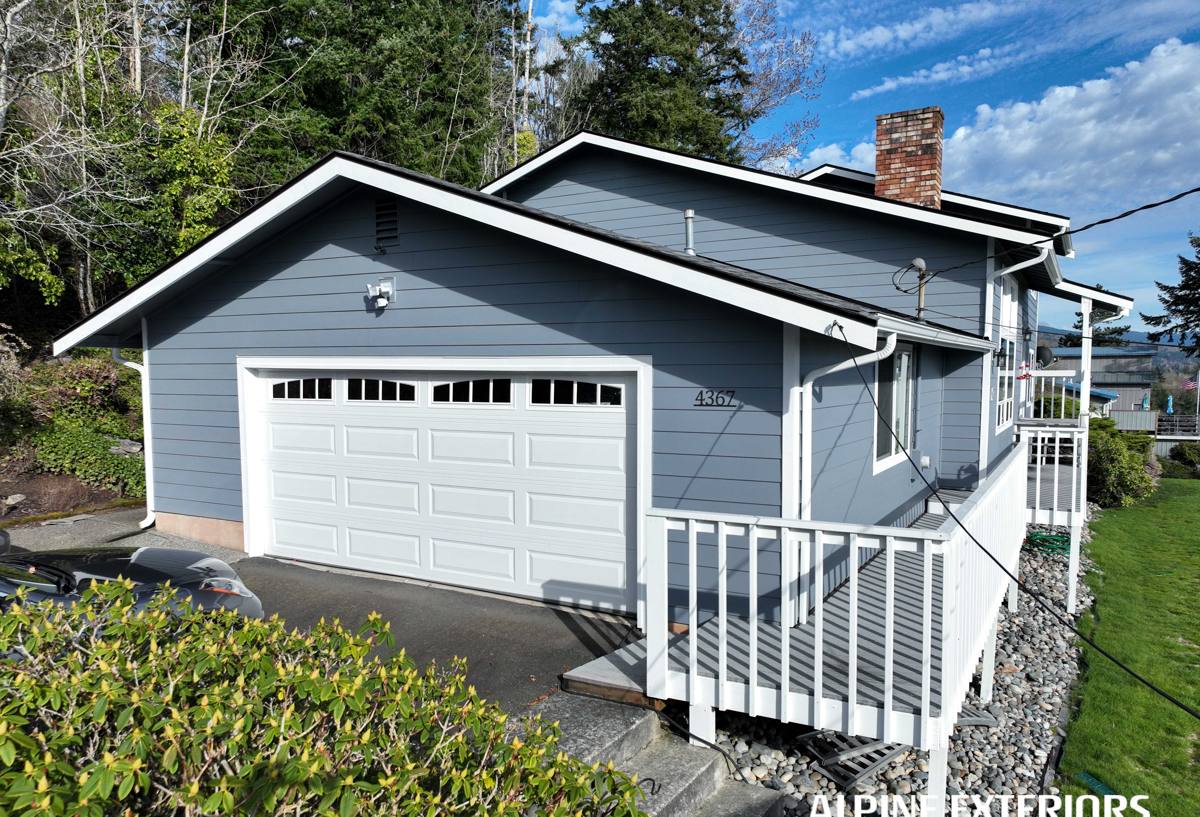
What Bellingham's Climate Actually Does to a Deck
It helps to understand the mechanism, not just the symptom, before you spend money on repairs.
Moisture Cycling
Whatcom County decks go through repeated wet-dry cycles most of the year. Wood swells when saturated and shrinks as it dries, and that movement works fasteners loose, opens up joints, and eventually cracks boards along the grain. Composite and PVC decking don't absorb water the same way, but the substructure underneath still does — and that's where most of the real damage tends to start.
Moss and Algae
Moss doesn't just look bad. It holds moisture directly against the decking surface long after the rain has stopped, which keeps wood fibers wet far longer than they'd otherwise be. On composite boards, algae growth in the grain pattern can make a surface genuinely slick and unsafe underfoot, especially on stairs.
Corrosion
Salt air is a slow but steady problem for any fastener, joist hanger, or post base that isn't rated for coastal exposure. Once a hanger or bracket starts to corrode, it loses holding strength well before it looks obviously failed — which is part of why structural inspection matters more than a visual once-over.
Signs a Barkley Deck Needs Repair, Not Just Cleaning
A pressure wash and a coat of sealant fixes cosmetic weathering. It does nothing for the issues below, which need actual repair:
- Boards that feel spongy, springy, or soft underfoot, especially near the house or at board ends
- Visible gaps or dark staining where the deck ledger meets the house siding or wall
- Rust streaks running down from screws, bolts, or metal connectors
- Any wobble in the railing when you push on it — this is a safety issue, not a cosmetic one
- Stairs that feel less solid than the rest of the deck, or show separation at the stringers
- Persistent moss or algae that comes right back within weeks of cleaning
- Standing water anywhere on the deck surface more than a few minutes after rain stops
- Visible daylight or movement between deck boards and the joists below
If you're seeing more than one or two of these, it's worth having someone look underneath the deck, not just at the surface.
What a Correct Deck Repair Actually Involves
The visible surface is the last thing we look at, not the first. A repair that only replaces bad boards and leaves the structure and moisture path untouched is a repair that fails again.
Structural Inspection First
We check the ledger board connection (where the deck attaches to the house), the joists, the posts and footings, and all structural hardware before deciding what needs to happen at the surface. This is where the actual failure usually starts in a wet climate like ours — not in the decking itself.
Flashing and Ledger Details
The ledger-to-house connection is the single most common source of hidden rot on decks in this region. If flashing is missing, cracked, or was never properly integrated with the house's water-resistive barrier, water gets behind the deck and into the house framing — a problem that's expensive to ignore and expensive to fix late.
Hardware and Fasteners
Given the salt air here, we use fasteners and structural connectors rated for coastal/exterior exposure, not standard interior-grade hardware. Mixing metals (for example, the wrong screw in a treated joist hanger) can actually accelerate corrosion through galvanic reaction, so matching hardware correctly matters more than it might seem.
Board Replacement
Only after the structure and moisture path are sound do we address decking boards, railing components, or stair treads — replacing what's damaged and matching material as closely as reasonably possible.
Repair or Replace? How We Help You Decide
Not every deck problem calls for a full rebuild, and not every deck is worth patching indefinitely. Here's how we generally think about it:
| Factor | Leans Toward Repair | Leans Toward Replacement |
|---|---|---|
| Structural framing (joists, posts, footings) | Sound, no rot or movement | Widespread rot, undersized, or failing footings |
| Ledger/flashing condition | Isolated issue, correctable | Long-term water intrusion into house framing |
| Decking surface damage | Scattered boards, easy to match | Majority of boards degraded or discontinued material |
| Age of the deck | Under 10-15 years, well-built originally | Older, or built to outdated code |
| Railing/stairs | Loose but structurally intact | Undersized or non-compliant with current code |
We'll always tell you honestly which category your deck falls into, including when a repair is the right call financially even if a full replacement would be "nicer."
Wood vs. Composite: Repair Considerations
Barkley has a mix of older wood decks and newer composite installations, and repair strategy differs between them.
Wood Decking
Cedar and pressure-treated lumber remain common and are generally straightforward to repair board-by-board, since matching dimensional lumber is easy. The tradeoff is ongoing maintenance — wood decking in this climate needs periodic cleaning, sealing, and inspection to keep moss from gaining a foothold and to keep the wood from checking and cupping.
Composite and PVC Decking
Composite resists moisture absorption in the board itself, which reduces some maintenance, but it isn't maintenance-free — surface algae and mildew still need regular cleaning, and matching an older composite board's exact color when only a few need replacing can be difficult since manufacturers change product lines over time. We'll tell you upfront if an exact color match isn't realistic so you can decide whether a full deck-surface replacement makes more sense than a patchwork repair.
Railings and Structural Lumber
Regardless of decking material, we generally recommend pressure-treated or naturally rot-resistant lumber for structural framing, since that's the part of the deck doing the real work and the part most exposed to sustained moisture from below.
Our Deck Repair Process
- On-site assessment: We inspect the deck from both above and below, checking framing, ledger connection, hardware, and surface condition.
- Written scope and estimate: You get a clear explanation of what's actually wrong, what needs to be repaired versus what's optional, and a straightforward cost range — no pressure to upsell into a full rebuild if repair is genuinely the right call.
- Structural repairs first: Ledger, flashing, framing, and hardware issues get addressed before any cosmetic work begins.
- Surface repair: Damaged boards, stair treads, and railing components are replaced and matched as closely as possible.
- Final check: We walk the deck with you, test railings and stairs, and point out any maintenance steps that will help it hold up through the next moss season.
Drainage and Moss Prevention Matter as Much as the Repair Itself
A well-repaired deck in Bellingham can still develop the same problems within a few years if water and moss aren't managed going forward. During a repair, we look at whether the deck surface has adequate slope to shed water, whether gaps between boards are consistent enough to let air circulate underneath, and whether nearby landscaping or gutters are dumping extra water onto the deck. Small adjustments here — a cleared gutter downspout, a trimmed branch shading the deck year-round — often do more for long-term deck health than any product applied to the surface.
Permits, Code, and Why It Matters for Repairs
Depending on the scope, some deck repair work in Bellingham and unincorporated Whatcom County may require permitting, particularly when structural framing, footings, or railings are involved. Guardrail height, baluster spacing, and stair rise/run all have code requirements that matter for safety, not just for passing inspection. We handle the permitting conversation as part of the estimate when the scope calls for it, so you're not left figuring out city or county requirements on your own.
Why Working With a Crew That Already Knows Barkley Helps
A contractor who repairs decks across Whatcom County, including in Barkley specifically, has already seen how this neighborhood's tree cover, moisture patterns, and older housing stock tend to age a deck. That's not a marketing point — it means fewer surprises during the job, a more accurate estimate up front, and repair choices (hardware grade, drainage details, material matching) that are already calibrated to what actually holds up here rather than a generic national approach.
If you're seeing soft spots, rust streaks, a wobbly railing, or moss that won't quit coming back, we're happy to take a look and give you a straightforward assessment of what your deck actually needs. Reach out for a free, no-pressure estimate using the form below.