 Bellingham Siding
 Birchwood's Siding Problem Isn't Like a Dry-Climate Problem
Birchwood is a Bellingham neighborhood sitting inside Whatcom County's marine climate zone, close enough to Bellingham Bay and the Puget Sound basin that salt-laden air reaches exterior walls on a regular basis. Combine that with our wet season stretching from fall through spring, and siding here is doing a different job than siding in a dry inland climate. It's not just keeping weather out — it's standing up to salt exposure, near-constant moisture, and shaded, slow-drying conditions that favor moss and algae growth for months at a time. A siding product and installation that would be perfectly fine in Spokane or Boise can fail early in Birchwood if it isn't matched to what this climate actually does to a wall.
Salt Air and Corrosion
Salt-carrying moisture doesn't just affect metal flashing and fasteners near the water — it travels inland on wind and settles on siding, trim, and hardware across Bellingham neighborhoods, Birchwood included. Over years, that exposure accelerates corrosion on unprotected fasteners and metal trim, and it can degrade coatings that aren't formulated to resist it. Any siding job here has to account for corrosion-resistant fasteners and flashing, not just whatever ships cheapest with the material.
Driving Rain and Wind-Driven Moisture
Whatcom County storms regularly bring rain sideways, not straight down. That matters because wind-driven rain finds its way into laps, seams, and penetrations that would stay dry in a calmer climate. Siding systems and installation details that rely on gravity alone to shed water — rather than proper lapping, flashing, and a drainage plane behind the cladding — are the ones that develop hidden moisture problems first.
Moss, Algae, and the Long Wet Season
Shaded exterior walls, tree cover, and Bellingham's extended damp season create ideal conditions for moss and algae to take hold on siding surfaces, especially on north- and west-facing walls that stay wet longest. Organic growth isn't just a cosmetic issue — it holds moisture against the surface, which shortens the life of anything that can absorb water or support rot.
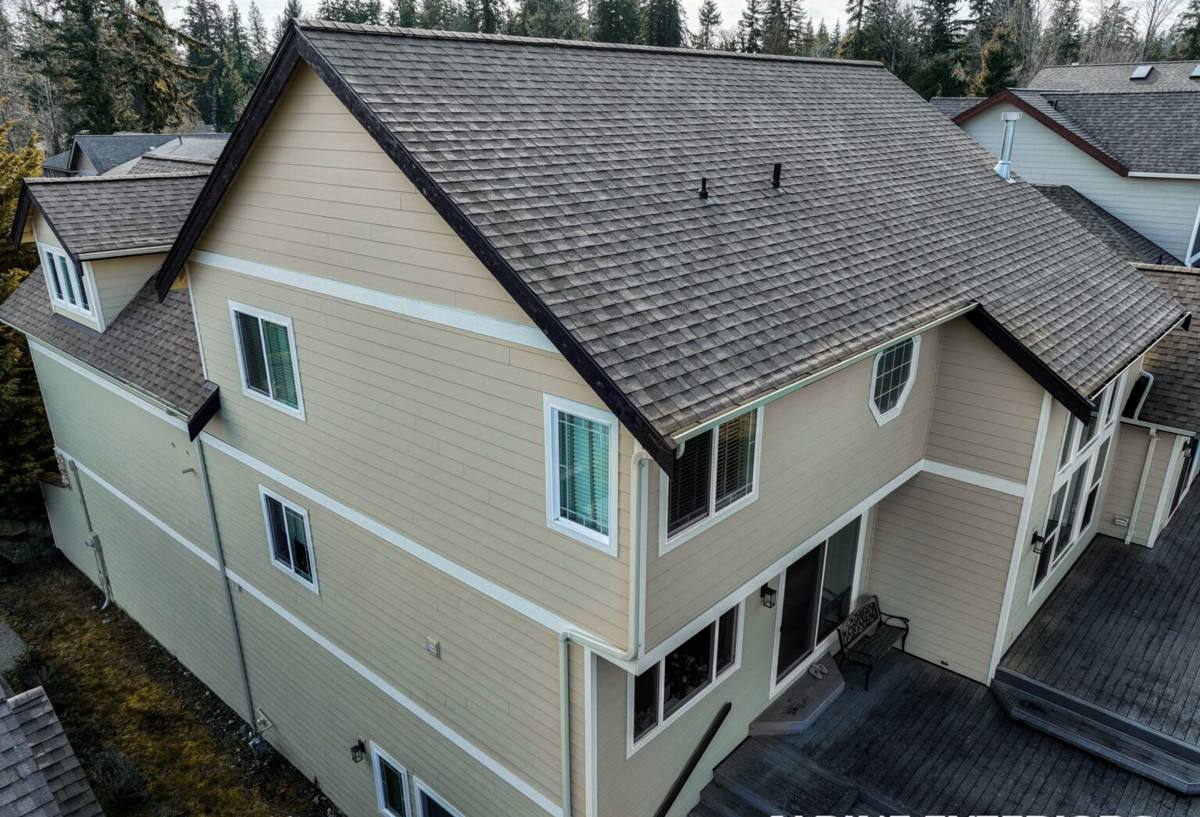
Why We Standardize on James Hardie for Homes Like These
We install James Hardie fiber cement siding exclusively — not vinyl, not LP SmartSide, not cedar or primed spruce. That's a deliberate standard, not a limitation on what we're capable of installing. Fiber cement is inorganic: it doesn't feed mold or moss the way wood-based products can, it doesn't soften or delaminate the way some engineered wood siding can when a seam stays wet too long, and it holds up to direct weather exposure without the ongoing maintenance burden that wood and some composite sidings carry in a climate this wet.
Built for This Climate Zone
James Hardie engineers its siding by climate zone, and the HZ5 product line is built for the wetter, more temperate weather found across the Pacific Northwest — different engineering than the version sold in hot, arid regions. That's a meaningful distinction: siding engineered for a different climate zone doesn't perform the same way here, and it's part of why product sourcing matters as much as installation quality.
ColorPlus Factory Finish vs. Field-Applied Paint
Hardie's ColorPlus finish is baked on at the factory under controlled conditions, which gives it better resistance to fading, chipping, and moss/algae staining than a field-applied paint job can consistently match — especially in a climate where the paint crew rarely gets a long stretch of dry, ideal painting weather. It also comes with its own finish warranty separate from the substrate warranty, which matters when you're evaluating long-term cost.
What a Correct Installation Actually Requires Here
Fiber cement siding is only as good as the installation behind it. In a high-moisture climate like Birchwood's, the details that get skipped on a rushed job are exactly the ones that cause the earliest failures.
- Weather-resistive barrier installed continuously behind the siding, lapped correctly, with no gaps at penetrations
- Minimum clearance maintained between siding and grade, roofline, decks, and patios so water doesn't wick up from below
- Corrosion-resistant fasteners driven at the correct pattern and depth — not overdriven, not underdriven
- Flashing installed at every window, door, and penetration, not caulk substituted for flashing
- Manufacturer-specified gaps left at butt joints and trim for expansion, then sealed with a sealant rated for the application
- Field-cut edges primed or sealed per manufacturer instructions before installation
None of this is exotic — it's all published in James Hardie's installation instructions. But skipping any one of these steps is exactly how a fiber cement siding job ends up with the moisture problems it was supposed to prevent, and it's also how a manufacturer's warranty gets voided without the homeowner ever knowing it happened.
How We Approach a Birchwood Project
- On-site assessment — we look at existing siding condition, sheathing, trim, and any signs of past moisture intrusion before quoting anything
- Tear-off and substrate check — removing old siding lets us inspect the sheathing underneath and address any rot or damage before it gets covered up again
- Weather-resistive barrier — installed fresh, lapped correctly, with flashing integrated at every window and door
- Hardie installation — plank, panel, or shingle profile installed to manufacturer spec, with fastening, clearances, and joint treatment done to code
- Trim and detail work — corners, fascia, and penetrations finished so water is directed away from the wall assembly, not into it
- Final walk-through — checking clearances, caulk lines, and finish before we call the job done
We don't skip the tear-off and substrate inspection step, even when it would be faster to install over existing siding. In a climate where hidden moisture is the most common cause of long-term damage, covering up a problem instead of finding it defeats the purpose of the new siding.
Signs Your Current Siding Is Already Losing the Fight
- Persistent moss or algae staining that comes back within weeks of cleaning
- Soft or spongy spots when you press on the siding, especially near the bottom courses
- Paint that's peeling, bubbling, or chalking faster than a normal repaint cycle would suggest
- Visible gaps opening at seams, corners, or trim joints
- Warping, cupping, or boards that no longer sit flat against the wall
- Nail heads popping through the surface or visible rust streaks below fasteners
Any one of these on its own might just mean a maintenance task. Several of them together, especially on a home that's had the same siding for fifteen-plus years, usually means the siding system itself is nearing the end of what it can do in this climate.
What Drives Cost on a Birchwood Hardie Project
| Factor | Why It Matters |
|---|---|
| Tear-off vs. new construction | Removing and disposing of existing siding, plus repairing any sheathing found underneath, adds labor that a bare-wall install doesn't require |
| Siding profile | Lap plank, shingle-style panels, and larger board-and-batten profiles differ in material cost and installation labor |
| Home size and wall complexity | Multiple stories, dormers, and cut-up wall lines take more time per square foot than a simple rectangular elevation |
| Trim scope | Full trim replacement versus reusing sound existing trim changes both material and labor totals |
| Access and site conditions | Tight lots, slopes, or limited staging area affect how efficiently a crew can work |
We give straight, itemized estimates rather than a single lump number, so you can see what's driving the cost and where there's room to make choices.
Maintaining Hardie Siding in This Climate
James Hardie siding is genuinely low-maintenance compared to wood, but "low-maintenance" isn't "no-maintenance," especially with Birchwood's moss and moisture exposure.
- Rinse siding with a garden hose a couple of times a year to clear pollen, salt residue, and organic buildup before it takes hold
- Keep gutters clear so overflow doesn't run down the wall face repeatedly
- Trim back vegetation and tree cover that keeps a wall section shaded and slow to dry
- Re-caulk joints and penetrations if you notice cracking or separation, rather than waiting for water to get behind it
- Watch trim and touch-up paint condition even though the ColorPlus field is factory-finished — trim is often field-painted and ages differently
Why It Matters That We Already Work Birchwood
A crew that already works this neighborhood knows what the marine climate, the local permitting process, and Whatcom County's inspection expectations actually require — not in the abstract, but from having done the work here repeatedly. That means fewer surprises mid-project, fewer callbacks for details that get missed by out-of-area crews unfamiliar with how hard this climate is on a wall assembly, and a faster, more accurate estimate because we're not guessing at what Bellingham weather does to siding over time. Installing one product exclusively also means our crew isn't relearning a different manufacturer's spec sheet on every job — they know James Hardie's requirements cold, which shows up in the quality of the finished work.
If you're weighing a siding replacement or repair in Birchwood, we're glad to come take a look, walk you through what we're seeing, and put together a straightforward, no-pressure estimate — no obligation, just an honest read on your home's exterior and what it actually needs.