 Bellingham Siding
 Board and batten has become one of the most requested looks for homes in Blaine — the vertical lines read as clean and modern on newer builds, and as classic Pacific Northwest farmhouse on older ones. It's a style that photographs well and ages well, but only when it's built with the right material and installed with an understanding of what Blaine's location actually does to a house. This page is about that combination: the look, the climate, and the installation details that separate board and batten that lasts twenty-plus years from board and batten that starts failing at year five.
Why Blaine Is a Different Job Than Inland Bellingham
Blaine sits right on the water at the top of Whatcom County, and that proximity to Semiahmoo Bay and Drayton Harbor changes the exterior equation. Homes here deal with salt-laden air moving off the water, wind-driven rain that hits siding at an angle instead of falling straight down, and a long stretch of the year — often five or six months — where shade, moisture, and cool temperatures combine to grow moss on anything that stays damp. None of that is unique to Blaine, but the combination is more concentrated here than it is a few miles inland.
Board and batten's vertical board pattern creates more seams, more joints, and more edges than a horizontal lap profile. That's not a knock on the style — it's just a fact that changes how the assembly behind it needs to be built. More joints means more opportunities for water to find its way behind the cladding if the details aren't handled correctly, and salt air accelerates corrosion on any fastener or flashing that isn't suited for a coastal environment.
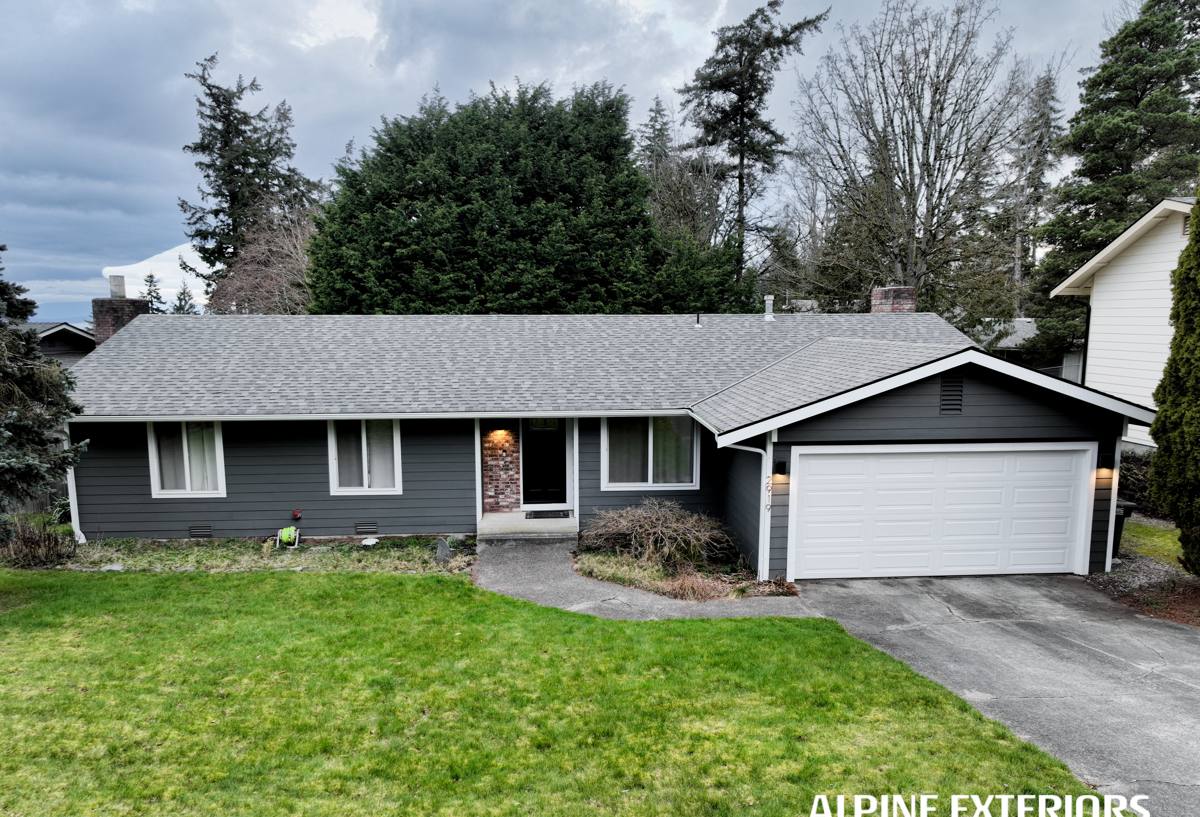
What Salt Air, Driving Rain, and Moss Actually Do to Siding
- Salt air corrodes standard fasteners and thin-gauge flashing over time, which is why fastener and flashing selection matters more in Blaine than it would forty miles inland.
- Wind-driven rain pushes water sideways and upward at butt joints, corner boards, and window trim — areas that a straight-down rain assumption doesn't protect.
- Extended moss season means anything that traps moisture against the wall — poor drainage, missing rainscreen gaps, caulked-shut weep points — stays wet longer and gives moss, algae, and eventually rot more time to take hold.
These aren't hypothetical concerns. They're the reason certain siding materials perform noticeably worse in a location like Blaine than they do in a drier or more sheltered part of the state, and why the material choice for a board and batten project here deserves more thought than picking a color.
Why We Install Board & Batten Only in James Hardie Fiber Cement
We don't install vinyl, LP SmartSide, cedar, primed spruce, or other fiber cement brands, and board and batten is actually one of the clearest examples of why. Vertical board profiles put real stress on whatever material sits behind the reveal:
- Vinyl board and batten is dimensionally unstable — it expands and contracts with temperature swings, and in a coastal wind exposure like Blaine's, that movement shows up as visible waviness and gaps at the battens over time.
- Cedar looks the part but is an organic material in an environment built to promote moss and moisture retention. It needs regular refinishing to keep performing, and skipped maintenance shows up fast as graying, cupping, or soft spots.
- LP SmartSide is an engineered wood product — better than raw lumber, but still wood-based, meaning it depends on caulking and finish integrity staying intact at every one of board and batten's many joints to keep moisture out.
James Hardie fiber cement doesn't share those weaknesses. It's non-combustible, dimensionally stable across temperature and humidity swings, and doesn't rot or feed moss growth the way organic materials can. Hardie's ColorPlus factory finish is baked on under controlled conditions and backed by a real finish warranty, which matters in a board and batten application where every board edge and batten strip is a place paint could otherwise fail first. For a coastal Whatcom County home, that stability is the difference between siding that holds its lines for decades and siding that needs attention every few years.
Material Comparison for Board & Batten in a Coastal Climate
| Factor | James Hardie Fiber Cement | Cedar | Vinyl | LP SmartSide |
|---|---|---|---|---|
| Moisture/rot resistance | Does not rot; engineered for wet climates | Vulnerable without diligent refinishing | Won't rot but traps moisture behind it | Wood-based; depends on sealed joints |
| Salt air / coastal durability | Strong with correct fasteners and flashing | Moderate, needs more upkeep near water | Can become brittle over time | Moderate, sensitive to sustained moisture |
| Dimensional stability | High — minimal expansion/contraction | Moves with humidity, can cup or split | Expands/contracts noticeably with heat | Moderate |
| Moss/algae resistance | Doesn't feed organic growth | Can host moss/algae if damp | Surface growth possible in shaded, damp areas | Can host growth if finish is compromised |
| Fire rating | Non-combustible | Combustible | Combustible, can melt/deform | Combustible |
| Typical maintenance | Occasional wash, repaint on a long cycle | Regular refinishing/staining | Low, but limited repair options | Regular caulk/finish checks |
What a Correct Board & Batten Installation Involves
Board and batten looks simple from the street, but the assembly behind it is doing real work. On a Blaine project, the details we treat as non-negotiable include:
Drainage and the rainscreen gap
A ventilated rainscreen gap behind the siding lets any moisture that does get past the surface drain out and dry, rather than sitting against the wall sheathing. In a climate with Blaine's rain frequency and moss pressure, this gap isn't optional — it's the difference between a wall assembly that dries out between storms and one that stays chronically damp.
Flashing at every horizontal break
Window heads, door heads, and any horizontal trim need properly lapped flashing that sheds water outward, not just caulk. Caulk is a maintenance item; flashing is a permanent water management detail, and we treat it as the primary defense, not a backup.
Fastening and batten spacing to spec
James Hardie publishes fastening and clearance requirements for board and batten assemblies for a reason — correct fastener type, spacing, and penetration depth keep the boards secure through wind events and prevent the kind of movement that eventually cracks caulked seams. Batten spacing over the board joints also needs to be consistent to hold the clean vertical lines that make this style work visually.
Corner and joint sealing appropriate for coastal exposure
Sealants and fasteners rated for coastal/marine exposure resist the corrosive effect of salt air better than standard-grade hardware, which matters at every joint on a board and batten wall given how many joints there are.
Our Process on a Blaine Board & Batten Project
- On-site assessment: we look at existing wall condition, current siding (if any), moisture history, and sun/wind exposure specific to the home's position relative to the water.
- Prep and moisture check: old siding removal (when applicable), sheathing inspection, and repair of any hidden moisture damage before anything new goes up.
- Rainscreen and flashing installation: the drainage plane and all flashing details go in first — this is the layer that does the real long-term work.
- Hardie board and batten installation: installed to manufacturer fastening specs, with coastal-appropriate hardware and consistent batten spacing.
- Finish and detail review: trim, corners, and joints checked before final walkthrough.
- Warranty paperwork: Hardie's product warranty and our workmanship coverage documented and handed over.
Maintaining Board & Batten Siding in a Blaine Climate
- Rinse siding periodically to clear salt residue and organic buildup before it can take hold, especially on shaded or north-facing walls.
- Keep gutters and downspouts clear so roof runoff isn't dumping extra water onto siding during heavy rain events.
- Trim back vegetation that shades siding and slows drying time — a leading contributor to moss growth.
- Have caulked joints and trim checked periodically, since even quality sealant has a service life.
- Address any small paint chips or impact damage promptly rather than letting exposed edges take on moisture.
Why a Crew That Already Works Blaine Makes a Difference
A lot of siding problems in coastal Whatcom County towns trace back to an installer applying a standard, inland approach to a location that doesn't behave like an inland location. Fastener choice, flashing detail, and rainscreen execution all need to account for what Blaine's wind, rain, and salt exposure actually do to a wall assembly over years, not just what passes inspection on install day. A crew that regularly works this area already knows which details can't be shortcut here — that experience shows up in how the job holds up ten and fifteen years down the road, not in how it looks the day the crew leaves.
If you're considering board and batten siding for a Blaine home, we're happy to walk the property, talk through what your specific exposure calls for, and give you a straightforward, no-pressure estimate. There's a form below to get that conversation started.