 Bellingham Siding
 Edgemoor's Location Makes Siding Choice a Bigger Deal Than Most Neighborhoods
Edgemoor sits close to the water, and that proximity changes what siding has to survive. Homes here take on a steady mix of salt-laden air, wind-driven rain off Bellingham Bay, and the long gray stretch of Pacific Northwest fall through spring when surfaces rarely get a chance to fully dry out. Add the tree cover common to Whatcom County lots and you get shaded, damp wall sections that stay wet longer than siding on an open, sunny elevation. None of this is unusual for Bellingham, but it's more concentrated in Edgemoor than in drier inland pockets of the county, and it's exactly the combination that separates siding materials that hold up for decades from siding that starts showing problems in five or ten years.
We install James Hardie fiber cement siding exclusively, and pages like this one exist because the reasons matter more here than in a mild, dry climate. This page focuses specifically on what a correct Hardie installation for an Edgemoor home looks like — not a generic rundown of the product line.
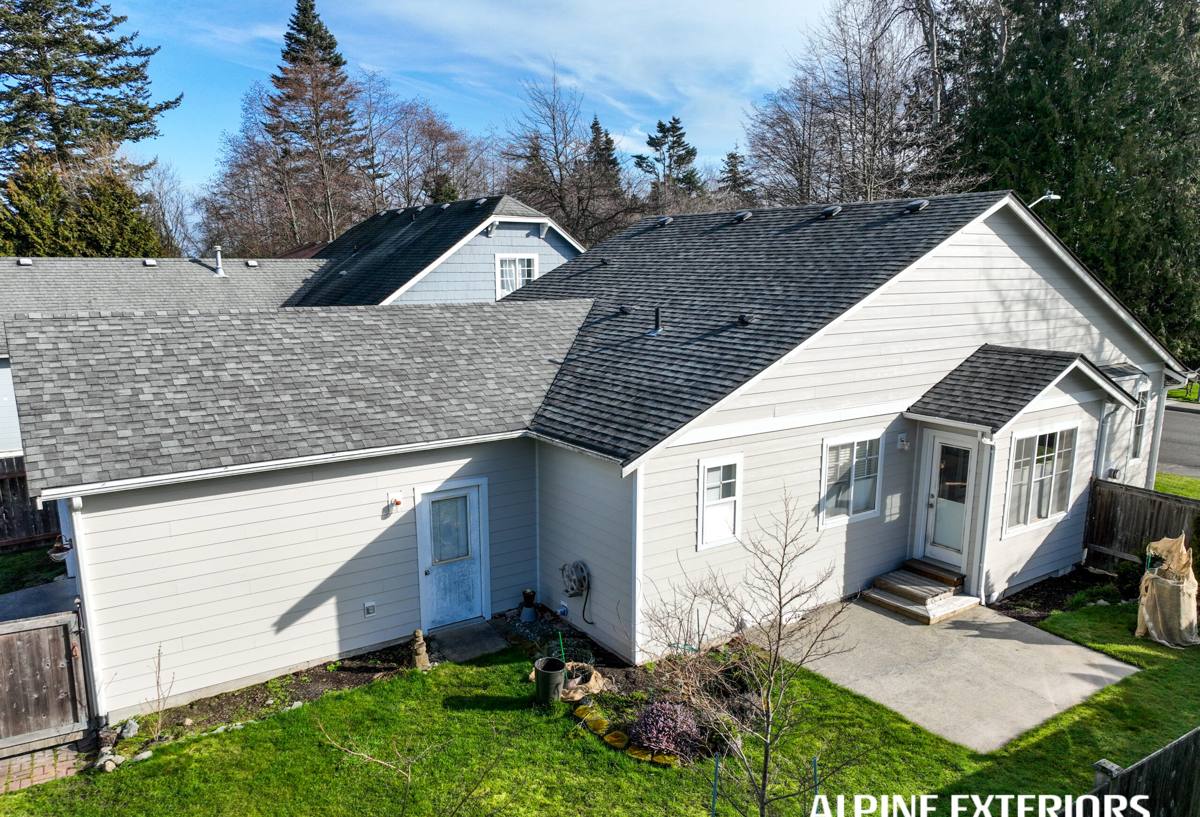
What Salt Air, Driving Rain, and Moss Season Do to Siding Over Time
Three climate factors do most of the damage to exterior siding in this part of Whatcom County:
- Salt air accelerates corrosion of fasteners, trim flashing, and any exposed metal, and it speeds the breakdown of finishes not engineered to resist it.
- Driving rain, especially on west- and southwest-facing walls, pushes moisture into every seam, lap joint, and penetration that isn't detailed correctly — caulk and paint alone don't hold up against sustained wind-driven wet weather year after year.
- Moss and algae growth thrives in the shaded, slow-to-dry wall sections common under mature trees and on north-facing elevations. Moss holds moisture against the siding surface far longer than open air would, which is a problem for any material that isn't dimensionally stable when wet.
Wood-based products swell, cup, and rot under this pattern. Vinyl can hold up structurally but expands and contracts with temperature swings in ways that open up gaps for moisture to find. Fiber cement, when it's the right product line and installed with the right details, resists all three of these mechanisms far better than the alternatives — which is the whole reason we standardized on it.
Why We Only Install James Hardie, Not Other Fiber Cement or Alternatives
There are other siding products on the market, including other fiber cement brands, engineered wood, and vinyl. Some of them are reasonable products in the right application. We don't install them on Whatcom County homes because, in a marine climate like this one, the margin for error matters, and James Hardie's engineering and track record give us the most confidence in a long-term result:
- Hardie's fiber cement formulation is non-combustible and dimensionally stable — it doesn't swell, crack, or delaminate the way wood-based composite sidings can when they take on repeated moisture cycles.
- The ColorPlus factory finish is baked on under controlled conditions, which holds color and resists fading and moisture intrusion at the finish level better than field-applied paint.
- Hardie engineers regional product lines (HZ5 for our climate zone) specifically for moisture and temperature conditions like ours, rather than shipping one generic formulation everywhere.
- The warranty is transferable and backed by a manufacturer with decades of specific fiber-cement manufacturing experience.
Products like primed spruce, cedar, LP SmartSide, or vinyl each have circumstances where they make sense elsewhere. For a home a few blocks from saltwater, exposed to sustained wind-driven rain and long moss seasons, we've made installing anything other than Hardie's engineered fiber cement a standard we don't compromise on.
The HZ5 Product Line: Why Climate Zone Matters
James Hardie makes different formulations for different climate zones, and this is not a marketing distinction — it changes how the material performs. HZ5 is engineered for the Pacific Northwest and similar wet, temperate climates, with a moisture-resistant formulation suited to the freeze-thaw and sustained-damp conditions we get here. Using a product engineered for a hot, dry, or humid-but-warm climate on a Bellingham home is the kind of shortcut that shows up as problems years later. Every Hardie installation we do in Edgemoor uses the HZ5 line, matched to Whatcom County's actual weather pattern rather than a national default.
Product Options for Edgemoor Homes
Within the HZ5 line, most Edgemoor homes end up choosing between a few common profiles depending on the home's style and the look the owner wants:
- HardiePlank lap siding — the most common choice, available in several exposure widths and both smooth and cedar-textured finishes, suited to traditional and craftsman-style homes throughout the neighborhood.
- HardiePanel vertical siding — often used as an accent on gables, entry features, or modern-style homes, and paired with lap siding on the main field.
- HardieShingle — a shingle-profile option for homes wanting a more traditional coastal look without the maintenance burden of real cedar shingles in a wet climate.
- HardieTrim — used around windows, corners, and fascia so the trim system matches the siding's moisture resistance instead of relying on standard wood trim that will fail faster.
What a Correct Installation Actually Involves Here
Fiber cement siding is only as good as the installation behind it. Most of the siding failures we see on older homes in this area aren't material failures — they're installation shortcuts that let water in behind a product that was otherwise fine. For Edgemoor specifically, a correct job includes:
- A drainable weather-resistive barrier installed correctly behind the siding, so any moisture that does get past the cladding has a path to drain and dry rather than sitting against the sheathing.
- Proper flashing at every penetration — windows, doors, hose bibs, vents, and any other wall penetration — since these are the most common entry points for wind-driven rain.
- Correct fastener spacing and type, using corrosion-resistant fasteners appropriate for a salt-air environment rather than standard fasteners that will corrode faster this close to the water.
- Manufacturer-specified clearances from grade, roofing, and decks, so siding isn't sitting in a position where it stays wet against soil, mulch, or a roof line.
- Correctly caulked and painted cut edges at every field cut, since an unsealed cut edge is one of the few places fiber cement can take on moisture if left exposed.
- Attention to shaded, low-airflow wall sections where moss and algae are most likely to take hold, including gapping and detailing that allows those areas to dry rather than stay damp longer than necessary.
Skipping any one of these doesn't usually show up as an immediate problem. It shows up in year six or eight, as staining, trim rot, or moisture intrusion at a spot that was never sealed correctly in the first place.
James Hardie vs. Other Siding Materials in Edgemoor's Climate
| Factor | James Hardie Fiber Cement | Vinyl | Cedar / Wood | LP SmartSide |
|---|---|---|---|---|
| Moisture resistance | Engineered for wet climates (HZ5) | Doesn't absorb, but seams can leak | Absorbs moisture, prone to swelling and rot | Wood-based core, vulnerable if moisture reaches it |
| Salt air durability | Strong, factory finish resists corrosion of the coating | Can become brittle over time | Requires ongoing sealing/staining | Requires intact factory coating; edges are a risk point |
| Moss/algae resistance | Dimensionally stable when damp | Resistant to moss itself, but traps moisture at seams | Very susceptible in shaded, damp areas | Susceptible if surface coating is compromised |
| Fire rating | Non-combustible | Combustible | Combustible | Combustible |
| Typical maintenance | Occasional wash, repaint on a long cycle | Low, but repairs are visually obvious | Regular sealing/staining, ongoing rot watch | Watch for edge/seam moisture intrusion |
Our Process for an Edgemoor Siding Project
Every Hardie installation we do follows the same sequence, adjusted for the specific home:
- On-site assessment — we walk the exterior, check for existing moisture damage, evaluate sun/shade exposure on each elevation, and note any trim, flashing, or drainage issues that need addressing before new siding goes on.
- Product and profile selection — matching HZ5 line, profile, and ColorPlus finish to the home's style and the owner's preference.
- Removal and substrate check — old siding comes off, and we inspect sheathing for any rot or damage that needs repair before the new weather barrier goes on. This step is where hidden problems from prior installations usually surface.
- Weather barrier and flashing installation — the drainage plane and flashing details go in correctly before a single piece of siding is hung.
- Siding installation to manufacturer spec — correct fastening, clearances, and sealing at every cut edge and penetration.
- Final inspection and walkthrough — we go over the finished work with the homeowner before calling the job done.
Signs an Edgemoor Home May Need Attention Now
- Visible moss or dark staining building up on north- or shaded-side walls
- Soft or spongy spots when pressing on wood or composite siding
- Paint that's peeling or bubbling rather than just fading
- Gaps opening up at trim, corners, or window edges
- Visible warping, cupping, or separation of siding boards
- Musty smell or discoloration on interior walls that share an exterior wall
Why a Crew That Already Works This Neighborhood Matters
Bellingham's climate isn't uniform from one neighborhood to the next, and a crew that mostly works drier, inland sites can miss the details that matter for a property closer to the water. Working regularly in and around Edgemoor and similar Whatcom County neighborhoods means we've seen how the local combination of salt air, rain exposure, and tree-shaded moisture plays out on real homes — which elevations need extra attention, where moss tends to build up first, and which flashing details actually hold up long-term in this specific environment. That local pattern recognition is part of what a correct installation depends on, along with using a product engineered for the climate in the first place.
If you're weighing a siding replacement or want a second opinion on an existing installation, we're happy to take a look and walk you through what we'd recommend for your home — no pressure, no obligation. Reach out for a free estimate using the form below.