 Bellingham Siding
 What "New-Construction Windows" Means for a Fairhaven Project
New-construction windows are built with a nailing fin around the frame that fastens directly to the wall sheathing before siding and house wrap go on. That's different from a replacement or "pocket" window, which slides into an existing frame with the exterior trim left in place. If you're building new in Fairhaven, adding a room, doing a gut remodel down to the studs, or replacing rot-damaged framing along with the glass, you're in new-construction territory whether the house is ten years old or a hundred.
The distinction matters because it changes how the window ties into the rest of the wall assembly. A new-construction window is only as good as the flashing, house wrap, and sealant details around it — and in a bayfront neighborhood like Fairhaven, those details carry more weight than they would somewhere inland and dry.
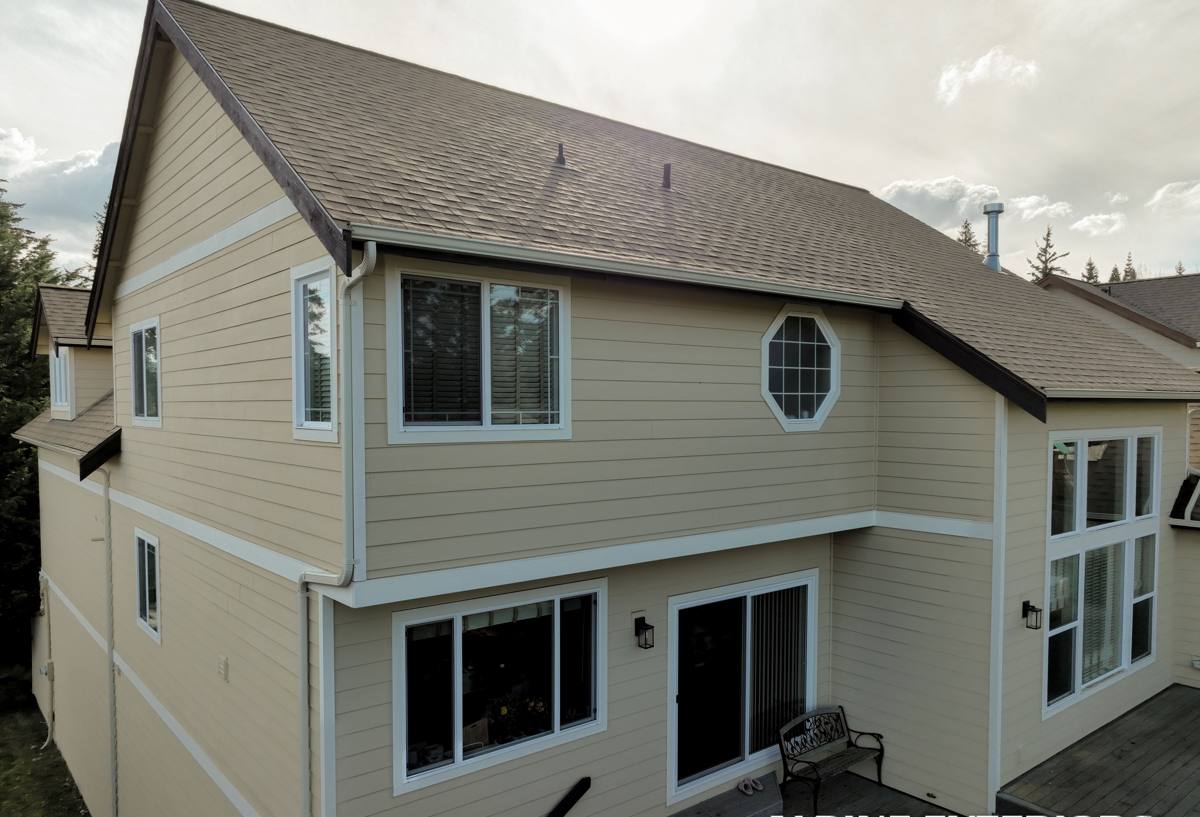
Why Fairhaven's Climate Changes the Job
Fairhaven sits close to Bellingham Bay, and that proximity brings three things most window installers inland don't have to plan for on every job:
- Salt-laden air that accelerates corrosion on exposed fasteners, hinges, and lower-grade cladding over time.
- Driving, wind-driven rain off the water that hits window openings at an angle, not just straight down — this stresses flashing laps and sill pans more than a typical Whatcom County rainstorm.
- A long moss and moisture season, roughly fall through spring, where damp shade and slow-drying surfaces let algae and moss gain a foothold on anything that stays wet — including window sills, trim, and the wall cavity behind a poorly flashed opening.
None of this means Fairhaven needs exotic materials. It means the installation has to be done in the right order, with the right products, every time — because a shortcut that's forgiving in a dry climate is not forgiving here.
What Happens When the Details Get Skipped
The most common failure we see isn't a bad window — it's a good window installed without a proper sill pan or with house wrap lapped the wrong direction. Water gets behind the cladding, doesn't fully dry between rain events because of our humidity, and you end up with rot, stained drywall, or a musty smell long before the window itself would have failed on its own.
What a Correct New-Construction Installation Involves
A proper install follows a sequence — skipping steps or doing them out of order is where problems start.
- Rough opening check. Confirm the opening is square, level, and sized correctly before the window ever shows up on site.
- Sill pan flashing. A sloped, sealed pan under the window directs any water that gets past the glazing back outside instead of into the wall.
- Window-specific flashing tape at the jambs and head, integrated with the house wrap in the correct shingle-lap order (bottom to top, so upper layers overlap lower ones).
- Setting and fastening the window through the nailing fin per the manufacturer's schedule — not just "enough nails to hold it."
- Head flashing above the window, tied into the wrap so water is directed around, not into, the top of the opening.
- Backer rod and sealant at the interior and exterior gaps, sized for the actual joint width rather than overfilled with caulk.
- Interior air-sealing with low-expansion foam or sealant so conditioned air isn't leaking out around the frame.
Every one of those steps is inspectable before the siding goes back on — which is exactly when we walk it, not after.
Frame Material and Glass: What Holds Up Near the Bay
There's no single "best" window brand, but there are real trade-offs between frame materials once salt air and constant moisture are part of the picture.
| Frame Material | How It Handles Salt Air & Rain | Maintenance |
|---|---|---|
| Vinyl | Won't corrode or rot; performs consistently in coastal humidity | Low — occasional cleaning |
| Fiberglass | Very stable dimensionally, resists moisture and salt exposure well | Low |
| Wood-clad | Good performance if the cladding seams are fully sealed; interior wood still needs protection from condensation | Moderate — watch cladding joints and interior finish |
| Bare wood | Attractive but the most exposed to our moss-season moisture; needs a disciplined maintenance schedule | High |
| Aluminum (non-thermally-broken) | Conducts cold and invites condensation on the interior; we don't recommend it for this climate | Low corrosion risk, but condensation issues |
For most Fairhaven new-construction and remodel projects, we lean toward vinyl or fiberglass for exposed, weather-facing walls, and reserve wood or wood-clad for covered porches, sheltered elevations, or where it matches an existing historic character and the homeowner understands the upkeep involved. We're not against wood windows — we just frame the trade-off honestly: they look great and perform fine when maintained, but they demand more attention in a marine climate than vinyl or fiberglass does.
Glass Package Basics
Double-pane, low-E glass with argon fill is the practical standard for this region — it manages our mild-but-damp winters without the added cost of triple-pane, which is usually overkill unless you're chasing a specific energy target or dealing with a north-facing wall that never sees direct sun.
Our Process, Start to Finish
- On-site assessment: We walk the rough openings (or existing walls, if this is a remodel) and note orientation, exposure to weather, and any framing issues before quoting.
- Product selection: We help you pick frame material and glass package based on that wall's actual exposure, not a one-size answer for the whole house.
- Written estimate: Clear line items — no vague "labor and materials" lump sum.
- Scheduling around weather windows: Openings get flashed and closed in as quickly as possible once they're exposed, so an unexpected Whatcom County downpour isn't sitting on bare sheathing overnight.
- Installation per the sequence above, photographed at each stage before it's covered by siding or trim.
- Final walkthrough: We test operation, check seals, and confirm everything is squared and weathertight before calling the job done.
Mistakes We Commonly Correct
Most callbacks we see in this neighborhood trace back to one of these:
- Sill pans skipped or improvised with caulk instead of a real sloped pan.
- House wrap taped in the wrong lap order, letting water track behind the seam instead of over it.
- Fasteners that aren't corrosion-resistant, left exposed to salt air on lower elevations.
- Foam or caulk used as the only air seal, with no backer rod, leading to gaps as materials shrink.
- Windows installed before the wall assembly was fully dried in, trapping moisture that later feeds mold or rot.
Cost Factors to Understand
New-construction window pricing depends on more than the window itself. Broadly, homeowners in the Bellingham area should expect costs to move up or down based on:
| Factor | Effect on Cost |
|---|---|
| Frame material (vinyl vs. fiberglass vs. wood-clad) | Vinyl typically lowest, wood-clad highest |
| Number and size of openings | More or larger openings raise material and labor time |
| Wall exposure (bayfront vs. sheltered) | Exposed walls may warrant upgraded flashing details or fasteners |
| New build vs. remodel/tear-out | Remodels often add framing repair or existing rot removal |
| Glass package | Standard low-E/argon vs. upgraded coatings or triple-pane |
| Access and scheduling | Multi-story or hard-to-reach openings add labor time |
We'd rather walk your specific project and give you real numbers than throw out a broad range that doesn't mean much until we've seen the openings.
A Checklist Before You Hire Anyone for This Work
- Ask to see their sill pan flashing method — if they can't describe it clearly, that's a red flag.
- Confirm they carry current liability insurance and, where required, a Washington contractor license.
- Ask how they sequence flashing with house wrap — "shingle lap" should be part of the answer.
- Ask what fastener and sealant products they use on exposed, weather-facing walls.
- Get the estimate in writing with materials and labor itemized, not lumped together.
- Ask whether they've worked in Fairhaven or similar bayfront conditions before.
Why Local Experience in Fairhaven Matters
A window that's flashed correctly for a dry, inland lot isn't automatically flashed correctly for a home exposed to salt air and driving rain off Bellingham Bay. Crews who work Fairhaven regularly already know which elevations take the brunt of winter storms, how long the moss season really runs in Whatcom County, and where the shortcuts that work elsewhere quietly fail here. That's not a marketing line — it's the difference between a window that's dry in year one and one that's still dry in year fifteen.
If you're planning new construction, an addition, or a remodel in Fairhaven and want windows installed the right way the first time, we're happy to walk the site and give you a straightforward, no-pressure estimate using the form below.