 Bellingham Siding
 Why Decks in Ferndale Wear Out Faster Than Homeowners Expect
Ferndale sits close enough to the water that salt-laden air is part of daily life, and that air is harder on outdoor structures than most homeowners realize. Salt accelerates corrosion in fasteners, joist hangers, and any exposed metal hardware, which is often the real reason a deck starts to feel "loose" or spongy years before the boards themselves look bad. Add in Whatcom County's long stretch of driving rain each fall and winter, and you've got moisture working its way into every joint, screw hole, and end cut on a regular basis.
Then there's moss. Ferndale's mild, wet climate gives moss a long growing season on any horizontal wood surface that doesn't get much direct sun — which describes most decks tucked under eaves or trees for at least part of the day. Moss holds moisture against the wood surface constantly, not just when it's raining, and that constant dampness is what actually rots decking, not the rain itself. A deck that looks fine in July can be hiding real structural problems that only show themselves once you know what to check.
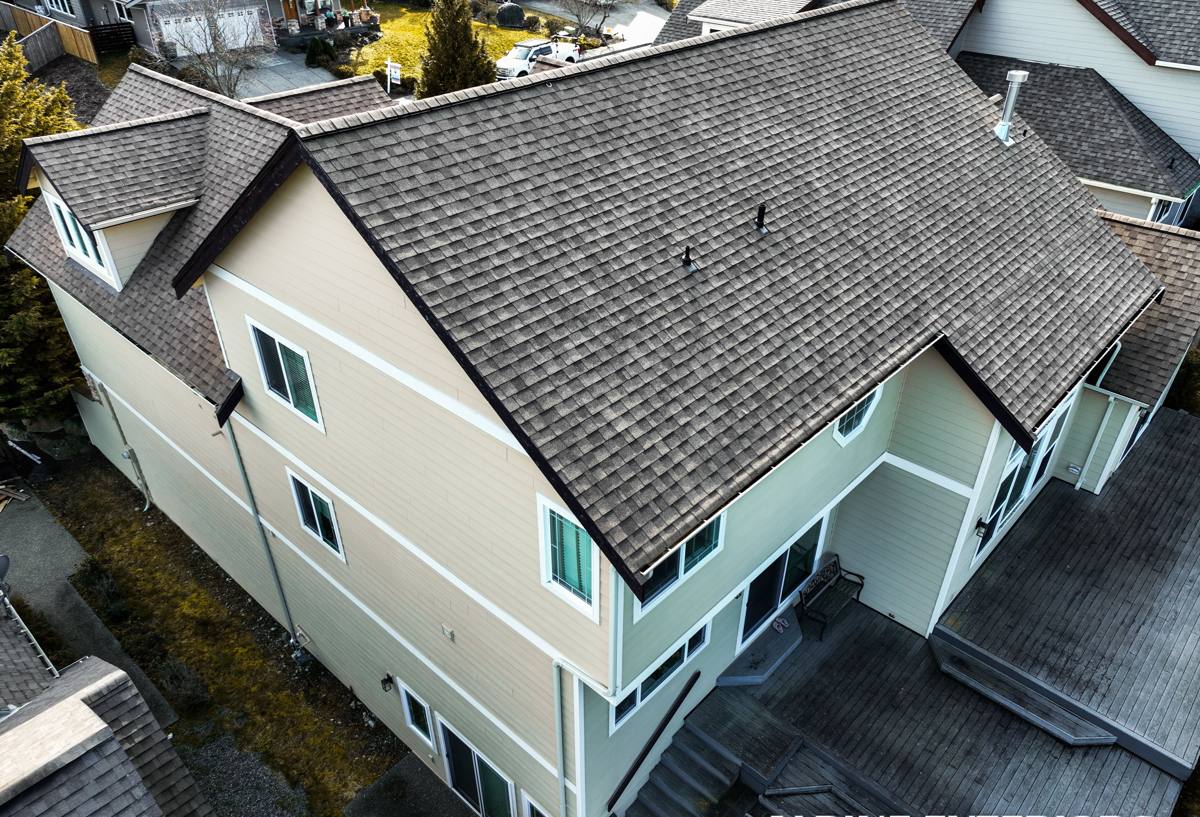
Signs a Deck Needs Replacement, Not Just Repair
Not every tired-looking deck needs to come out entirely. But there's a point where patching boards or re-staining stops being worth it, and pushing past that point is how homeowners end up with a safety problem instead of a cosmetic one. We look for a specific set of warning signs before recommending full replacement over repair.
Structural red flags
- Soft or spongy spots when you walk across the deck, especially near the house
- Rust staining or crumbling around joist hangers and ledger board connections
- Visible gaps or separation where the ledger board meets the house siding
- Posts or footings that have shifted, settled, or show rot at ground contact
- Railings that wiggle or flex under normal pressure
When repair still makes sense
If the framing underneath is sound and the problems are limited to a handful of surface boards, spot repair is the honest recommendation — we're not going to talk a Ferndale homeowner into a full tear-out when a targeted fix will hold up fine. The distinction matters because the framing and ledger connection are what actually keep a deck safe; surface boards are largely cosmetic and wear-related.
What a Correct Deck Replacement Actually Involves
A deck replacement done right goes well past pulling up old boards and screwing down new ones. The parts nobody sees — flashing, fastener grade, footing condition — are what determine whether the new deck lasts 10 years or 25 in this climate.
The ledger board and flashing
This is where a deck attaches to the house, and it's the single most common failure point we find on older decks in this area. Without proper metal flashing directing water away from the ledger-to-siding joint, rain works its way behind the board over time and rots both the ledger and the house framing behind it. Any replacement we do includes correcting this connection, not just reattaching the new ledger the same way the old one was installed.
Footings and posts
Footings need to sit below frost depth and bear on solid, undisturbed soil — something that's easy to get wrong on sloped or previously landscaped lots, which are common around Ferndale. We check every footing during demo rather than assuming the old ones are adequate just because the deck has stood for years.
Framing and hardware
Joists, beams, and all connecting hardware should be rated for exterior, coastal-adjacent use — stainless steel or heavy hot-dip galvanized fasteners, not standard exterior-grade screws that will corrode faster in salt-influenced air. This is a place where cutting corners doesn't show up for a few years, and then it shows up all at once.
Choosing Decking Material for Ferndale's Climate
There's no single "best" decking material — there's a best material for a given budget, sun exposure, and how much upkeep a homeowner actually wants to do. Given the moss and moisture pattern common here, some options are a better fit than others.
| Material | Moisture & Moss Behavior | Maintenance | Typical Lifespan |
|---|---|---|---|
| Pressure-treated wood | Absorbs moisture readily; moss and algae take hold if not cleaned regularly | Annual cleaning, periodic re-sealing | 10-15 years |
| Cedar | Naturally rot-resistant but still needs sealing to shed water long-term | Sealing every 1-2 years | 15-20 years |
| Capped composite | Won't rot; textured surfaces can still hold moss in shaded, damp spots | Periodic washing, no sealing needed | 25-30 years |
| PVC decking | Fully synthetic, sheds water well, most resistant to moss buildup | Occasional washing | 25-30+ years |
Our honest take on the trade-offs
Wood costs less upfront but demands the most ongoing attention — if a homeowner isn't going to clean and reseal it on schedule, moss and moisture will get ahead of it fast in this climate. Composite and PVC cost more initially but essentially remove the moss problem from the equation, which is a meaningful trade-off for a lot of Ferndale homeowners tired of scrubbing boards every spring. We install both wood and composite/PVC systems and will size the recommendation to the budget and how much maintenance the homeowner actually wants to sign up for, not push whatever has the highest margin.
Our Deck Replacement Process
- On-site inspection — we check framing, footings, ledger condition, and moisture damage before quoting anything, so the estimate reflects what's actually there.
- Written scope and permit filing — we handle the permit application with Whatcom County or the City of Ferndale as applicable, so the homeowner isn't the one chasing paperwork.
- Demo — full removal of old decking, railings, and any compromised framing, with a check of what's underneath before we build back.
- Framing and ledger correction — new joists, proper flashing at the house connection, and footings brought up to current code where needed.
- Decking and railing installation — installed to the manufacturer's spec for whatever material was chosen, including proper gapping for drainage and expansion.
- Final walkthrough and cleanup — we inspect the finished deck with the homeowner and clear the site of all debris and old materials.
Permits and Code Considerations Around Ferndale
Most full deck replacements in Whatcom County require a permit, particularly when the deck is attached to the house or elevated above a certain height — the exact thresholds depend on the jurisdiction, since Ferndale and unincorporated Whatcom County can have different requirements. Guardrail height, baluster spacing, and stair rise/run are the details inspectors check most closely, and they're also the details that matter most for actual safety, not just paperwork. We pull the permit as part of the job rather than leaving it to the homeowner, and we build to pass inspection the first time.
Maintenance That Actually Extends a New Deck's Life
The material choice matters, but so does upkeep — even the best decking benefits from a little seasonal attention in a climate that stays wet as long as this one does.
- Sweep debris and standing leaves off the deck surface regularly, especially in fall
- Rinse or scrub moss and algae off boards before it has a chance to establish, particularly in shaded corners
- Keep gutters and downspouts clear so runoff isn't draining directly onto or under the deck
- Check railings and stair connections once a year for looseness
- For wood decks, plan on re-sealing on the schedule the product calls for — skipping a cycle is when moisture damage gets a foothold
- Trim back vegetation that's shading the deck and keeping it damp longer than the rest of the yard
Why It Matters to Hire a Crew That Already Works in Ferndale
Deck framing and materials that hold up fine in a drier inland climate don't always perform the same way this close to the water. A crew that works Ferndale regularly already knows which fastener grades hold up to the salt exposure here, how deep footings need to go on the area's typical soil, and which corners of a lot tend to stay damp long enough to grow moss year-round. That local pattern recognition is the difference between a deck that's built to a generic code minimum and one that's actually built for where it sits. We're not guessing at what this climate does to a deck over time — we see it on every replacement we do in this area.
If your deck is showing soft spots, loose railings, or just more moss than it used to, we're happy to take a look and give you a straight answer on whether it needs full replacement or just targeted repair. Reach out below for a free, no-pressure estimate — there's no obligation, just an honest assessment of what your deck actually needs.