 Bellingham Siding
 Why Sehome Siding Takes More Punishment Than It Looks Like
Sehome sits close enough to Bellingham Bay to catch salt-laden air off the water, close enough to Western Washington University's hillside to hold onto tree cover and shade, and squarely inside a Whatcom County marine climate that delivers driving rain sideways off the Sound for months at a stretch. None of that shows up in a listing photo. It shows up five, ten, fifteen years later, in siding that's peeling at the laps, fasteners bleeding rust through the paint, and a green film creeping up from the ground line that never quite goes away, even in July.
Homes in this neighborhood tend to be older and mixed in age and style, which means a lot of Sehome siding is original wood, aging cedar, or a first-generation composite that was never engineered for this specific combination of salt exposure, shade, and near-constant moisture. Fiber cement done correctly changes that equation. Fiber cement done poorly just fails in a different, more expensive way. This page is about the difference.
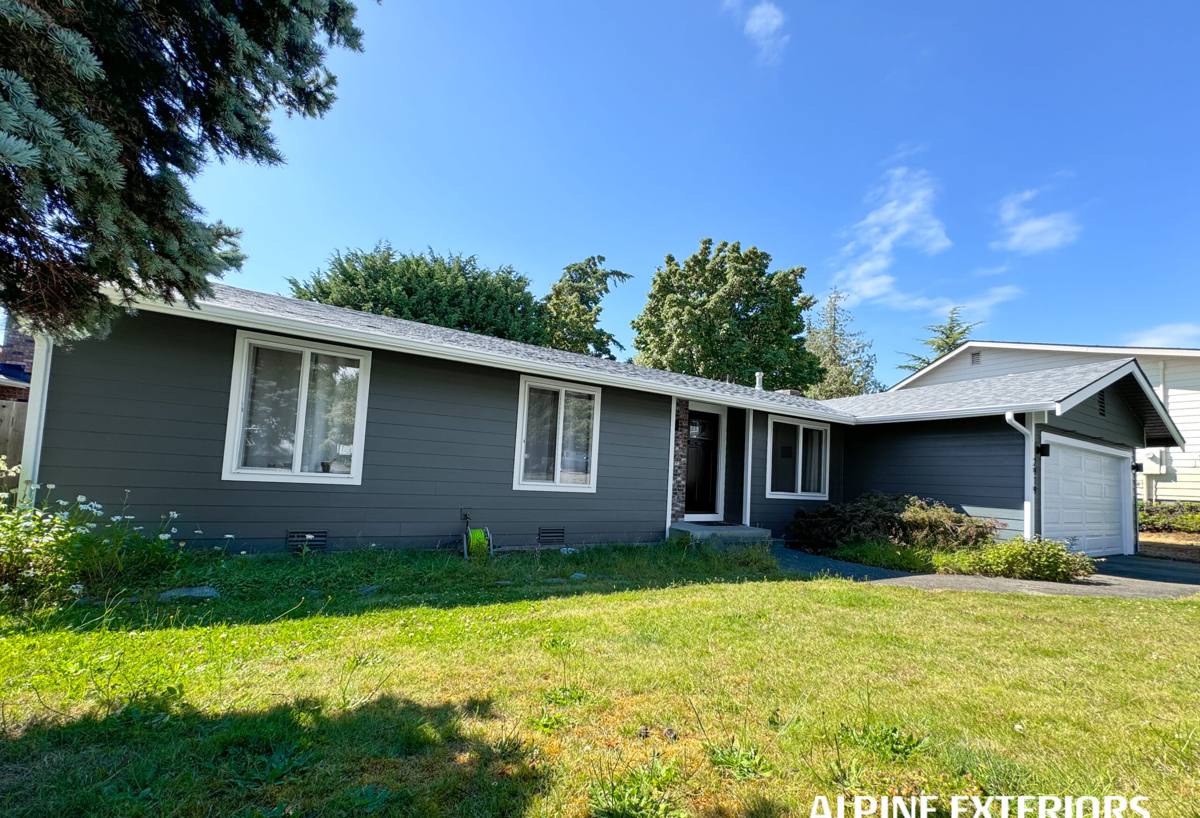
What Salt Air, Rain, and Moss Season Actually Do to a Wall
It helps to understand the mechanism, not just the symptom. Three things are working on a Sehome exterior wall at the same time:
- Moisture cycling — siding gets soaked by driving rain, then dries slowly because Bellingham's damp air doesn't pull water out of building materials the way a drier climate would. Wood-based products swell and shrink with every cycle, and that repeated movement is what eventually cracks paint film and opens seams.
- Salt-laden air — proximity to the bay means airborne salt settles on exposed metal: nail heads, flashing, trim fasteners. Ordinary galvanized fasteners corrode faster here than they would inland, and once a fastener rusts, it stains the siding around it and loses holding power.
- Moss and shade — mature tree canopy common on Sehome's hillside lots keeps siding shaded and slow to dry. Moss doesn't just sit on the surface; it holds moisture against the wall and produces organic acids that break down caulk and paint film over time, especially on north-facing walls and anywhere overhangs are shallow.
Individually, any one of these is manageable. Together, over a Bellingham winter and a long Whatcom County moss season, they're what separates siding that lasts three decades from siding that needs attention in eight years.
Why Sehome's Housing Stock Makes This More Than a Cosmetic Decision
Sehome has a mix of older single-family homes, hillside lots with real elevation change, and infill construction sitting right alongside it — which means the siding problems we get called about here aren't uniform. On some homes it's original wood siding that's been repainted so many times the profile lines are disappearing. On others it's a composite product from an earlier era of home improvement that was never rated for this level of coastal moisture exposure. What ties it together is that almost none of it was engineered specifically for a marine, salt-influenced, shade-heavy environment.
Fiber cement addresses the actual failure modes at play in this neighborhood: it doesn't rot, it doesn't feed insects, it holds paint and factory finish far longer than wood under repeated wet-dry cycling, and it doesn't burn — a real consideration on wooded, shaded lots. It's not a cosmetic upgrade. It's a material match for the specific stress this neighborhood puts on a wall.
What a Correct Fiber Cement Installation Actually Involves
Fiber cement is only as good as the details underneath it. A rushed install on a beautiful product still fails in this climate — usually faster than the wood it replaced, because moisture gets trapped instead of being able to work its way out. A correct job includes:
Behind the siding
- A continuous weather-resistive barrier (housewrap) installed shingle-style so water sheds outward, not into the wall cavity.
- Proper flashing at every window, door, and roof-to-wall intersection — including kick-out flashing where a roofline meets a sidewall, one of the most common leak points we find on older Sehome homes.
- A minimum ground clearance so the bottom edge of the siding never sits in standing water or splash-back from landscaping.
- A rainscreen gap on walls with heavy shade or limited drying potential, letting bulk moisture drain and the wall breathe instead of trapping dampness against the sheathing.
The siding itself
- Corrosion-resistant fasteners appropriate for a coastal, salt-exposed environment — not the standard interior-grade fastener that shows up in a lot of budget installs.
- Manufacturer-specified gaps at butt joints and panel ends, sealed and painted per spec so movement doesn't crack the finish.
- Factory-primed or factory-finished cut edges sealed in the field, since an unsealed cut edge is the single most common place fiber cement siding starts absorbing water it wasn't designed to absorb.
- Caulking only where the manufacturer actually calls for it — over-caulking traps moisture just as reliably as under-caulking lets it in.
Every one of these steps is invisible once the job is finished. That's exactly why they're the ones that get skipped by installers being paid by the square foot instead of by the correct result.
What Drives Cost on a Sehome Job
Every home is different, and we won't quote a number without seeing the house, but the factors that actually move the price on a fiber cement job in this neighborhood are fairly consistent:
| Factor | Why it matters here |
|---|---|
| Tear-off and sheathing condition | Older Sehome homes sometimes hide moisture damage under original wood siding that only shows up once it's removed |
| Home height and hillside access | Two-story homes on sloped lots need more staging and scaffolding time than a flat, single-story property |
| Trim and detail complexity | Older architectural detailing around windows, corners, and gables takes more labor to flash and finish correctly |
| Board profile and exposure | Lap width and texture affect material cost and how many linear feet of joint need sealing |
| Rainscreen or drainage upgrades | Heavily shaded, low-drying walls sometimes justify an added drainage gap, which adds labor but reduces long-term moisture risk |
Our Process From Estimate to Finished Wall
- On-site inspection — we walk the exterior, check for existing moisture damage, and look at drainage, shade patterns, and roofline intersections specific to your lot.
- Sheathing check — once old siding comes off, we inspect the sheathing underneath before anything new goes up. Damaged sheathing gets repaired, not covered over.
- Weather barrier and flashing — housewrap, window and door flashing, and roof-to-wall flashing go in before a single piece of Hardie touches the wall.
- Siding installation to manufacturer spec — correct fasteners, correct gaps, correct clearances, on every elevation, not just the street-facing side.
- Finish work — cut edges sealed, caulk joints completed per spec, touch-up paint matched to the factory ColorPlus finish where needed.
- Final walkthrough — we go over the finished job with you before we consider it done.
A Maintenance Checklist for Bellingham's Salt Air and Moss Season
Fiber cement is low-maintenance, not no-maintenance. A few simple habits go a long way in this climate:
- Rinse the exterior annually to clear salt residue and organic buildup, especially on walls facing the water or under heavy tree cover.
- Trim back vegetation and tree limbs so walls get airflow and sunlight — the biggest single factor in how fast moss returns.
- Check caulk lines around trim, windows, and butt joints once a year; failed caulk is cheap to fix and expensive to ignore.
- Keep gutters clear so overflow doesn't run down the face of the siding at concentrated points.
- Address any moss or algae growth promptly rather than letting it establish — it's far easier to remove early.
- Repaint only where the finish is actually damaged; factory ColorPlus finish holds color far longer than field-applied paint and doesn't need a routine repaint cycle.
Why We Only Install James Hardie
We install James Hardie fiber cement exclusively — not LP SmartSide, not vinyl, not other fiber cement brands, not primed wood. That's a deliberate standard, not a sales preference. Hardie's HZ10 product line is engineered specifically for climates like ours: high moisture, moderate temperatures, and long wet seasons. The ColorPlus factory finish is baked on under controlled conditions, which holds up to UV and moisture cycling far better than field-applied paint, and it comes with a stronger, transferable warranty structure than most alternatives on the market. The core material itself is non-combustible, which matters on shaded, wooded lots where wildfire exposure and ember risk are a real consideration for insurers and homeowners alike.
We're not going to tell you other products are junk — plenty of them have legitimate uses. We simply won't put our name on an installation using a product we don't think holds up to this specific climate over the long run. That's a standard we apply to every job, not just the ones in Sehome.
Why Hiring a Crew That Already Works This Neighborhood Matters
A siding installer who's never worked a hillside Sehome lot doesn't know to expect shaded north walls that never fully dry, older homes with layered siding history, or the specific flashing failures that show up at roof-to-wall intersections on this style of home. A crew that already works in this part of Bellingham has seen what's usually hiding under original siding here, knows how the City of Bellingham handles permitting for exterior re-siding work, and can plan around the rain windows that define a Whatcom County work schedule instead of getting caught by them.
That local familiarity doesn't replace craftsmanship — it just means fewer surprises, fewer change orders, and a job that accounts for this neighborhood's real conditions from the first estimate instead of discovering them mid-project.
If you're weighing your options for a Sehome home, we're happy to take a look and give you a straightforward, no-pressure estimate — what your siding actually needs, what it would take to do it right, and an honest number before any work begins. There's a form below whenever you're ready.