 Bellingham Siding
 Decking in Lynden Has to Answer to the Weather First
Lynden sits inland from Bellingham Bay, but that doesn't mean it's spared from what Whatcom County's marine climate does to an outdoor structure. The moist air that moves in off the coast still reaches the valley, and it brings the same slow, patient damage with it: driving rain that gets pushed sideways under railings and against ledger boards, long stretches of grey, humid weather that never quite lets wood dry all the way through, and a moss season that can run from October into May in a shaded yard. On open farmland lots around Lynden, wind-driven rain across unobstructed fields can hit a deck just as hard as it hits one closer to the water. None of this is dramatic on its own. It's cumulative — and it's exactly what a correctly built composite deck is designed to shrug off, and what a poorly built one will fail on within a few seasons.
We're not going to pretend composite decking is a miracle material that erases every maintenance chore. It isn't. But it removes the failure points that wood struggles with most in this climate — surface checking, splintering, and the annual sand-and-seal cycle — while shifting the real work to getting the substructure, drainage, and board selection right the first time.
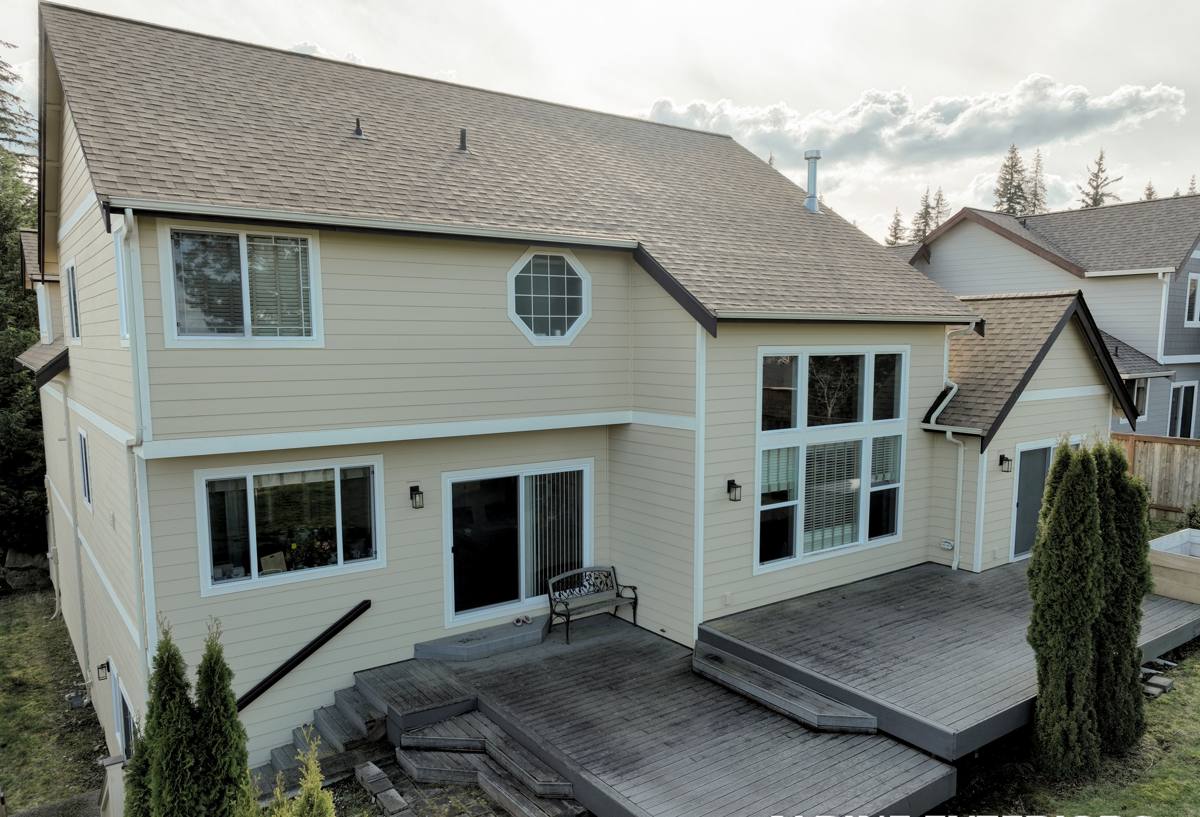
What Composite Decking Actually Solves Here
The honest case for composite decking in a Whatcom County climate comes down to moisture behavior, not looks. Wood decking is a renewable, breathable material, which is exactly why it moves — swelling with rain, shrinking as it dries, cupping and cracking as that cycle repeats year after year in a climate that rarely gives wood a long dry stretch to fully stabilize. Composite boards, especially capped composite and PVC-based boards, don't absorb water the way wood fibers do, so they don't cup, splinter, or need refinishing to stay weather-tight.
What composite doesn't solve: heat retention on dark boards during a sunny stretch, the higher upfront material cost compared to standard pressure-treated lumber, and the fact that composite is only as good as the frame underneath it. A capped composite board on a poorly ventilated, poorly flashed frame will still trap moisture where it meets the house, and mold doesn't care what the walking surface is made of.
Where Wood Still Makes Sense
We're not anti-wood. Cedar still has a place for homeowners who want a natural look and are willing to stay on top of cleaning and sealing on a real schedule. Composite makes the most sense for homeowners who want to stop doing that maintenance, or who've already gone through a wood deck failing early in this climate and want to avoid a repeat.
Choosing the Right Composite for a Lynden Lot
Not all composite decking is built the same, and the differences matter more here than they would in a dry climate.
Capped vs. Uncapped Composite
Capped composite has a plastic shell wrapped around a wood-plastic composite core, which is what actually keeps moisture out of the fibers inside. Uncapped or early-generation composite boards expose that core, and in a wet climate they can absorb moisture at the edges and cut ends over time, leading to swelling and, eventually, mold growth in the surface texture. Our standard is capped composite or full PVC for anything going into a Whatcom County yard — it costs more up front, and we tell every homeowner that plainly, but it's the difference between a deck that stays clean for fifteen years and one that starts showing dark streaking in five.
Grooved-Edge vs. Square-Edge Boards
Grooved-edge boards use a hidden fastener clip system, which gives a clean, screw-free surface and — just as important in this climate — doesn't create a screw head where water can pool and sit against the cap. Square-edge, face-screwed boards are sometimes the right call around stair edges or picture-framed borders, but for open field areas we default to hidden fastening.
Color and Sun Exposure
Darker composite colors hide dirt and moss shadowing better, but they run hotter underfoot on the rare sunny day and can accelerate thermal expansion if the substructure spacing wasn't cut for it. Lighter and mid-tone colors show grime sooner but stay cooler and are more forgiving of minor gapping errors. We walk homeowners through this trade-off before ordering, not after.
What a Correct Installation Actually Involves
Most composite deck problems we get called out to repair in this area didn't come from the decking material — they came from the frame or the flashing underneath it.
Substructure and Drainage
Composite decking is heavier than wood and doesn't flex the same way, so joist spacing has to match the manufacturer's specification for the board profile being used — not the older spacing rules of thumb from a wood deck. We also grade and vent the substructure so water that gets under the boards (and in this climate, some always will) has somewhere to go instead of sitting against the joists.
Ledger Board and House Connection
This is where deck work and siding work overlap, and it's the single most common failure point we find on older decks in Whatcom County. If the ledger board isn't properly flashed where it meets the house — with flashing that actually sheds water out and away from the wall assembly, not just caulk covering a gap — driving rain works its way behind the siding at that joint. That's a rot and mold problem that shows up inside the wall long before anyone notices it from the deck side.
Fastening for Movement
Composite still expands and contracts with temperature, just less dramatically than wood. Gapping between boards, at the house, and at any obstruction has to account for that movement or you get buckling at the ends within the first year or two.
Moss, Mold, and What Maintenance Actually Looks Like
Composite decking doesn't need staining, but it's not maintenance-free, and we won't tell a homeowner it is. In a shaded Lynden yard, moss and algae will still find a foothold on any horizontal surface, composite included — it grows on the surface film rather than into the board, which is the good news, because it comes off with a deck-safe cleaner and a stiff brush or a soft-wash rinse rather than sanding.
- Rinse or soft-wash the deck surface once or twice a year, more often under trees or in constant shade
- Keep gutters and downspouts near the deck clear so runoff isn't dumping directly onto boards
- Sweep debris out of board grooves and gaps before it composts in place and holds moisture
- Check the ledger flashing and any wall-to-deck junction annually for early signs of staining or soft trim
- Avoid pressure-washing at close range or high pressure — it can strip the cap layer's texture over time
Composite Decking Cost Factors
We don't publish flat prices because every deck here is different — square footage, framing condition, height off grade, and railing choice all move the number. What we can tell homeowners honestly is what tends to push a project toward the higher or lower end of the range.
| Cost Factor | Typical Impact | Why |
|---|---|---|
| Board tier (capped composite vs. PVC vs. entry-level) | Medium to High | Material cost and moisture performance both scale together |
| Existing substructure condition | Low to High | A sound frame keeps cost down; rot or undersized joists mean rebuilding before decking goes on |
| Fastening system (hidden clips vs. face screws) | Low to Medium | Hidden fastener systems add labor time but reduce long-term water pooling at fastener points |
| Railing material | Medium | Composite and metal railing systems vary widely in price and in how well they handle this climate |
| Height off grade / stairs | Medium to High | Multi-level decks and stair framing add engineering and labor beyond flat, low-grade decks |
| Ledger flashing and house tie-in work | Low to Medium | Doing it correctly the first time costs less than repairing water damage later |
Our Process, From Estimate to Finished Deck
- On-site visit to assess the existing structure (if any), grade, sun and shade exposure, and how the deck will tie into the house
- Honest recommendation on board tier and fastening system based on that specific lot, not a one-size answer
- Written estimate covering substructure work, decking, railing, and flashing as separate line items so homeowners see where the cost is going
- Permit handling where required by the jurisdiction
- Framing and flashing work, inspected before boards go down — this is the step that determines whether the deck lasts
- Decking, railing, and finish trim installed to manufacturer spec for gapping and fastening
- Walkthrough with the homeowner covering realistic maintenance expectations before we call the job done
Why a Crew That Already Works Lynden Matters
Whatcom County's climate isn't uniform from one town to the next, and a crew that mostly works drier inland regions can miss details that matter here — proper ledger flashing for sustained wet-season exposure, joist spacing that accounts for moisture-driven wood movement in the substructure, and moss-prone shade patterns that change where drainage needs to go. A crew based in Bellingham that regularly works Lynden and the surrounding county knows the permitting expectations for the jurisdiction, has already seen how open-field wind exposure behaves differently from a tree-sheltered in-town lot, and isn't guessing at spacing tolerances because of a one-off job in an unfamiliar climate. That familiarity shows up less in the sales pitch and more in the parts of the job nobody sees once the boards are down — the flashing, the fastening, the grading underneath.
If you're weighing composite decking for a home in Lynden or anywhere else in the Bellingham area, we're glad to walk the property, look at what's there now, and give a straight, no-pressure estimate — no exaggerated claims about how little maintenance you'll do, just a clear picture of what the job actually involves and what it will cost. Use the form below to get started.