 Bellingham Siding
 Built for Happy Valley's Weather, Not Just Any Roof
Happy Valley sits close enough to Bellingham Bay that salt-laden air works its way into every exposed metal surface, every run of trim, and every roof edge in the neighborhood. Add Whatcom County's long wet season — months of rain that comes in sideways off the water — and a moss season that can stretch from fall through spring, and you have a climate that's genuinely harder on a roof than most manufacturers' generic installation guides assume. A metal roof that's correctly specified and installed for this environment will outlast the neighborhood's older shake and asphalt roofs by decades. One installed the way it would be in a dry inland climate tends to show problems in five to ten years: fastener corrosion, moss holding moisture against seams, and flashing that was never really detailed for wind-driven rain in the first place.
This page covers what a metal roof needs to hold up over Happy Valley specifically, what we do differently because of it, and how our process runs from first estimate to final cleanup.
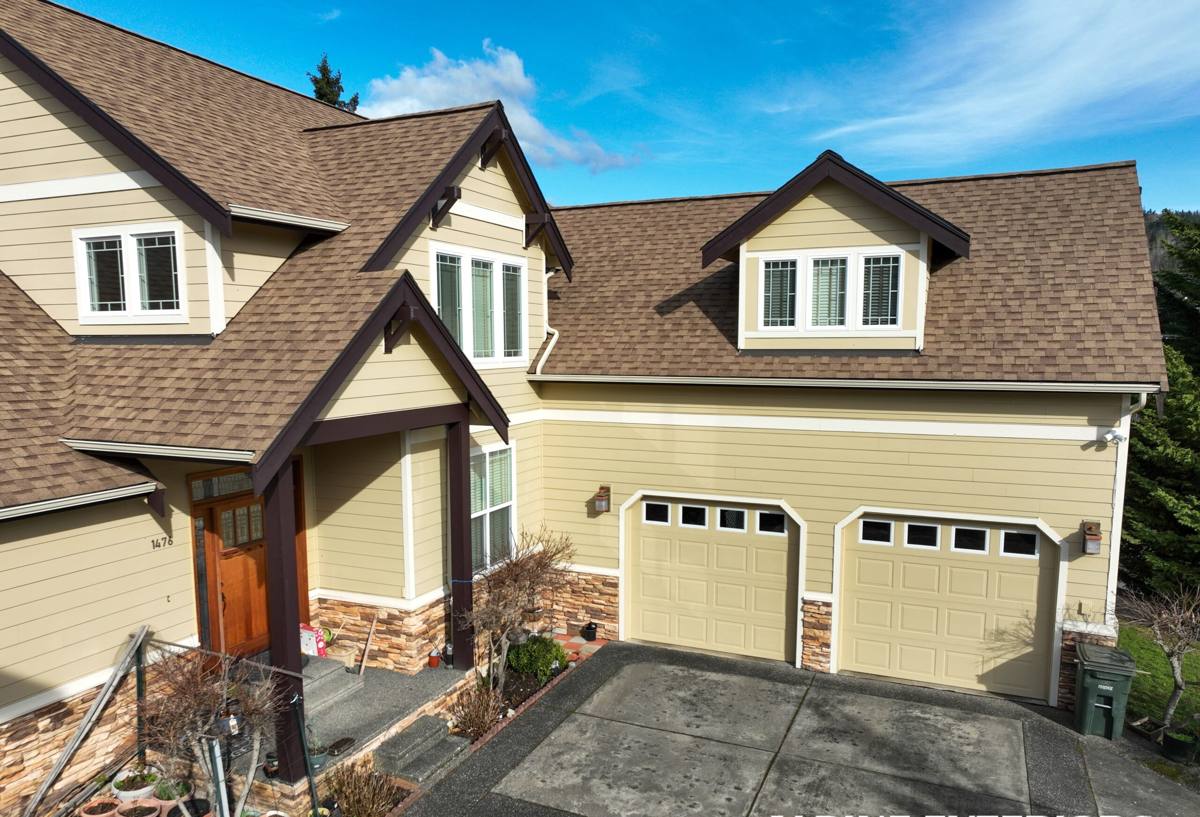
What Salt Air, Rain, and Moss Do to a Roof Over Time
Salt Air and Corrosion
Salt-laden air doesn't need to be blowing hard to matter — it settles on metal day after day, and over years it accelerates corrosion anywhere the protective coating is thin, scratched, or missing: cut edges, exposed fastener heads, and field cuts made with the wrong tool. That's why fastener choice and edge treatment matter more on a Bellingham roof than they would forty miles inland.
Driving Rain
Wind-driven rain off the bay doesn't fall straight down — it pushes sideways and even upward under laps, at ridges, and around penetrations like vents, chimneys, and skylights. A roof that relies on gravity alone to shed water at these points will eventually leak. Every flashing detail on a Happy Valley job needs to be built around wind-driven rain, not just vertical rainfall off a chart.
Moss and Sustained Moisture
Whatcom County's moss season is long, and Happy Valley's tree cover and moisture keep roofs damp for extended stretches even between storms. Moss holds water against a roof surface long after the rain stops, which is bad news for asphalt shingles and can still cause problems on metal if debris builds up in valleys and behind ridge caps. A well-installed metal roof sheds moss far better than shingles, but it isn't immune to buildup around obstructions.
Metal Roofing Options for Happy Valley Homes
Not every metal roofing system is a good match for this climate, and not every system is worth the added cost for every home. Here's how the common options compare on a coastal Whatcom County property:
| System | Best for | Coastal durability | Trade-offs |
|---|---|---|---|
| Standing seam (concealed fastener) | Homes staying long-term, full roof replacements | Excellent — no exposed fasteners to corrode | Higher upfront cost; needs an experienced crew to detail correctly |
| Exposed-fastener panel | Outbuildings, budget-conscious re-roofs | Good, but fastener heads and gaskets need periodic inspection | Fasteners can loosen or corrode over time and require maintenance |
| Stone-coated steel | Homes wanting a shake or shingle look with metal's lifespan | Very good — coating protects the steel | More installation steps; coating damage needs prompt attention |
For most Happy Valley homes we recommend standing seam or stone-coated steel over exposed-fastener systems on the main house, simply because there's nothing on the exposed roof surface for salt air and moisture to work on. Exposed-fastener panels still have a place — sheds, shops, and outbuildings where upfront cost matters more than a decades-long service life.
Coatings, Color, and Long-Term Appearance
The paint or coating system on a metal panel matters as much as the metal underneath it in this climate. Higher-grade coatings resist chalking and color fade under UV and salt exposure far better than basic finishes, which is worth asking about directly rather than assuming every "metal roof" quote includes the same coating quality. We can walk you through panel and coating options that fit the look of your home without cutting corners on what's actually protecting the steel.
What a Correct Installation Actually Involves
Underlayment and Deck Prep
Metal doesn't forgive a bad deck. Before any panel goes down, we check the sheathing for rot or soft spots — common on older Bellingham homes where a past roof held moisture longer than it should have — and install a high-quality synthetic or ice-and-water underlayment at eaves, valleys, and penetrations. In a climate with this much sustained rain, underlayment isn't a formality; it's the backup system that protects the house if wind ever drives water past the metal itself.
Fasteners and Flashing
We use fasteners and flashing rated for coastal exposure, not standard-grade hardware that's fine forty miles from salt water but starts showing rust streaks within a few winters here. Every flashing detail — valleys, sidewalls, chimneys, skylights — is lapped and sealed to shed wind-driven rain, not just water falling straight down.
Ventilation
A metal roof over a poorly ventilated attic traps moisture from inside the house against the underside of the deck, which causes its own rot and mold problems no matter how good the roof surface is. We check ridge and soffit ventilation on every metal roofing job — it's often the difference between a roof system that lasts and one that fails from the inside out.
Our Process From Estimate to Cleanup
- On-site assessment. We look at the existing roof, deck condition, ventilation, and any moss or moisture staining before quoting anything.
- Written estimate. You get a clear scope — panel type, underlayment, flashing details, and a firm price — not a vague allowance.
- Tear-off and deck repair. Any soft or rotted decking is replaced before a single panel goes down.
- Underlayment and flashing installation. This is where most of a roof's long-term performance is decided, and it's the step that gets rushed on lower-bid jobs.
- Panel installation. Panels are set, seamed, or fastened to manufacturer spec and adjusted for the coastal exposure of your specific site.
- Final walk-through and cleanup. We walk the job with you, clear debris and fasteners from gutters and the yard, and answer questions about upkeep.
Keeping Moss and Algae From Taking Over
Metal roofing resists moss far better than asphalt or wood shake because there's no organic surface for it to root into, but debris still collects in valleys, around penetrations, and behind chimneys — and wherever debris sits wet under tree cover, moss and algae can still get a foothold. A few habits keep a metal roof performing the way it's supposed to in this climate:
- Clear needles and leaf debris from valleys and behind chimneys or skylights once or twice a year
- Keep gutters clear so water isn't backing up under the roof edge
- Trim back overhanging branches that keep sections of the roof shaded and damp longer than the rest
- Have flashing and sealant points checked every few years, especially after a hard windstorm off the bay
- Address any moss or algae staining early rather than letting it sit through another wet season
Cost Factors to Expect
Every roof is priced on its own specifics, but the main variables that move the number on a Happy Valley metal roofing job are consistent:
| Factor | Why it matters |
|---|---|
| Panel system chosen | Standing seam costs more upfront than exposed-fastener panels but needs less long-term maintenance |
| Roof complexity | Valleys, dormers, and multiple roof planes add flashing work and labor time |
| Deck condition | Rot or soft sheathing found during tear-off adds repair cost that's hard to quote sight-unseen |
| Tear-off scope | Removing existing shingle or shake layers versus roofing over adds disposal and labor cost |
| Access and pitch | Steep or hard-to-access roofs take longer and require more safety setup |
We'd rather walk your roof and give you real numbers than quote a range that doesn't hold up once we're actually on the deck.
Why a Crew That Already Works Happy Valley Matters
A roofing crew that's worked this neighborhood already knows which older homes tend to have deck issues under the existing roofing, how site lines run relative to prevailing wind and rain off the bay, and which flashing details actually hold up here versus which ones look fine on paper but fail in three winters. That local track record matters more on a metal roof than on almost any other exterior project, because a metal roof is only as good as its flashing and fastening details — and those are exactly where an inexperienced or out-of-area crew tends to cut corners without realizing it. We're also familiar with Bellingham and Whatcom County permitting requirements, so scheduling inspections doesn't become a surprise delay partway through your project. We're a local crew working this county day in and day out, which means we're accountable to the same neighborhood we're roofing.
A Homeowner's Pre-Project Checklist
- Ask what underlayment and flashing materials are being used, and why — not just what panel color or profile
- Confirm whether your existing roof will be torn off or roofed over, and understand the trade-offs either way
- Have your attic ventilation checked as part of the estimate, not as an afterthought
- Get the fastener type and coating rating in writing if you're considering an exposed-fastener system
- Ask how the crew handles deck repair if rot is found once the old roof comes off
- Confirm what the warranty covers on materials versus workmanship, and for how long
If you're weighing a metal roof for a Happy Valley home, we're happy to take a look and give you a straight answer about what your roof actually needs — no pressure, no inflated scope. Use the form below to request a free estimate.