 Bellingham Siding
 Why Fiber Cement Belongs on Puget Homes in the First Place
Homes in the Puget area sit close enough to the water that the climate does more than just get wet in the winter. Salt-laden air moves through wood and painted surfaces differently than it does further inland, driving rain gets pushed sideways into wall assemblies during winter storms, and the shoulder seasons stay damp long enough for moss and algae to take hold and stay there. Any siding material that's marginal on moisture resistance gets exposed here faster than it would in a drier part of the state. That's the entire reason fiber cement, installed correctly, matters more in Puget than it does in a lot of other neighborhoods we work in around Bellingham.
Salt Air and Wind-Driven Moisture
Salt air accelerates the breakdown of paint film, corrodes exposed fasteners, and speeds up the swelling and softening that wood-based siding is already prone to. It doesn't take a direct ocean-front lot to feel this — homes throughout Whatcom County's marine-influenced neighborhoods, including Puget, see it in how fast trim caulk fails and how quickly a cheap paint job starts chalking.
A Moss Season That Doesn't Really End
Bellingham's moss and algae season isn't really a season — on north-facing and shaded walls it's close to year-round. Siding that absorbs moisture gives moss something to root into over time, especially at laps, seams, and butt joints. Siding that stays dimensionally stable and doesn't wick water just gets cleaned off; it doesn't degrade underneath.
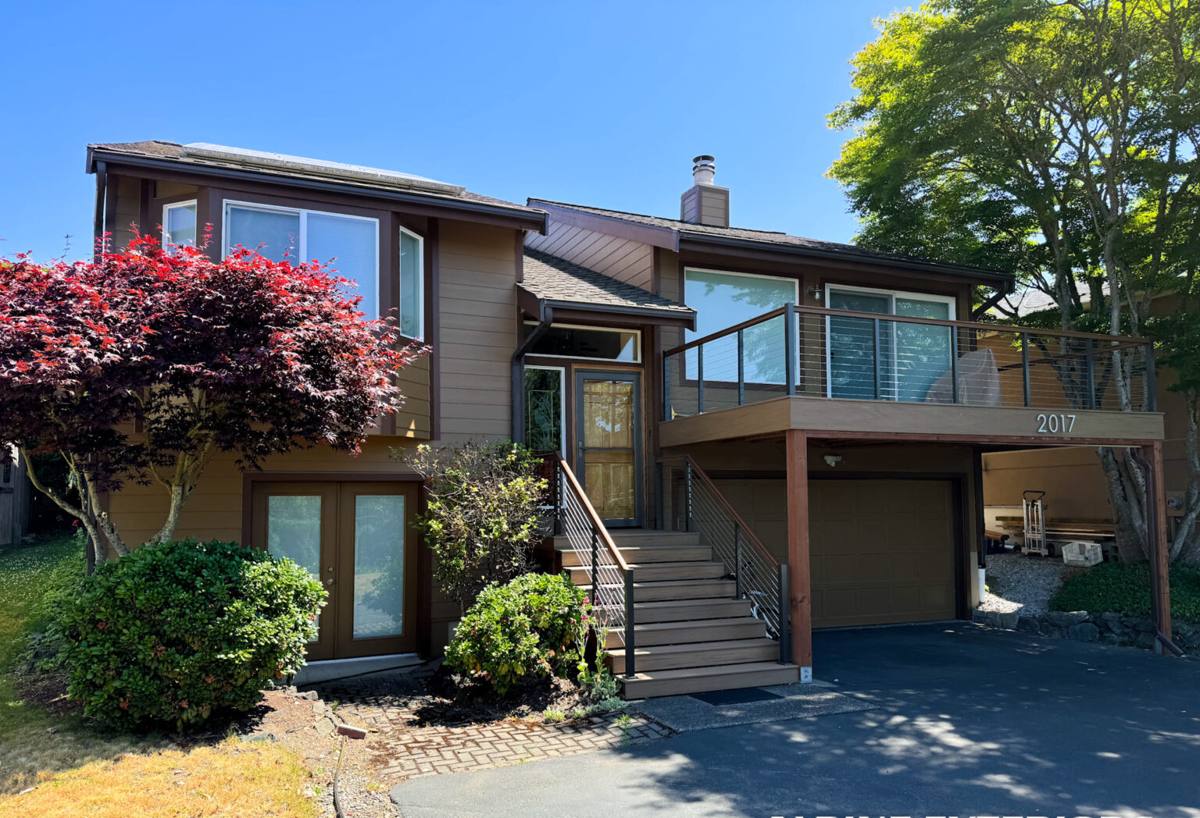
What Fiber Cement Actually Solves for This Climate
Fiber cement is cement, sand, and cellulose fiber pressed and cured into a plank or panel. It doesn't rot, it doesn't provide a food source for the organic growth that thrives in this climate, and it doesn't expand and contract with moisture the way wood or wood-composite products do. That dimensional stability is what keeps caulk joints and paint film intact for years instead of months. It's also non-combustible, which matters given how many Whatcom County properties border trees and dense landscaping.
None of that is unique to one brand — fiber cement as a category solves these problems better than wood, wood composite, or vinyl. But not all fiber cement is manufactured, finished, or warrantied the same way, and that's where our standard comes in.
Why We Only Install James Hardie Fiber Cement
We install James Hardie products exclusively — not LP SmartSide, not vinyl, not other fiber cement brands, not primed wood. That's a deliberate standard, not a sales preference:
- ColorPlus factory finish — baked-on, not field-applied, so color and moisture protection start at the plant instead of depending on job-site weather conditions during a Bellingham install window.
- Climate-engineered product line — Hardie's HZ5 formulation is built for the Pacific Northwest's freeze-thaw and moisture cycle rather than a one-size-fits-all mix.
- Transferable warranty — backed by a large manufacturer with decades of field history, which matters if you sell the home before the siding's service life is up.
- Proven long-term performance — when installed to spec, Hardie siding has a long track record in exactly this kind of wet, marine climate.
We're not going to tell you every other product on the market is worthless — some have real strengths. We just won't put our name on a job where the material or the finish is the weak link in a climate this hard on siding.
What a Correct Installation Involves on a Puget Home
Fiber cement is only as good as the installation behind it. Most siding failures we get called out to inspect aren't material failures — they're installation shortcuts that let water get behind the siding, where fiber cement can't help you.
Moisture Management Behind the Siding
Correct house wrap, properly lapped and taped seams, and flashing at every window, door, and penetration are what actually keep driving rain out of the wall assembly. A rain screen gap behind the siding — a small furring space that lets any moisture that does get in drain and dry — is standard practice on homes facing our weather, and it's one of the details that separates a crew that understands this climate from one that's just following a generic install sheet.
Fastening, Clearances, and Caulking
Hardie specifies fastener type, placement, and spacing for a reason — get it wrong and you create stress points where the board can crack or the finish can fail early. Ground clearance and roof-line clearance keep splash-back moisture and gutter overflow off the bottom courses. And the caulking at trim and joints has to be a product rated for this kind of sustained moisture exposure, not just whatever's cheapest at the yard.
| Detail | Correct Approach | What Happens If Skipped |
|---|---|---|
| Rain screen / drainage gap | Furring strips or drainable wrap behind siding | Trapped moisture, premature rot in sheathing |
| Window and door flashing | Fully lapped, integrated with house wrap | Water intrusion at penetrations, hidden framing damage |
| Fastener placement | Per Hardie spec, corrosion-resistant fasteners | Board cracking, streaking, early fastener failure |
| Clearance above grade/roofline | Minimum gap maintained per manufacturer spec | Wicking moisture, moss colonization at bottom courses |
| Joint caulking | Paintable, high-movement sealant at all seams | Cracked caulk lines, water tracking behind boards |
Our Process, Start to Finish
Inspection and Estimate
We start by walking the exterior with you, looking at existing siding condition, moisture staining, trim, and anything the current wall assembly is already telling us. That's where we catch problems — soft sheathing, missing flashing, undersized clearances — before they become surprises mid-project.
Installation
Old siding comes off, the wall assembly gets inspected and repaired as needed, house wrap and flashing go in correctly, and then the Hardie product goes up to spec — proper fastening, proper clearances, proper caulking. We don't skip the parts that don't show once the siding's up, because those are the parts that determine whether it lasts.
Final Walk-Through
Before we call a job done, we walk it with you — trim lines, caulking, touch-up paint at cut edges, and cleanup. You should know exactly what was done and why before we leave.
- Does the estimate specify Hardie product line and profile by name, not just "fiber cement"?
- Is house wrap and flashing repair scoped separately, or bundled as an assumption?
- Does the contract call out fastener type and rain screen/drainage approach?
- Is the manufacturer's warranty registration included as part of the job?
- Is there a clear written timeline given Bellingham's weather windows?
What Fiber Cement Siding Costs in the Puget Area
Cost varies by home size, existing siding removal, and how much wall repair is needed once the old material comes off — a home with hidden moisture damage from years of wind-driven rain will cost more to get right than one that's simply due for an upgrade. Broad ranges are more useful than a single number here, since every home's condition is different.
| Cost Factor | Why It Matters in This Climate |
|---|---|
| Sheathing/framing repair | Long-term moisture exposure near the water can hide rot behind old siding |
| Siding profile and trim detail | More corners, dormers, and trim add labor and material |
| House wrap and rain screen system | A proper drainage plane costs more up front but prevents the failures this climate causes |
| Access and site conditions | Steep lots, tight setbacks, or mature landscaping affect crew time |
| Paint vs. ColorPlus finish | Factory-finished ColorPlus avoids a field paint job and its own weather-dependent timeline |
Why Local Experience in Puget and Bellingham Matters
A crew that already works in Puget knows what a marine-exposed wall looks like after twenty years versus what a wall on a more sheltered inland lot looks like — and that affects how we scope moisture repair before siding ever goes up. It also means knowing the practical realities of scheduling around Whatcom County's wet stretches, coordinating with the City of Bellingham on permitting where it applies, and not treating every home in the area like it's getting the same generic install. That local pattern-matching is worth more than it sounds like on paper — it's the difference between a contractor guessing at what a marine climate does to a wall and one who's already seen it firsthand on homes like yours.
Maintenance: What Owning Hardie Siding Actually Looks Like Here
Correctly installed Hardie siding with a ColorPlus finish is genuinely low-maintenance, but "low" isn't "none" in this climate. Plan on periodically washing off moss and algae buildup, especially on shaded or north-facing walls, and doing a yearly walk-around to check caulk lines at trim and penetrations. Because the finish is baked on at the factory rather than field-applied, you're not on the same repaint clock you'd be on with wood — but you still want to catch a failed caulk joint before a wet winter turns it into a bigger problem.
If your Puget-area home's siding is showing its age — or you just want an honest read on what shape it's in — we're glad to walk the exterior with you and give you a straightforward, no-pressure estimate. There's no obligation, and you'll get a clear picture of what your home actually needs before you decide anything.