 Bellingham Siding
 New-Construction Windows Are a Different Job Than Replacement Windows
If you're building new or adding on in the Puget area of Whatcom County, the windows going into those rough openings are not the same product or the same install method as a replacement window going into an existing wall. New-construction windows have a nailing fin (sometimes called a nail flange) that gets fastened directly to the wall sheathing before siding goes on, and they get built into the wall's water management system from the studs out. There's no existing frame to work around, no old flashing to inspect and reuse — you get one shot to build the opening correctly, and once the siding closes it up, mistakes are hidden for years until they show up as rot or a stain on the drywall.
That matters more here than in a lot of places. Whatcom County sits right on Puget Sound, which means salt-laden air, wind-driven rain off the water, and a moss season that runs long into the year on shaded north and west walls. A new-construction window installed without the right flashing sequence or the right hardware for this environment doesn't fail in year one — it fails in year eight or ten, quietly, behind the trim.
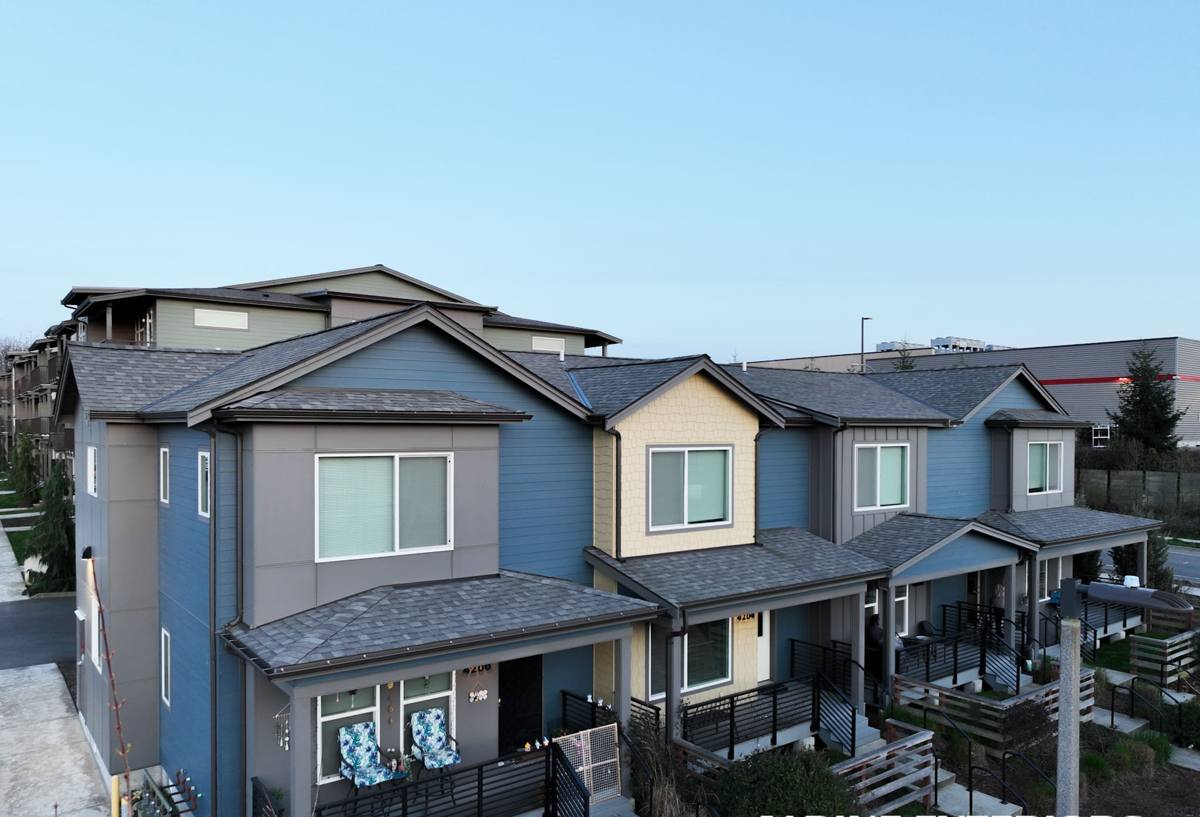
What Puget's Climate Actually Does to a New Window Install
Salt Air
Homes closer to the water deal with airborne salt that settles on hardware, fasteners, and metal flashing. Over time it accelerates corrosion on anything that isn't rated for a marine or near-marine environment — cheap fasteners, uncoated flashing tape edges, and low-grade weep hardware are the first things to show wear.
Driving Rain
Storms coming off the Sound don't just fall straight down — wind pushes rain sideways into wall assemblies, which means water gets tested against every seam, joint, and flashing lap on a window opening. A flashing detail that would be fine in a drier, calmer climate can leak here if it's not shingle-lapped correctly.
Long Moss Season
Extended damp periods keep siding, trim, and sills wet longer than in drier regions. Any spot where water can pool instead of drain — a poorly sloped sill, a missing sill pan, a gap in the weather-resistive barrier — turns into a place where moss, algae, and eventually rot get a foothold.
None of this means new-construction windows are a bad idea in Puget — it's the standard method for new builds. It means the install has to account for what this specific climate throws at a wall assembly, not just follow a generic checklist.
Anatomy of a Correct New-Construction Window Install
A window that will hold up through decades of Puget Sound weather gets built in a specific order. Skipping steps or doing them out of sequence is the single biggest cause of hidden window leaks in new construction.
- Rough opening check — verify the opening is square, plumb, and sized correctly before the window ever goes in.
- Sill pan flashing — a sloped, sealed pan under the window that directs any water that gets past the glass back outside instead of into the wall cavity.
- Jamb flashing — side flashing that laps over the sill pan.
- Window set — the unit is set into the opening, shimmed level and plumb, and the nailing fin fastened per the manufacturer's pattern.
- Head flashing — installed last on the top, shingle-lapped over the jamb flashing and integrated with the wall's weather-resistive barrier so water always sheds outward and downward, never into a seam.
- WRB integration — the housewrap or building paper is taped and lapped over the flashing at every edge, maintaining a continuous drainage plane before siding goes on.
- Interior and exterior sealing — low-expansion foam or backer rod and sealant around the frame, sized to the gap, without over-packing that can bow the frame.
Every one of those laps has to shed water downward and outward — a single reversed lap, or a piece of tape run the wrong direction, defeats the whole system even if every other step was done right.
Choosing Frame and Glass for a Near-Water Climate
Material choice matters more on a Puget build than it would inland. Salt air and sustained moisture change how different frame materials age.
| Frame Material | How It Handles Salt Air & Moisture | Maintenance |
|---|---|---|
| Vinyl | Doesn't corrode; UV and temperature swings can affect long-term color and seal life | Low — occasional cleaning |
| Fiberglass | Very stable dimensionally, resists moisture and corrosion well, holds paint/finish long-term | Low |
| Wood-clad | Good insulating properties, but any breach in the exterior cladding exposes wood to rot risk in a wet climate | Higher — cladding seams and any exposed wood need monitoring |
| Aluminum (uncoated) | Conducts cold, can corrode faster in salt air without marine-grade coatings | Moderate to high near the water |
Hardware — hinges, locks, and fasteners — should be rated for coastal or marine exposure regardless of frame material, especially on homes closer to the Sound. On glass, orientation matters as much as brand: south and west-facing openings benefit from Low-E coatings tuned for solar heat gain control, while north-facing glass in a shaded, mossy yard is more about condensation resistance than heat gain.
How the Job Actually Runs
Coordinating With Your Builder
On a new build or addition, window install has to slot into the framing schedule at the right moment — after sheathing and WRB are up, before siding starts. We work directly with your general contractor or framer to confirm rough opening sizes match the ordered windows before they ever arrive on site, which avoids costly reorders or forced trims that compromise the opening.
Install Day
Each opening gets the full flashing sequence above, not a shortcut version. We check every unit for level, plumb, and square before final fastening, and we test operable sashes and locks before moving to the next opening.
Final Check
Before we call a job finished, we walk every window with you (or your builder) to confirm sealant lines are clean, hardware operates smoothly, and flashing is fully integrated with the wall assembly — not just visually caulked over.
What Drives Cost on a Puget New-Construction Window Job
| Factor | Why It Affects Price |
|---|---|
| Frame material | Vinyl is typically the most economical; fiberglass and wood-clad cost more upfront but perform differently over time |
| Number and size of openings | More or larger openings mean more flashing detail work and labor hours |
| Glass package | Upgraded Low-E coatings, tempered glass where code requires it, or specialty glazing add cost |
| Exposure and orientation | Openings facing prevailing wind-driven rain off the Sound may warrant upgraded flashing details or hardware |
| Access and building height | Second-story or hard-to-access openings take more time and staging |
| Coordination complexity | Working alongside an active framing crew on a tight schedule can affect labor efficiency |
Exact numbers depend on the specific plans, so we'd rather walk your project and give you real figures than throw out a placeholder range that doesn't match your build.
Why It Matters That We Already Work in Puget
A crew that only occasionally works this close to Puget Sound can still install a window correctly on paper and still get the details wrong for this specific environment — the wrong fastener grade, a flashing detail that would be fine forty miles inland but isn't here, or a schedule that doesn't account for how long a wet spell can hold up siding crews waiting to close in an opening. Working new-construction jobs in and around Bellingham and Whatcom County regularly means we're not guessing at how salt air, driving rain, and a long moss season interact with a wall assembly — we're building to what actually holds up in this climate, and we're used to coordinating with local builders and framing crews on their timelines.
A Practical Checklist Before Your Windows Go In
- Confirm rough opening sizes against ordered window sizes before delivery
- Ask what sill pan flashing method will be used and how it's sloped
- Confirm flashing laps are sequenced sill, jamb, then head — in that order
- Ask what fastener and hardware grade is specified, especially if your lot is close to the water
- Confirm how the window flashing integrates with your specific weather-resistive barrier
- Ask how sealant gaps will be sized and what product will be used
- Get a walkthrough of finished openings before siding closes them in
If you're planning a new build or addition in the Puget area and want windows installed right the first time, we're happy to take a look at your plans and walk your site. There's no pressure and no cost to get an estimate — just fill out the form below and we'll get in touch.