 Bellingham Siding
 Why Siding Repair in Puget Isn't the Same as Siding Repair Everywhere Else
Puget sits close enough to Bellingham Bay that homes here deal with a slightly different mix of punishment than siding a few miles inland. The salt-laden air off the water accelerates corrosion on fasteners and trim. Wind-driven rain off the Sound doesn't just fall straight down — it gets pushed sideways into laps, seams, and any gap where flashing was skipped or caulk was asked to do a job it was never built for. And Whatcom County's long, wet, mild winters mean moss and algae have months to establish themselves on north-facing and shaded walls before a dry stretch ever interrupts them. None of this is exotic — it's just what coastal Pacific Northwest weather does to a house, year after year. The homes that hold up are the ones where the siding, the water-resistive barrier behind it, and the flashing details were all done correctly the first time, or repaired correctly when something failed.
When we get a repair call in Puget, we're rarely looking at one isolated problem. Usually there's a visible symptom — a soft spot, a stain, a section of siding that's pulling away — and a less visible cause behind it that's been building for a while. Repairing the visible part without finding the cause is how the same repair call happens again in two years.
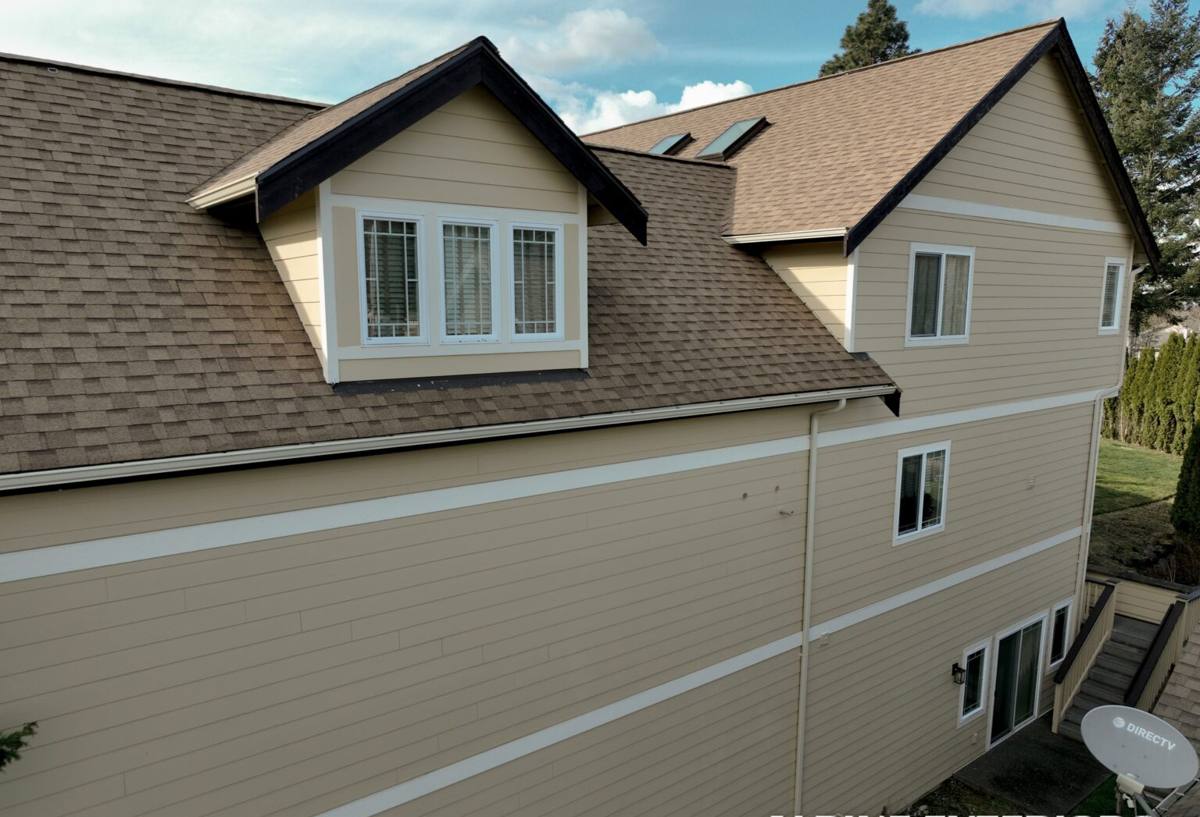
What Salt Air, Rain, and Moss Actually Do to Your Siding
Salt Air and Corrosion
Airborne salt is a mild but persistent corrosive. It works on exposed steel and aluminum fasteners, on metal flashing and trim, and on any hardware that isn't rated for coastal exposure. Corroded fasteners lose their grip on the siding they're holding, which is how you end up with boards that rattle in the wind or slowly work themselves loose at the nail line — long before the siding material itself has failed.
Driving Rain and Water Intrusion
Lap siding is designed to shed water down and out, but that only works if the laps, seams, corners, and penetrations (hose bibs, light fixtures, vents) were flashed and caulked correctly when the siding went up. Wind-driven rain finds every shortcut. Once water gets behind the siding, it doesn't dry out quickly in our climate — it sits against the sheathing and the water-resistive barrier, which is where rot actually starts.
Moss and Sustained Moisture
Moss doesn't just look bad. Once it establishes on a wall, it holds moisture against the siding surface far longer than bare siding would ever stay wet on its own. On a material that isn't engineered to handle that — untreated wood trim, some engineered wood products, older or poorly finished siding — that constant damp exposure is what eventually leads to soft, swollen, or delaminating sections, particularly on north- and east-facing walls that get less direct sun to dry out between rain events.
Signs a Puget Home Needs Siding Repair
Most siding damage is easier to catch early than it is to fix once it's been ignored for a season or two. Walk your exterior a couple of times a year and look for:
- Soft or spongy spots when you press on the siding, especially near the bottom courses and around windows
- Visible gaps opening up at seams, corners, or where trim meets siding
- Bubbling, peeling, or discolored paint/finish in one localized area rather than uniformly across the wall
- Streaking, dark staining, or persistent moss/algae growth concentrated on shaded or north-facing walls
- Boards that have visibly cupped, warped, or pulled away from the wall
- Rust streaks running down from fasteners or metal flashing
- A musty smell or visible staining on interior walls that back up to an exterior wall showing damage
- Woodpecker holes or insect activity, which often follows moisture damage that's already softened the material
Table: Common Symptoms and What They Usually Mean
| What You See | Likely Cause | Urgency |
|---|---|---|
| Loose or rattling boards | Corroded or failed fasteners | Moderate — fix before wind drives more moisture in |
| Soft spot near the bottom of a wall | Trapped moisture, often from poor drainage at grade or a failed flashing detail | High — active rot risk |
| Isolated bubbling/peeling finish | Water getting in from a specific point source (window, penetration, seam) | Moderate to high depending on spread |
| Heavy moss on one wall only | Shade and moisture retention pattern specific to that exposure | Low urgency on its own, but worth inspecting the wall beneath it |
| Gap opening at a corner or seam | Material movement, failed caulk joint, or original installation shortcut | Moderate — a maintenance item that becomes urgent if left |
What a Correct Siding Repair Actually Involves
A repair that actually holds starts with figuring out why the siding failed, not just patching what's visible. On most Puget calls, our process looks like this:
- Diagnose before we touch anything. We pull back siding around the damaged area to check the sheathing and water-resistive barrier underneath. If those are compromised, patching the visible siding alone just hides the problem.
- Check the flashing and drainage path. A lot of repeat failures trace back to a flashing detail that was never installed correctly — around a window, at a roof-to-wall transition, or where a deck or porch ties into the house. We fix the water path, not just the symptom.
- Replace damaged material, don't just seal over it. Caulk can hide a problem for a season, but it isn't a repair for rotted or delaminated material. Compromised sections get cut out and replaced.
- Match the existing siding correctly. Profile, exposure, and finish need to line up so the repair doesn't stand out and so water still sheds the way the wall was designed to shed it.
- Re-fasten with appropriate hardware. Given the salt exposure closer to the bay, fastener choice matters more here than it would ten miles inland.
- Address the moss, not just the siding. If moss growth caused or contributed to the damage, we'll talk about trimming back vegetation, improving airflow, or other steps that reduce how long that wall stays wet.
Repair vs. Replacement: How We Decide
Not every damaged section needs a full re-side, and we're not going to tell you it does. But there's a point where patch repairs stop making financial sense. Here's how we walk homeowners through that decision:
| Factor | Favors Repair | Favors Replacement |
|---|---|---|
| Extent of damage | Isolated to one or two areas | Recurring across multiple walls |
| Age and condition of remaining siding | Siding is otherwise sound and well-installed | Original installation has systemic flashing or WRB issues |
| Underlying material | Fiber cement or another moisture-tolerant material | A moisture-sensitive product nearing the end of its useful life |
| Cause of damage | A single fixable point of failure (one bad flashing detail) | Widespread age-related wear or a product mismatched to this climate |
| Cost over time | Repair cost is a small fraction of replacement cost | Repeated repair calls are adding up close to replacement cost |
Why We Repair and Install James Hardie — Not Other Siding Products
We only work with James Hardie fiber cement siding, and that standard applies to repairs, not just new installations. When we're replacing a damaged section, we're not going to tie a patch of vinyl or engineered wood into an otherwise different system, and when a whole wall or a full re-side is the right call, Hardie is what we recommend and install.
The reasoning is straightforward for a climate like ours. Fiber cement doesn't absorb and swell with moisture the way wood-based products can, which matters directly on a wall that's been sitting under moss or catching driving rain for years. It's non-combustible. And James Hardie engineers specific product lines — their HZ5 line, for example — for harsher, wetter climate zones rather than shipping one generic product everywhere. Add a factory-applied ColorPlus finish that's baked on rather than field-painted, and a transferable warranty that backs the product, and it's a system that's built for exactly the conditions Puget deals with, not just tolerant of them. We won't pretend other materials don't have their own advantages — cost and installed weight, mainly — but for a home exposed to salt air and a long wet season, we're not willing to install something we don't think will hold up, and we'd rather turn down that work than warranty a product we don't trust in this climate.
Our Process for Puget Siding Repair Calls
We keep this simple and honest, start to finish:
- Inspection first. We look at the damage, pull back siding where needed, and check for moisture or rot before quoting anything.
- A clear, written scope. You'll know exactly what's being repaired, what material is being replaced, and why — no vague line items.
- Honest repair-vs-replace advice. If a small repair is genuinely the right call, that's what we'll recommend. If the damage points to a bigger underlying problem, we'll tell you that too.
- Weather-aware scheduling. Bellingham's rain patterns mean we plan repair work around dry windows so the wall isn't opened up and exposed longer than it needs to be.
- Clean execution. Matched materials, correct flashing, proper fastening, and a finished wall that looks and performs like it was never damaged.
Why It Matters That We Already Work in Puget and Around Bellingham
A crew that works Whatcom County regularly already knows which exposures in a neighborhood like Puget tend to hold moisture longest, which walls fight moss no matter how often they're cleaned, and how far wind-driven rain off the bay actually travels inland. That's not a substitute for a proper inspection of your specific home, but it does mean fewer surprises and a repair plan built around how this area actually behaves — not a generic checklist written for a drier climate. We're not guessing at how salt air and a long moss season interact with a wall; it's what we see on repair calls in this area on a regular basis.
If you're seeing soft spots, staining, moss buildup, or loose siding on your Puget home, we're happy to take a look and give you a straight answer on what's going on and what it would take to fix it right. Reach out for a free, no-pressure estimate using the form below.