 Bellingham Siding
 Storm Damage in Lynden: What Makes It Different Here
Lynden sits out in the open Nooksack Valley, away from the wind buffer that trees and hills give parts of Bellingham. When a Pacific storm system pushes through Whatcom County, Lynden roofs take wind-driven rain at angles that don't affect more sheltered neighborhoods, and gusts that funnel across flat farmland can lift shingles and flashing that would hold fine somewhere more protected. Add in the long, wet stretch from October through May, and a Lynden roof spends most of the year either actively wet or holding moisture from the last storm.
That combination — open exposure plus sustained dampness — is why storm damage here rarely announces itself with a dramatic hole in the roof. More often it's a lifted shingle tab, a flashing seam that opened a quarter inch, or granule loss that thins a shingle's protection. Left alone through another Whatcom County winter, small storm damage becomes a slow leak, then a soaked deck, then an interior repair that costs far more than the roof work would have.
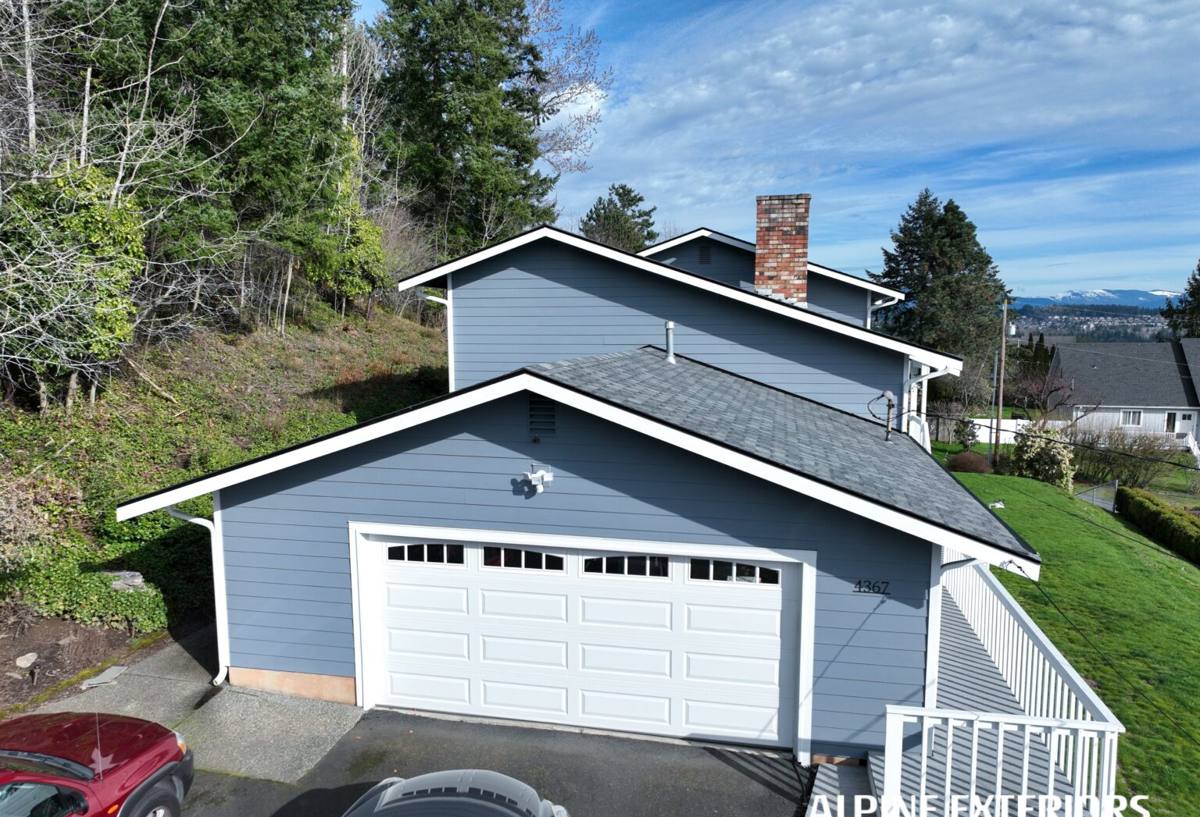
What Counts as Storm Damage (and What Doesn't)
Homeowners often assume storm damage means missing shingles after a windstorm made the news. In practice, we see a wider range of storm-related issues on Lynden roofs, and it helps to know what falls into that category before you're trying to explain it to an insurance adjuster.
Common storm damage we find
- Wind-lifted or creased shingles, especially along ridge lines and roof edges where uplift is strongest
- Flashing knocked loose or bent around chimneys, vent stacks, and skylights
- Gutters pulled away from the fascia by wind load or debris weight
- Granule loss from wind-driven rain and hail, thinning the shingle's protective layer
- Small branch or debris impacts that puncture or crack shingles without an obvious hole
- Water intrusion at seams that were fine before the storm but opened under wind pressure
What's usually NOT storm damage
Granule loss from ordinary age, moss growth that's been building for years, or flashing that was installed poorly to begin with are wear-and-tear issues, not storm events — even if a storm is what finally exposed them. We'll tell you honestly which category your roof falls into, because that distinction matters for how the repair gets paid for and how we approach the fix.
The Hidden Risk After a Storm: What Moss and Moisture Do Next
A storm-damaged roof that doesn't get fixed doesn't just sit there — it gets worse, and Whatcom County's climate accelerates that process. Once a shingle is lifted or a seam is open, moisture works its way underneath and stays there, because Lynden doesn't get the long dry stretches that let a roof fully dry out between rain events. That trapped moisture is exactly what moss needs to establish itself, and moss roots work their way under shingle edges, lifting them further and holding even more water against the deck.
We regularly find that what started as a single wind-lifted shingle after a fall storm has, by the following spring, turned into a patch of moss holding water against plywood sheathing that's starting to soften. The repair at that point is no longer "replace a shingle" — it's deck repair plus shingle replacement plus moss treatment, and the cost climbs accordingly. Storm damage is cheapest to fix in the days and weeks right after the storm, before the region's damp season has time to compound it.
What a Correct Storm Damage Repair Involves
A proper storm repair isn't just swapping out the shingles you can see are missing. We look at the whole system, because storm damage almost always affects more than the obvious spot.
Deck inspection
Before any new material goes down, we check the roof deck underneath the damaged area for soft spots, staining, or rot. If water got past the shingles, the deck is the first thing it reaches, and covering a damaged deck with new shingles just hides a problem that will resurface.
Underlayment
The underlayment is your roof's backup barrier if the shingles ever fail — which is exactly what happens in a storm. If it's torn, saturated, or missing in the repair area, we replace it as part of the job rather than skipping it to save time.
Flashing
Flashing failures around chimneys, vents, and valleys are one of the most common sources of storm leaks, and one of the most commonly rushed repairs. We re-seat or replace flashing rather than just re-sealing it with caulk, because caulk is a temporary fix, not a repair.
Shingle matching and installation
We match shingle type, color, and where possible, age-weathering as closely as the market allows, and we install to the manufacturer's nailing pattern and exposure — not just "close enough." A storm repair installed loosely is a repair that fails in the next storm.
Our Process for Lynden Storm Repairs
- Inspection and documentation. We walk the roof (or use a ladder and photos where a full walk isn't safe) and document every area of damage, not just the spot you called about.
- Honest assessment. We tell you plainly whether you're looking at a repair, and whether any of it is likely storm-related versus wear-and-tear, before any work starts.
- Written scope and estimate. You get a clear breakdown of what's being repaired and why, in writing, before we schedule work.
- Repair. Deck, underlayment, flashing, and shingle work is done in that order, with each layer checked before the next goes on.
- Final check. We inspect the completed repair and the surrounding roof area, so you're not calling us back next month for something we could have caught the first time.
Repair vs. Replacement: How We Decide
Not every storm-damaged roof needs full replacement, and not every roof can be responsibly patched. The honest answer usually comes down to the roof's age, how widespread the damage is, and what we find once we're actually up there.
| Factor | Leans toward repair | Leans toward replacement |
|---|---|---|
| Roof age | Under 12-15 years, good condition elsewhere | Nearing or past typical shingle lifespan |
| Extent of damage | Isolated to one section or slope | Scattered across multiple slopes |
| Deck condition | Sound, dry sheathing under damage | Soft or rotted decking found |
| Moss/moisture history | Minimal, damage is recent | Long-standing moss and trapped moisture |
| Shingle match availability | Same product still available | Discontinued, mismatch would be obvious |
We'll walk you through where your roof lands on that spectrum and let the facts, not a sales pitch, drive the recommendation.
Working With Your Insurance Company
Most storm damage repairs in Whatcom County involve an insurance claim, and having a contractor who documents damage clearly makes that process go smoother. We photograph and describe damage in terms adjusters can act on, and we can walk the roof with an adjuster if that's useful. What we won't do is inflate a scope of work to pad a claim, or tell you something is storm damage when it's really age-related wear — that kind of misrepresentation can cost you the claim entirely, and it's not how we operate.
What to Do After a Storm: A Practical Checklist
- From the ground, look for missing or visibly lifted shingles, dented gutters, or debris on the roof
- Check the attic or top-floor ceilings for new stains, damp spots, or a musty smell
- Photograph anything you can see safely from the ground before cleanup starts
- Avoid climbing onto the roof yourself, especially on wet or moss-covered sections — footing is genuinely dangerous
- Call for an inspection promptly rather than waiting to see if it "gets worse" — in this climate, it will
- Keep any communication with your insurance company in writing, and ask your contractor for a written scope of damage
Why a Crew That Already Works Lynden Matters
Storm repair isn't a one-size-fits-all job. A crew that works Lynden regularly knows how this valley's open exposure and long wet season change what "correct" looks like here versus a roof tucked into a more sheltered Bellingham neighborhood. We know which flashing details tend to fail first under this area's wind patterns, how fast moss takes hold once a shingle's lifted, and what a deck looks like after months of trapped moisture versus a fresh leak. That local pattern recognition is what keeps a repair from becoming a repeat visit.
It also means a real person answers when you call, not a call center routing you to whoever's available three counties away. If you're dealing with storm damage on a Lynden roof, we're glad to take a look and give you a straight answer about what it needs. Reach out for a free, no-pressure estimate using the form below.